REMEMBERING REENA VIRK: PROSE AND REFLECTIONS BY GITANJALI LENA

This week we’ve been remembering Reena Virk on blackcoffeepoet.com.  Monday saw the 14 year anniversary of her murder. Reena was 14 and killed 14 years ago on November 14, 1997: 14, 14, 14.

We had a very educational video roundtable and book reivew and interview and today a prose piece by Gitaanjali Lena.

I’ve known Gita for years.  It’s always a pleasure running into her and sharing words.  Gita is known for her good politics, great attitude, and radical poetry.  The last reading of Gita’s I witnessed saw her throw a shoe across the room in mid sentence!

Watch and learn as Gita Lena reads Who Was Reena Virk?

Posted in Poetry | Tagged , , , , , , , , | 3 Comments

REMEMBERING REENA VIRK: INTERVIEW WITH DR. MYTHILI RAJIVA, CO-EDITOR OF “REENA VIRK: CRITICAL PERSPECTIVES ON A CANADIAN MURDER”

Mythili Rajiva is associate professor of Sociology at Saint Mary’s University (Halifax, Nova Scotia).

Her research focuses on girlhood, the Canadian South Asian diaspora, and racialized identities.

Her work has appeared in such journals as The Canadian Review of Sociology, Girlhood Studies and Feminist Media Studies.

Mythili is the co-editor of Reena Virk: Critical Perspectives on a Canadian Murder.

Watch a roundtable discussion on the Reean Virk case with Rajiva’s co-editor Sheila Batachary, book contributor Tara Atluri, and community member Mandeep Kaur Mucina.

BCP: Why a book on Reena Virk?

MR: The idea of working on the case had been in my head from about 2004 onwards, maybe because of a shift in my own identity from being a graduate student just starting a ph.d. in 1997 to where I was in 2004, finishing my thesis. I think it was Salman Rushdie who once said that the journey creates us; writing a thesis on South Asian Canadian girls’ experiences of racism in adolescence made me realize how much I cared about social justice issues.

The case had always haunted me, but up to this point, it had been at a visceral level. When I started analyzing it through the scholarship on racism and identity that I’d read for my thesis, I realized the case mattered to me deeply, both at a personal as well as a political level. But when I started doing research, I found very little academic work. What little there was, was excellent, and informed much of my thinking around the topic; but the scholars who were offering a more complex and critical reading of the case seemed to be writing into a void, as if no one was listening. It seemed even stranger to me that such a highly publicized case would not be taken up at the very least by criminologists or other researchers in a more sustained fashion. But it wasn’t. Before we published this collection, the only book available on Virk’s murder was Rebecca Godfrey’s True Crime novel, which, as a couple of authors in our collection point out (see Atluri; also see Byers), offered a problematic re-telling of the story.

So I was reading this great scholarship, and wondering why there wasn’t more, and then I met Sheila and we talked about doing some kind of project together. I decided that we needed to encourage more critical scholarship on this case, a next generation so to speak, and even more crucially, we needed it not to disappear from public view, as most academic work does, in a single article in a journal or book. I initially considered a special issue in a journal, but this didn’t seem to offer enough scope, especially since I felt that anything written on the case would have to locate itself in relation to the earlier material. I wanted to bring both the existing and new material together; I think like any solidarity movement, there’s strength in numbers. People are more likely to pay attention to a bunch of people yelling about something than one person, right? So that’s where I got the idea for the book, and then all I had to do was talk Sheila into it, which wasn’t that hard!

BCP: What was the process in putting this book together?

MR: Once we decided we were going to do a book, and that it was going to be an anthology that included the existing material, we got in touch with the scholars and asked if they’d be willing to have their work included as reprints. I have to say that they were incredibly gracious and very supportive of the project from the beginning. Then we sent out a call for papers on the internet, on both social activist and scholarly websites. We got a lot of responses, and some great abstracts, and for awhile we were worried that the project was getting too big.

However, like with any project, life happens; not everyone who originally signed on was able to complete but we were really pleased with the final chapters. Our job as editors was to shape the process and guide the work along, but our contributors really made the substantial contributions.

BCP: How long had you been thinking about ReenaVirk before the book came about?

MR: As I’ve already mentioned, the case had been in my head since it first happened, kind of like those terrible stories you hear and no matter how much you try to excise them from your mind, they linger. It was also a personal thing. My thesis subject was on South Asian girls and racism, and I was a South Asian Canadian girl who had experienced racism in childhood and adolescence, in the form of racial epithets or having “friends” make racist comments or jokes around me.

Obviously, though painful in their own way, I’m not saying that my experiences are comparable to Virk’s, but I think it’s important to point out that they’re on a continuum of racism that people of colour have experienced and continue to experience in our supposedly tolerant and multicultural country. The book is about making links between the ordinary everyday experiences of racism and the more serious acts of violence against people of colour. So I was personally invested in the case, from the beginning.

BCP: Who, or what, are your influences and reasons for doing this kind of work?

MR: That’s tough because there have been so many. But I could name a few scholars that have given me a theoretical lens through which to interpret my own struggles with belonging, as a racialized minority girl growing up in a primarily white society.

Frantz Fanon’s moving work on the pychic violence of racism; Homi Bhabha’s writing on the “unhomeliness” of the immigrant experience and the trauma of the ordinary: when who we choose to love, where we are allowed to sit, what streets we are allowed to walk down etc. become points of political contestation; Chandra Mohanty’s beautiful call to arms, “to make feminist analysis dangerous to empire”, which I sincerely hope is part of what we’ve done in this book; and queer feminist philosopher Judith Butler’s work, especially her post 9/11 writing, where she asks what role grief plays in the service of the national imaginary; why we grieve for some lives but not others, and how we might conceive of a politics of grief that does not justify violence, and retaliation but instead recognizes the mutual vulnerability that constitutes us all as human beings, that we are all capable of being injured and committing injury. According to Butler, “the struggle against violence accepts that violence is one’s own possibility.”

An ethical stance in the world is, therefore, about recognizing one’s own rage and then seeking to limit the injury you might cause through this rage.

BCP: The book is raw at some points, challenging, honest, and stimulating. What are you as co-editor trying to convey to your readers with these 9 selected essays?

MR: So many things but I guess, overall, I want readers to re-think the discourse of violent girls on the playground perpetuated by the media and certain “experts”. Instead, I would like them to think about how Reena’s life and death are a troubling reminder of the racism that pervades Canadian culture, as painful as that may be to acknowledge.

When “we”, which is to say, members of the dominant group (white, Christian middle class, Anglo Canadians), view certain groups as “immigrants” regardless of how long the community has been in Canada; when we see brown or black skin as the opposite of “Canadian”; when we construct certain communities as having barbaric cultural practices without looking at our own social problems, we create an “us” and “them”, with the former being constructed as superior. It’s a seamless transition then to treating those we think don’t really belong as second class citizens. And this sense of superiority is false anyway.

The Canada that we think we know through our mythologies (“the true north, strong and free”, the peacekeeper, the multicultural democracy), is a nation founded on the brutal exploitation and marginalization of indigenous peoples, built through the labour of many migrant groups, not just French, English or European, but people of colour, some of whom paid the high price of alienation, explicit state racism and even violence and death. This history has to be acknowledged so we can have a radical revisioning of what makes someone a “real” Canadian.

BCP: How long were you working on your essay The Killing Season Interrogating Adolescence in the Murder of Reena Virk? Can you briefly give the crux of it?

MR: I wrote and presented a draft of the paper in the fall of 2005 at a conference on child rights, so the final chapter was a long time in the making and went through several iterations before it was published in the book. The main argument is that the Canadian media’s ubiquitous descriptions of growing girl violence and the refusal to ask whether social relations such as race, gender, class or sexuality played a part in the murder, were influenced by a discourse on adolescence pervasive in North America.

So, when incidents like the Virk murder take place, we have a moral panic where people talk about girls becoming more violent and adolescents in general being out of control with boredom, hormones and a lack of moral subjectivity. This really pathologizes teenagers, as if they are the only ones capable of bullying, aggression and murder.

Last time I checked, adult society was winning that competition, but this reality gets erased systematically in news coverage. The teenagers involved in the case were treated as if they symbolized the degeneration of youth in general. But who raises youth? Who schools them? Who offers particular media frames and images up to youth that tell them who belongs for what reasons? Who implicitly encourages the social and peer hierarchies that develop so strongly in adolescence? Adult society does, and then it wants to blame young people as solely responsible for violent behaviour.

For example, children and adolescents don’t learn racism in a vacuum. Sure, children identify differences among themselves at a very young age, but at what point do they realize which differences are important and which are not? They learn it from parents, teachers, larger culture and peers. They pick up very quickly that adult society values certain people and not others, and then they create their own social hierarchies that are partially informed by larger social relations. But this can’t be acknowledged at a societal level, because then we would have to say we are actually not doing a great job of raising children who see others as equals, regardless of race, ethnicity, class, sexuality or ability. In the Virk case, this played out in the media’s refusal to acknowledge racism as even a possible motive. The handful of times that racism was raised in either tv or newspaper articles, it was immediately dismissed, as if it was impossible that these white kids could be racist. They could be vicious, murderous and without remorse, but not racist, because of course, then that might mean that the larger adult society that they were learning their values from, was racist too.

BCP: While reading the book I had to put it down several times because of them descriptions of the murder and the horrific way the media represented the case. Was writing and putting the book together a painful experience?

MR: Yes it was a very painful experience. I didn’t realize how hard it would be when I started.

I was reading and watching all the media, and encountering the brutality that characterized the case. I think being forced to live day in and day out with a recognition of the horror that people are capable of inflicting on one another left some scars. On the other hand, I think that my reaction also speaks to my own first world, middle class privilege. My life is, and has always been, far removed from contexts of brutal and violent domination; I know that a significant portion of the world, including people in Canada, are not so lucky. Violence is simply a daily part of their lives.

So the case threatened my comfort zone, and that is a good and necessary thing for people with any kind of privilege to experience. I felt a similar wrenching at the end of the project.

Alongside a pride in the work and relief at its completion were worries about whether I had ever had the right to embark on this project, and whether it was fundamentally exploitative – stealing Reena’s voice, as it were. I spent a lot of time thinking about this as we wrapped up the introduction to the manuscript as well as a lot of time interrogating my own privilege in relation to Reena. I think none of that is particularly surprising; it’s a form of survivor guilt for those of us whose identities are not simply fashioned through the myth of the western liberal subject. Women, racial, sexual or other minorities, those people who belong to marginalized groups, are always seen and see themselves as something more than individual selves. Their “I” is always linked to a “We”.

In my case, being second generation and South Asian, and experiencing racism growing up, was what made me feel a connection to Reena Virk, a sense that this could’ve been me. But part of my discomfort stemmed from the fact that alongside my marginalization, I had certain forms of privilege that Reena didn’t have access to and, so, in another sense, maybe it couldn’t have been me. I think it’s both my marginality and privilege that pushed me to do this book in the first place, and it’s where I think real social change has to take place. It’s not enough to focus on the forms of marginality we encounter as individuals or groups. As black feminist scholar bell hooks points out, we also have to acknowledge and surrender our own privilege and participation in forms of domination, if we want to change the world.

BCP: What was most disturbing to me was the fact that Reena was not only erased in books and media, as was race, and Reena was not being mourned. The focus, and sadness, was that white girls were on a social decline as opposed to a young Brown woman being killed by such girls and a boy.  What disturbs you most about this case?

MR: I think you’ve summarized exactly what I find most disturbing. Whenever I saw or read media reports on the case, I would feel so angry. While Virk’s image appeared repeatedly, and her tragic story was re-told, it was always through a politics of pity; she was presented through a framing that implicitly constructed her as an Other; as not belonging to Canadian peer culture because she didn’t look like a “normal” girl. She was killed because she failed to fit in. For myself, and I think many other subjects who live their marginality through their embodiment ( racialized, transgendered, poor or differently abled bodies, to name a few), it was pretty easy to read the code behind this hegemonic storyline: she wasn’t thin, white, middle class, heteronormative, she wasn’t the ideal Canadian girl. But the media simultaneously used these images and storylines and yet refused to ask if there might be a problem with the ideal itself; that maybe a lot of Canadian girls didn’t “measure up” to this standard. That maybe the standard was racist, homophobic, elitist and ableist. They never asked if there was a problem with the ideal, just as they never explored whether a group of mainly white girls viciously beating up a Brown girl might raise some serious doubts about our success in fostering racial equality among children and adolescents, let alone in adult society.

BCP: Do you teach this case at your University? If so, what do you make sure your students get from your work? And how do you get them to understand the brevity and complexity of the case? How do white female students respond?

MR: I have taught the case a little bit recently as the manuscript was wrapping up. In some ways, I think I was too close to it, and living with it for a good four years made it kind of an obsession. I needed to have spaces where I could teach and think about other forms of oppression otherwise my concerns with social justice would’ve shrunk to this particular case. Some of the class discussions that did take place were difficult; like most Canadians, the students were horrified and felt very sad that this could’ve happened, but they wanted to keep it at the level that the people involved must’ve been monsters, rather than the murder being an inevitable, if extreme, consequence of both the history and contemporary reality of racism in Canada. The focus was often on whether or not the girls involved in the beating or its witnessing had ever said anything racist, because if not, clearly racism was not an issue.

The fact that Virk was an outcast, at least in part because she was brown, was something many students didn’t want to see. For some white female students, they pointed out that even among white girls, there is a lot of “mean girl” behaviour if a person doesn’t fit in in terms of looks, weight or clothes.

The Virk case for them was another example of this, rather than anything to do with racial belonging. One way I tried to get them to complicate this was to ask if there is an ideal girl image to which Canadian girls aspire. There was often a general consensus that there was, and then I would ask them to describe this girl as she appeared in their minds. After the descriptions, I would ask them whether the fact that this ideal girl was always white, often blonde, thin, middle class and heterosexual, told us anything about how difficult it might be to fit in if you couldn’t meet some or all of those standards.

I think this type of exercise was helpful, because some students did begin to see what I was trying to get at.

BCP: To me, Reena Virk was first a face without a name and later a name without face. That might be the case for many people. Why is there no picture of Reena Virk in the book?

MR: The media continually flashed one particular picture of Virk over and over again. We thought about using this picture maybe as a cover, but almost immediately felt that it would sensationalize the book. Many people are familiar with that picture, but we didn’t want to “sell” the book in this manner. We also did not want to use the picture because it seemed to us that Reena’s appearance was the focus of media attention and the implicit reason given for why this happened (she was awkward, a misfit etc.), yet this was not accompanied by any explanation of what she didn’t fit into. We wanted to move away from this line of thinking to focus on the systemic issues in the case.

BCP: Does the Virk family know about the book? Do the killers? Media and authors critiqued in the book?

MR: I don’t know whether or not the family knows. We thought about contacting them initially, but we also felt that as an act of scholarship, we needed it to be honest in ways that might not have pleased Reena’s family. I also don’t know whether or not Warren or Kelly knows about it. The mainstream media has, for the most part, ignored the book, which is not unusual for an academic book. Of course, given that it’s a searing critique of their hegemonic “take” on the case, it wouldn’t surprise me if that’s why they’re not interested. But it’s hard to say.

BCP: Are there questions I have not asked, or topics I have not touched that you would like to address?

MR: No, these were great questions and I had to really think about my answers. They weren’t surface or trite, which I’m very glad about, because the case itself as well as the book is a serious one and our investment in it has been anything but superficial.

Thanks very much for recognizing that, with such thoughtful questions.

Posted in Uncategorized | Tagged , , , , , , , , , , , , , , , , , | 4 Comments

REMEMBERING REENA VIRK: VIDEO ROUNTABLE + REVIEW OF “REENA VIRK: CRITICAL PERSPECTIVES ON A CANADIAN MURDER”

Reena Virk: Critical Perspectives on a Canadian Murder

Edited by Mythili Rajiva and Sheila Batacharya

Reviewed by Jorge Antonio Vallejos

One Brown girl.

Two killers with white privilege.

Seven attackers.

Twenty onlookers.

This is the Reena Virk case.

November 14, 1997 was a day that shocked the land now known as Canada.  Panic ensued in the country after Reena Virk, a 14 year old South Asian girl, was murdered by her peers.  The panic wasn’t about the maintenance and escalation of racism in a colony that started with said social ill.  The panic wasn’t about the escalation of xenophobia, fatphobia, homophobia, and many other phobias.  The panic wasn’t about the origins and rise in attitudes and beliefs that lead to the murder of a young Brown girl.

The panic was over the supposed downfall of white youth, in particular white girls, in a white run society.

Reena Virk: Critical Perspectives on a Canadian Murder outlines the Reena Virk court case and the surrounding issues left out of media discourse and the many court cases spanning 12 years.  Editors Mythili Rajiva and Sheila Batacharya put together a collection of 9 essays that critically look at the Reena Virk case (2 written by the editors) that interlock race, gender, class, age, and sexuality.

Rajiva and Batacharya are both South Asian women, as are most of the book’s contributors, which counters the mainly white written accounts of the Reena Virk case. “Both editors also have a personal stake in the collection…they have a strong sense of empathy with Virk’s struggles to belong, which are inextricable from her death at the hands of her white peers,” (p. 2).

Rajiva and Batacharya are self identified feminist and anti-racist scholars.  Each essay follows the same framework.  By using this scope they bring a completely new perspective that Canadians, and the world, were not given via national and international media in the form of various news sources, a true crime book, a novel, and a play.

Rajiva and Batacharya point out how “mainstream explanations and responses have not addressed how issues of racialized violence against women are central to this crime,” and state, “this collection reframes the murder of Reena Virk by placing it squarely within the context of violence against racially subordinated women,” (p. 7).

To put it simply, race was left out of the case and the umbrella of girl violence covered many elements that led to the killing of Reena Virk.

Reena Virk was Brown, South Asian, the daughter of immigrants, and did not fit into heteronormative standards imposed on people in Canadian-colonial society.  Living in Victoria, British Columbia, a mainly white place, Reena lived under a microscope with oppressive eyes watching her.  Reena had to survive name-calling, threats, and intimidation for much of her youth especially near the end of her life.

The murder was brutal and it is outlined in the book.

Two sections telling of the violence had me put the book down to be picked up much later:

1) pages 4 and 5 of the intro

2) lower portion of page 57 of Batacharya’s essay Hootchies and ladies: Race, gender, sexuality, and “girl violence” in a colonial white settler society.

Batacharya does not follow the sensationalist ways that journalists tend to write about crime.  Although the descriptions are detailed they are not meant to get a rise out of the reader.  They are not written in a way to please an editor and publisher looking for sales.  Batacharya lays truth on the page in a respectful way.

Batacharya challenges conventions of bullying, swarming, youth violence and girl violence.  “These euphemisms suggest that what is at issue is the deviance of those involved rather than issues of domination and subordination and the context of how Reena Virk came to be dehumanized, tortured and murdered,” (p. 36).

Dehumanized.  Tortured.  Murdered.

These words not only describe the murder of a South Asian teen in British Columbia.

These words describe the history of the stolen land now called Canada.

To Batacharya and her fellow writers in the collection Colonialism cannot be left out of the discourse.  Race, which has been omitted by media, police, and the courts, is rooted in colonialism.  To talk of race in the murder of Reena Virk one has to talk of colonialism and the true history of the land where the murder took place.

“I would argue that colonialism is always a factor, and the task at hand is how to materially and discursively dissect and disrupt it,” (p. 41).

Batacharya does so via academic sources, her experience as a viewer at Kelly Ellard’s (one of Reena Virk’s two killers) first and third trials, and researching the true history of the land now known as Canada.

Batacharya points out that notions of femininity are rooted in white supremacy; Native women have been targets of colonial violence since European invasion (things have not changed as is evident with the 800+ Missing and Murdered Aboriginal Women in Canada); feminisim is seen and described as the downfall of femininity and the reason for rise in ‘girl violence’; women of colour and Native men have always threatened white colonial nation building; and that race was central to the case.

Batacharya concludes with, “The question is not whether racism was a factor, but how it is a factor—how it shaped the context in which the murder of Reena Virk occurred and the social responses to it during the past 13 years,” (p. 69).

Mythili Rajiva’s essay The Killing Season? Interrogating Adolescence In The Murder of Reena Virk points out what was and is overlooked in the case: “racism, sexism, classism, and homophobia,” (p. 298).

Two things stick out from this deep and complex chapter:

1)    Who and what was being mourned

2)    The saveable white girl

Again, I was found putting the book down, disgusted, sad, and angry when reading who was being mourned.  Rajiva points out that Reena Virk was being mourned not because she was a person who was murdered for no reason other than being Brown and not part of the norm, but, rather, because her murder was the sign of the decline of the ideal Canadian woman: white women.

To the courts, media, and the larger Canadian society, Reena Virk was, and is, a body, nothing more.

Further evidence of this is how 20 people watched Virk get beat prior to her murder.  One onlooker, Lorne Lloyd-Walters, tried pulling Warren Glowatski away from beating Virk: “This is not your fight,” he said.  This was not out of human empathy, rather, it was Walters not wanting his friend to get in trouble.  Reena Virk being assaulted, later to be killed, was of no concern to Walters.  His friend possibly getting in trouble with the law was more of a concern than a young woman of colour being gang beaten.

What was, and is, of main concern is the state of the Canadian woman.  Such women being white, straight, middle class, able bodied, and as far away from a woman like Virk as possible.

Evidence of this is in how Kelly Ellard, one of two of Virk’s killers, was portrayed in media accounts and books: young, pretty, from a good family etc.  Her portrayals were also questions: how could this happen?

Ellard was saveable because she was young, white, straight, and from a middle class family.  Virks’s other killer, Warren Glowatski was not saveable because of his class and his non-hypermasculine and non-heteronormative ways of being that were seen as queer and non-gender normative.

Rajiva writes, “Ellard, by virtue of her whiteness, her middle class status, her gender, and her apparent location in a racialized heterosexual esthetic was, and continues to be, constructed subtextually in public discourses and practices as the only retrievable adolescent subject,” (p. 300).

Ellard was tried 3 times and finally convicted.  Why?  No other killer in Canada has been given that many chances.  Why Ellard?

Two chapters of great interest to me were deconstructing the books and plays written about the murder.  Tara Atluri’s, Under Whose Bridge? Race, class, and gender in Rebecca Godfrey’s book Under The Bridge, and Michele Byers’, Putting on Reena Virk: Celebrity, authorship, and identity, point out how race was erased, how the white woman is central to Canada, and how the writers of such books gained celebrity, and profit, from Reena Virk’s murder via racist, hollywood like, sloppy and inaccurate re-tellings of her murder.

Reckless eyeballing: Being Reena in Canada by Tess Chakkalakal points out that Reena Virk’s murder was a Canadian lynching.

Lynching!

Yes, Canada, the safe haven for the world, is a place where people have been lynched, and where Reena Virk, a Brown woman, was lynched in 1997.  Chakkalakal argues strongly, with great evidence, and a comparison to big cases in the United States such as Emmitt Till’s murder in 1955, Mississippi, that Reena Virk’s killing was a Canadian Lynching.

The strength of the collection is not only its framework it’s the accessibility of language.  Most academic books are basically an unknown language to the non academic.  If only academics can read such books the information is lost on the shelves of university libraries.  What is the point of challenging discourse if only a few can read such discourse?

Another strength is the rooting of colonialism within the text, in this case Canadian colonialism.  The editors and writers of this book practice responsible scholarship and allyship in terms of situating the book in the true history of the land where Virk was murdered.  There is no tokenization of Indigenous peoples or their struggle as is the case with many non-Indigenous academics, and activist writers as well as activist groups in Canada.

There are some problems with the book.  Some of the essays talk of the erasing of Reena Virk in media, books, and plays.  But, there is no visual image of Virk anywhere in the book!  For someone like myself, who for years Reena Virk was a face without a name and later a name without a face, no picture makes no sense and can lead to people not picking up the book.

Also, certain accounts in the book contradict each other and fact.  One writer states there were 7 attackers and 2 killers.  Another writer states 8 attackers and 2 killers.  Which is it?  Further, one writer states that all the attackers and killers where white while other writers in the book state that some of the attackers and killers were of colour and some were mixed race.  Which is it?

Although the book is clearly about a murder, I would have appreciated a warning as to where in the book the accounts of the brutal murder were written.

Why read Reena Virk: Critical Perspectives on a Canadian Murder?

The book tells the truth about an important case that was masked as simply “girl violence”.  Complexities, as well as realities, were written about that the mainstream does not want to touch.

Reena Virk should be remembered in a good way, and her murder should be told truthfully, not via accounts written by white people (many being opportunists) who don’t want to admit that the country they live in is racist, and has been since its inception.

The intro puts it simply:

“Virk’s story is, thus, of fundamental importance to those who have suffered in the past, and to those in the present and future who (will) continue to negotiate the legacy of difference and marginality,” (p. 26).

Such peoples, and those who are, or want to be, allies to such peoples should read Reena Virk: Critical Perspectives on a Canadian Murder.

Tune into BlackCoffeePoet.com Wednesday November 16, 2011 for an interview with Mythili Rajiva, Co-editor of “Reena Virk: Critical Perspectives on a Canadian Murder”. 

Posted in Uncategorized | Tagged , , , , , , , , , , , , , , , , , , , , , , , , , , | 12 Comments

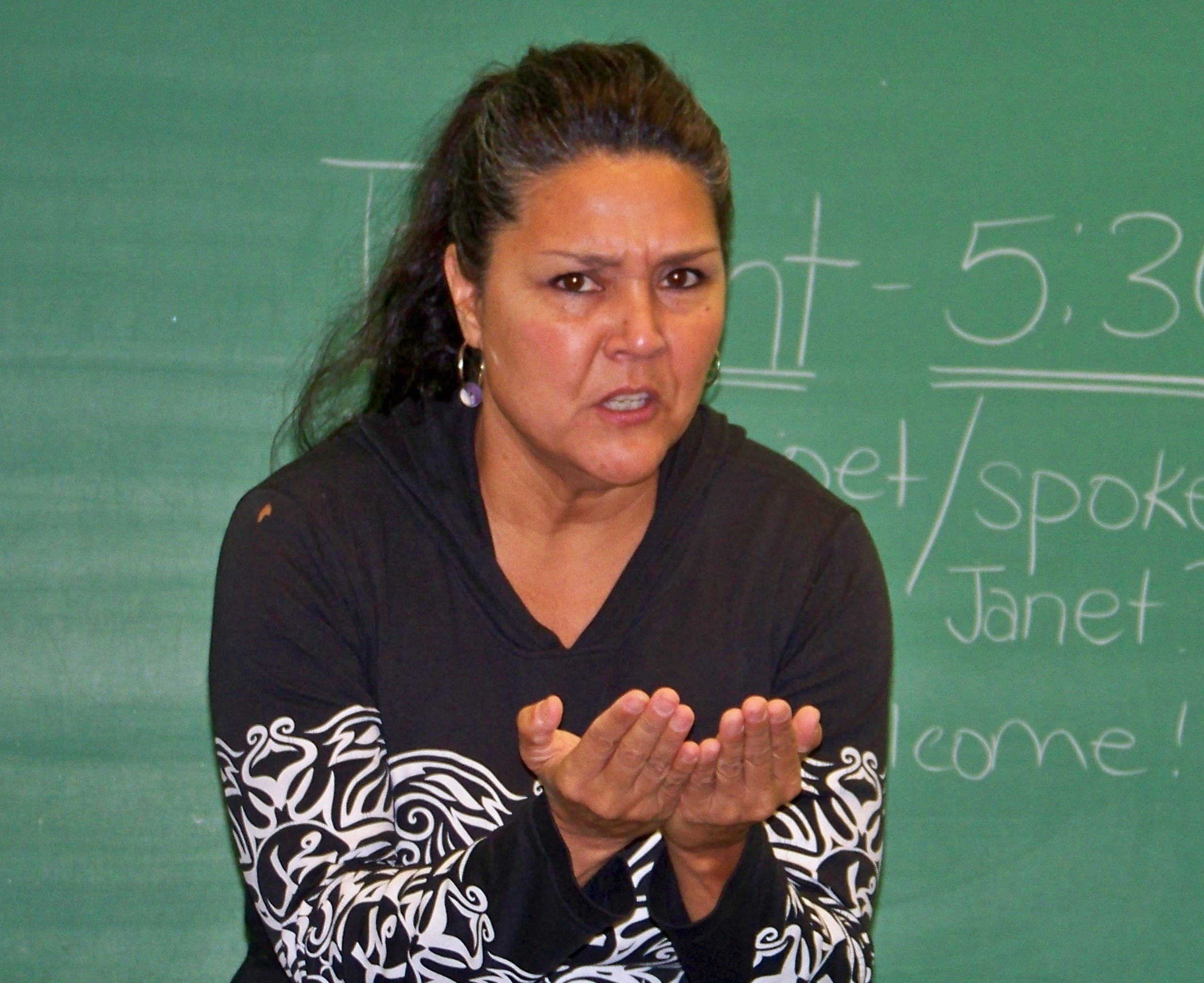
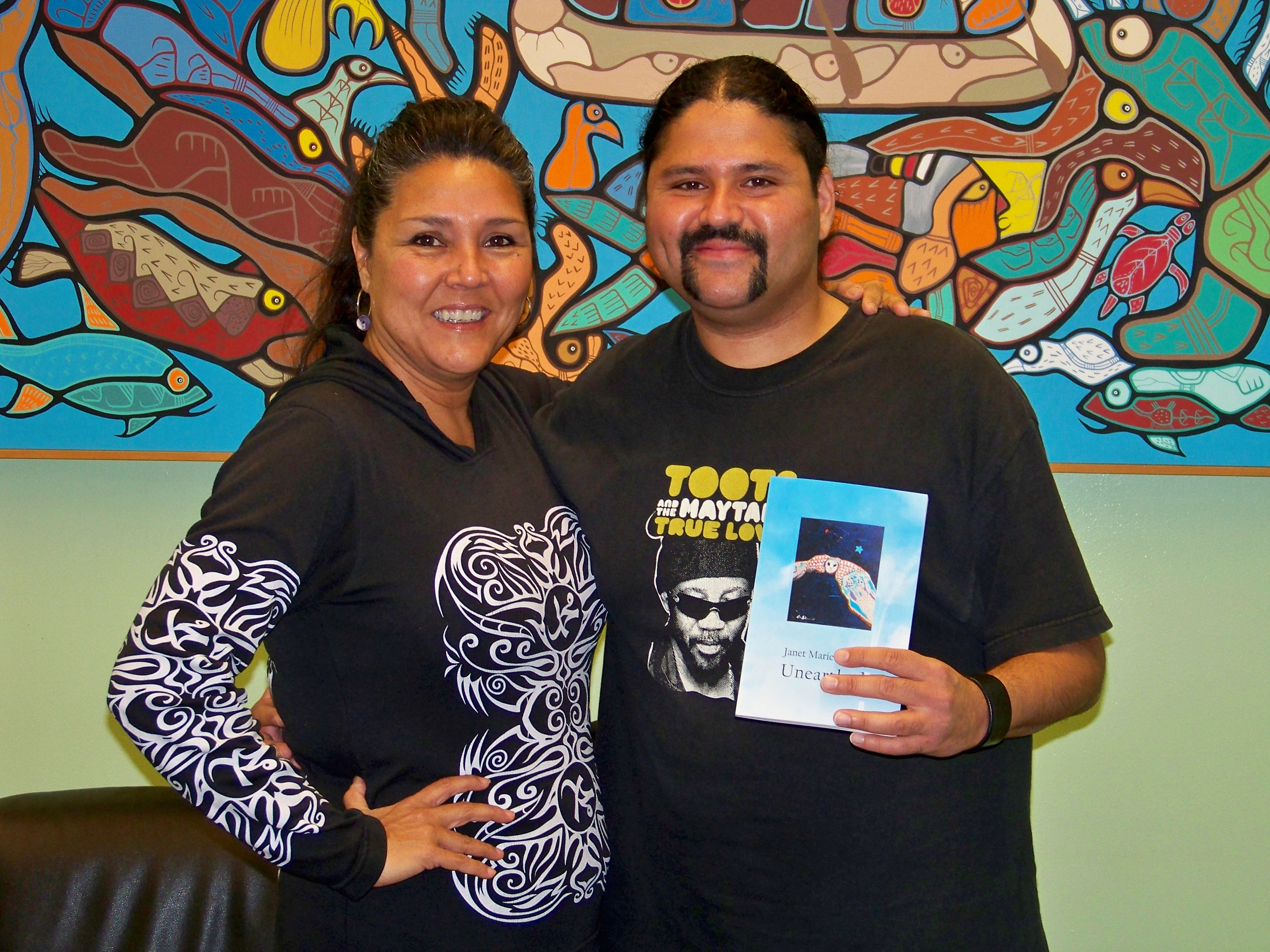
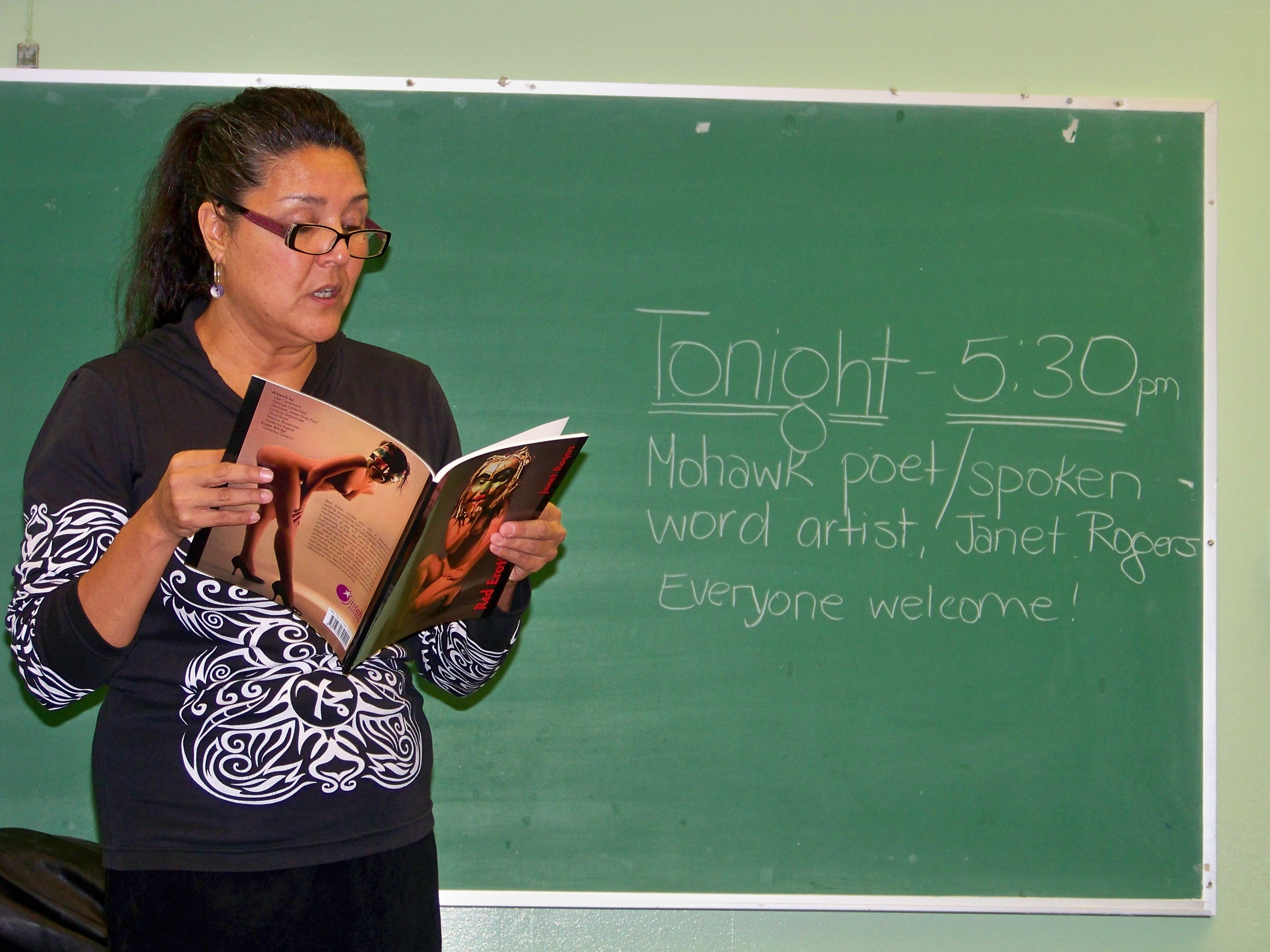
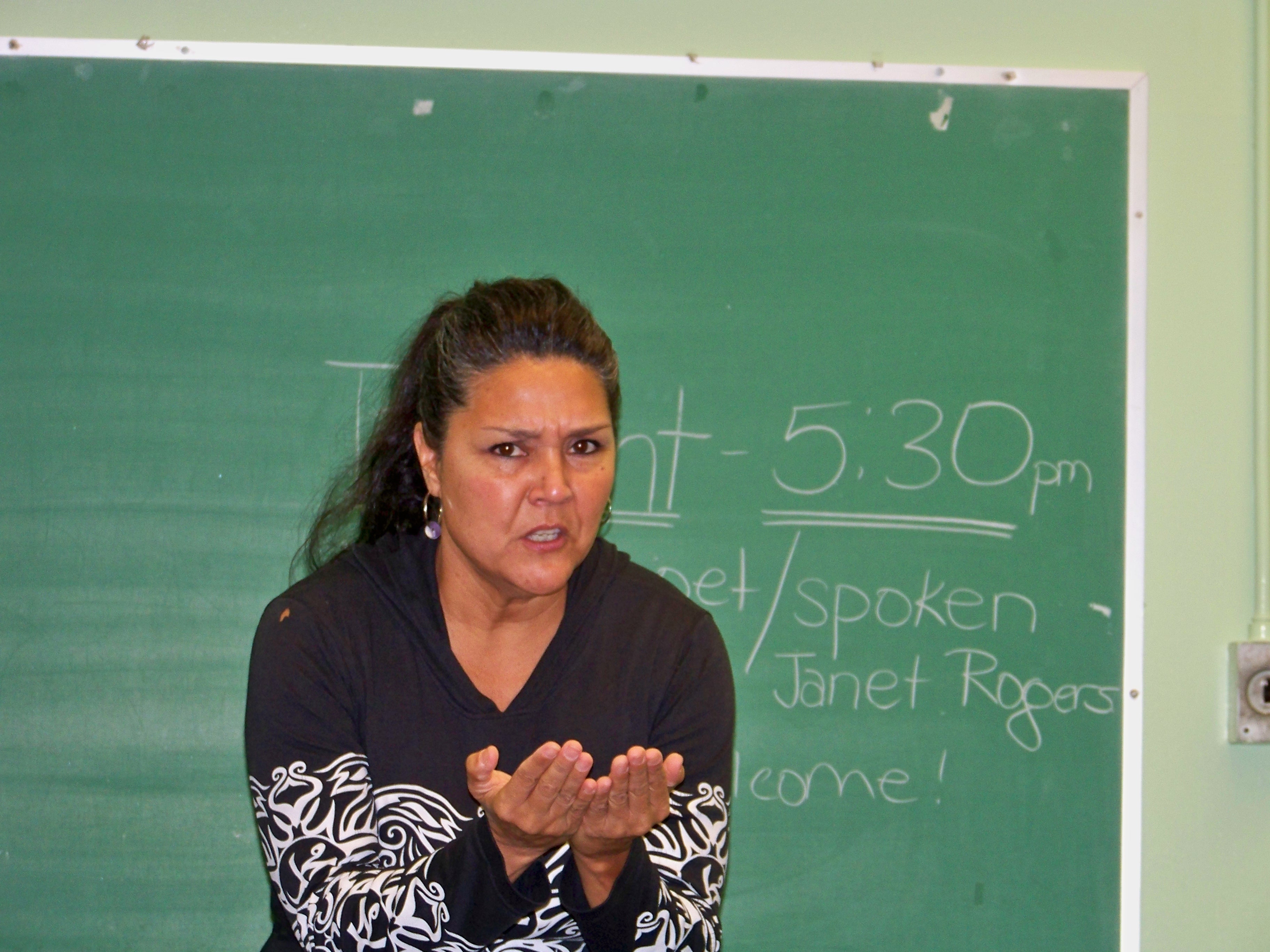
MOHWAK POET JANET MARIE ROGERS READS FROM HER NEW BOOK “UNEARTHED”

Janet Marie Rogers is a sweetheart!

I remembering reviewing her CD Firewater last year, and interviewing her, as great experiences.

Meeting her for the taping below were even greater!  

Reading her book Unearthed blew me away.

Janet is chill, kind, funny, and humble; this years new interview shows it all.

Enjoy Janet read from Unearthed.

Posted in Poetry | Tagged , , , , , , | Leave a comment

INTERVIEW WITH MOHAWK POET JANET MARIE ROGERS

Janet Marie Rogers is a Mohawk/Tuscarora writer from the Six Nations band in southern Ontario. She was born in Vancouver, British Columbia, and has been living on the traditional lands of the Coast Salish people (Victoria, British Columbia) since 1994.

Janet works in the genres of poetry, short fiction, science fiction, play writing, spoken-word performance poetry, video poetry and recorded poems with music.  Unearthed is her third collection of poetry.

BCP: Why the title Unearthed for your new collection of poems?

JMR: I am Bear Clan. Bears dig in the dirt for roots and other medicines, they unearth what they need. I think of my poetry as medicine. It is what I have to offer the world as medicine, something good for the mind and spirit and body. That is my wish anyway. Also, many of the poems address “spirit” and speak of the experience of those we love who have gone to spirit. They unearth themselves from this world. Unearthed has multi-meanings, and I liked that about the word.

BCP: What was the process of putting this collection together?

JMR: As a writer, I am constantly writing. So over time, the collection started to build. The process for this collection was to print the poems so I had a physical thing to handle, and pack around with me. I took my time to read through each piece and began to short list my own work. I only wanted my strongest poems to make the cut. Leaf Press took no time at all to accept the manuscript. They allowed me to choose my own editor. I took no time to ask Secwepemc poet Garry Gottfriedson to edit the collection. His notes were so helpful and encouraging. I had always admired him as a writer, now I know he is a great editor and mentor. He saw there were three distinct themes to the collection Love, Politics and Identity. Having the work divided into themes help me to make the messages in each piece more clear. It was a wonderful process and both Garry and my publisher were a dream to work with. A three way street of respect.

BCP: This is your third book, how is this collection different from the first two?

JMR: You know each new collection grows as the writer grows. That is to say, I’m still pretty much the same person I was when the first book came out, just stronger, wiser, my skin is thicker and my vision is more clear. The new poems reflect that for sure. I’ve lived, travelled, survived loss and am here to tell you about it. Again, that’s my medicine. The messages in the poems can help you, even if it is just through affirmation. I like to think of each new book as a big sibling to the last one. They are related, like brothers and sisters.

BCP: How is the process of writing poems for a book different than for a CD of spoken word?

JMR: The writing process is no different from the page to an audio recording. When I write, I use long hand and write the very first draft of anything with a pen onto paper. So the process is the same. I also read both out loud; the page poem and the spoken word recording. The difference is where they end up living and existing in the world. The audio recording takes a bit more time and attention to complete for obvious reasons. Those poems live with music tracks which have to be located, timed, read with, worked out and finally recorded. The book poems get printed and presented at readings and enjoyed by the reader. The audio recording can live on the airwaves. Way cool!

BCP: Who are you reading these days?

JMR: I’m consuming all I can on Mohawk poet E. Pauline Johnson in readiness for a two week research fellowship at the National Museum of the American Indian. I am reading a lot of her biographies and enjoying how the information there transports me to a time when she walked this earth. No doubt, I’ll be reading a lot of archival material during the fellowship.

BCP: Please list 5 essential Indigenous writers for the blackcoffeepoet.com readers.

JMR: Well I’ve already been singing the praises of my editor Garry Gottfriedson. I recommend you get any one of his poetry books: Skin Like Mine, Glass Teepee or Whisky Bullets.

I also recommend Cree writer Thompson Highway. He’s kind of like the Buffy Sainte Marie of native writers because he’s in a class all of his own and he broke so much ground for other native writers and playwrights.

I love Louise Half. Her writing is strong and unique and she a very good presenter of her work.

If your into Poly-Sci, I suggest my Mohawk bro Taiaiake Alfred. His writing is smart and I very much appreciate the non-apologetic statements his writing addresses in Peace, Power and Righteousness and Wasase.

Last but not least, Nicola Campbell has certainly mastered the children’s writing genre as well as the poetry and creative non-fiction genres.

BCP: It’s Indigenous Sovereignty Week next week. What does that mean to you?

JMR: I don’t like the word Sovereign because it’s a very old English word and it actually means accepting bits of rights as handed down from a higher power. Where’s the empowerment in that? And I understand we do these things: National Aboriginal Day, National Native Heritage Month etc. to draw attention to or to create celebration around our contributions and our survival, but where Indigenous people are concerned, celebrating our survival is one thing, living and thriving needs to be done every single day.

BCP: You practice different forms of art: poetry, spoken word, painting, and film making. Can you give Advice to other multi-disciplinary artists like yourself?

JMR: This is a great time to be an artist. It’s a super great time to be an Indigenous artist because I see so much fusion and hybrids of art practices taking place and no one’s nose is getting bent too much out of shape over it. The Yaqui Indian who plays classical guitar is recording with the white guy percussionist, the pow wow dancer is performing with the Indian metal bands, its all good. When I think of how open the possibilities are for poetry to live in multiple places at once, I get really turned on by that. So in terms of advice, I’d say, as long as you’re not messing with anyone else’s cultural properties but your own, and you are an artist working from the heart and pure inspiration – the sky’s the limit and even then some…

Tune in to BlackCoffeePoet.com Friday November 11, 2011 for a video of Janet Marie Rogers reading from her new collection “Unearthed”.  

Posted in Poetry | Tagged , , , , , , , , , | 3 Comments

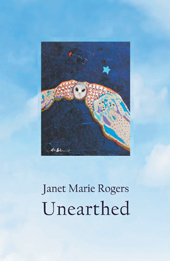
UNEARTHED

Unearthed

By Janet Marie Rogers

Reviewed by Jorge Antonio Vallejos

Amazing!

If I could get away with a one-word review the above would be it.

But let’s go a little deeper.

My first introduction to Roger’s work was last year and via her spoken word CD Firewater.  That too was amazing.

Unearthed is poetry on the page.  It’s different but just as powerful.  And Rogers has not strayed off her anti-colonial path.  Her words are just as fierce and poignant as ever.  And if they could be physically felt there would be a lot of people laying flat on their backs with a copy of Unearthed at their side.

While laying in bed reading Unearthed I was being uncovered.  Rogers peeled back layers with every sentence.  I smiled, laughed, stopped to think, and felt like someone knew what I was going through, specifically in terms of past heartbreaks.

Rogers isn’t just a tough Mohawk.  I’m sure she can stand at the front lines if need be but I saw a different side to Rogers.  The anthropologist hating Mohwak woman (“we create deep tracks for anthropologists to make fiction of our past”) was there but so was the woman who wrote about love loss in a good way, not Harelequin style.

In Free To Love Rogers writes of being honest, free, and in pain.  It’s not a tragic poem about never being able to love again.  That shit’s overdone.  Free To Love is about those hardships that come when you make yourself vulnerable: the gamble, the courage, the ride with no final destination in sight. 

Rogers writes of being “wounded and all” and that “passion should not be confused with romance although it all lives in the same neighbourhood”.  She believes in her actions and responsibilities but also in a higher power.  Her descriptions of agency, “we are the train, we are words, we feel pain, we make medicine”, are followed by “The Great Mystery does not inspire questions but holds answers.”  

Although Rogers has seen a lot, written about her experiences, and travels sharing her knowledge, she is not afraid to show that she does not know it all.  As she writes of Great Mystery knowing the answers she share her questions in Many Things Greater:

What happened to love?

Where is honour and support?

When did men begin to believe women are disposable?

Where are the miracles?

Rogers knows she doesn’t have all the answers so she spreads questions on the page, into our minds, and out into the universe.  Her title, Many Things Greater, shows her humble side and speaks for itself.

The activist side to Rogers is ever present.  Her spirituality shines but so does her in your face attitude.  With Aboriginal issues gaining more press and the Brown face of this colonial land now having a stronger voice, peoples want to know more but they often want to be spoon fed.  Rogers has a message, plain and simple, in It Can Happen:

I am not your teacher

I am a poet. 

Rogers might not tell or teach you straight out but she definitely shows you.  What The Carver Knows is just that.  I was taken back to a time when I was in Vancouver for a student journalism conference.  Ninety-nine percent of the conference was white.  Outside our hotel sat a Native carver who worked his craft day and night, wet or dry, cold or warm.  He was Brown and had long black hair like me.  And I was the only person I would see who would say, “Hi,” to him via a nod or words spoken.

What The Carver Knows is about a homeless Native carver who works wood past, present, and future, and so much more.  He sits on the sidewalk “transforming yellow cedar” while sipping on coffee.  People walk by, ignore, or don’t see him, or don’t want to see him:

he claims the cement as home

on a damp street corner

in a city which see so many like him

it rolls its eyes as numbers grow

he moans and bleeds

lets droplets fall  

onto a thirsty earth

seeping down to meet

the bones of those who’ve gone before

we live envious

of his skills and ability to survive

while we complain daily

of superficial hardships

and spoiled-rotten hardaches

Janet Marie Rogers does not spell it all out.  Neither will I.

Easy Time resonated with me a whole lot.  As someone who’s been assaulted by cops, arrested several times, and incarcerated twice I appreciated Rogers’ exploration of our current prison system.  While reading the poem you can see that Roger’s has thought about this topic, this reality, this extension of colonization that now houses mainly men of colour, 25% of which are Native to this stolen land. 

Rogers writes of hyperamasculinity and the masking of pain:

alpha-boys

challenge and retreat

they beat the bars

and feign bravery

on the range

men, impressing men

they pretend

it doesn’t hurt

If Rogers was not a woman I would’ve thought the poet had done time with men.  Although the poem is not about her you can see that she does hurt, the poem is pain, and unlike the men who hide their emotions Rogers writes it. 

Unearthed is an uncovering of so many issues, emotions, real lives who society would rather walk by, ignore, tuck away in a closet.  Through poetry Rogers shares her life and experiences and thoughts.  She stays true to her challenging nature and shows the reader her loving side as well.  As a Mohawk keeper of the land, poem by poem, page by page, Rogers herself is unearthed.

Posted in Poetry | Tagged , , , , , , , , , , | 3 Comments

D’BI.YOUNG ANITAFRIKA TALKS + PERFORMS THE SANKOFA TRILOGY

Interviewing d’bi.young anitafrika was an amazing experience.  

We’d met before at a workshop I did with her at International Women’s Day 2008. I remember being impressed with how she conducted the group and with her performance at the end of the session.

d’bi., although well known worldwide, is very humble and treated me like I was BIG media: lights, camera, action!  

d’bi. was patient and understanding with my low-budget production: my tri-pod collapsed in front of her, my camera wasn’t working well… Still, she answered all my questions and gave me an entire hour out of her busy schedule.  

We laughed, talked, shared, and hugged.

d’bi. opens the Sankofa Trilogy, part of a 15 month global tour, tonight, 8 pm, at the Tarragon Theatre in Toronto, ON, Canada.  

Check d’bi. out and watch the interview + amazing performance below. 

Posted in Poetry | Tagged , , , , , , , , , , , , , , , , , , , , , , | Leave a comment

CHATTING UP UNIVERSITY CLASSES

Chatting Up University Classes

By Jorge Antonio Vallejos

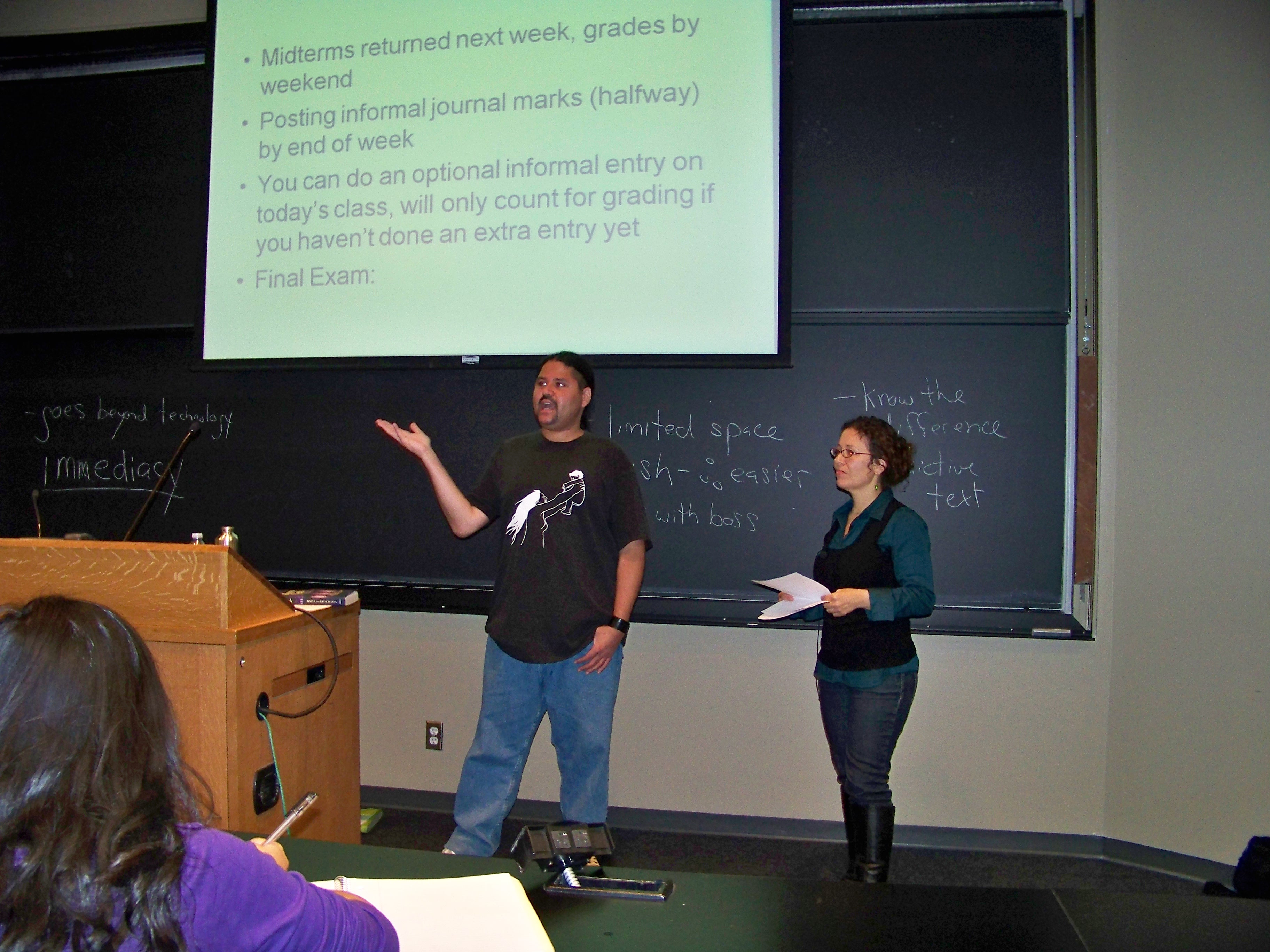
I’ve got another speaking gig in 3 hours.  It’s my second speaking gig in two days. 

Tonight is the Black Feminist Theory course at OISE (Ontario Institute for Studies in Education) at University of Toronto taught by Black Professor Erica Neegan.  

Yesterday was the Sociology of Gender course at UofT Scarborough taught by Professor Vannina Sztainbok.

Blackcoffeepoet.com has done a lot for me.  You could say I’ve done a lot for myself. 

But, it’s not about me.  And it is about me. 

I started this site because I didn’t get into an MFA in Creative Writing program.  I tend not to wait around for shit.  So, instead of waiting to re-apply I started my own program:

read, review, interview, videotape; monday, wednesday, friday; and do it all over again.

One great year has passed.

But blackcoffeepoet.com is more that just poetry.  It’s my activism via writing.  And that’s why I’m read and re-posted in various parts of the globe as well as being asked to speak and do workshops.

Yesterday was half interview and half talk.  Professor Vannina Sztainbok introduced me to her students, followed by asking me several questions in front of her 50+ person class consisting mainly of women of colour:

1. Last week we read an article by R.W. Connell on masculinity. Connell argues that all men benefit from gender violence, even if they are not personally violent. What do you think of that?

2. In your blog, you write that men – as a group – don’t speak out enough against violence against women. At least not in enough numbers. What is it that caused you to speak out against gender violence? Was it your upbringing, your schooling, a particular influence?

3. Can you go over the specific things men can do on an everyday basis to take a stand against violence?

4. There is a sign that you’re holding up in your blog? I can’t quite make out what it says. Can you tell us what it says?

5. Last week we have been reading about masculinity and the idea that there is a hegemonic or dominant masculinity – white, middle-class – and that there are other masculinities – gay, black masculinity, working-class masculinity, for instance. This suggests that while men – as a group – hold a certain degree of power in certain situations, not all men benefit equal from patriarchy. Is this something that you can relate to as a young man.

6. We have been talking a lot about violence against women, but men are often the victims of male violence as well. This is epitomized with the phenomena of youth violence – particularly gang violence, but also violence against gay men, or gaybashing. Can you comment on this?

Every question took sometime to answer. 

Vannina stood beside me at the front of the class.  I shared my history as a troubled teen, my journey from being a violent and angry hyper masculine male to the ally to women and several other oppressed groups I am today. 

I shared a poem, personal stories, and info about important cases people should know about like the murders of South Asian teen Reen Virk, sex worker Stephine Beck, and the 800+ Missing and Murdered Aboriginal Women in Canada.

The class was quiet and attentive; I was scanning the room as I chatted so as to see if people were actually listening to me or chatting on Face Book; I believe it’s the former as I received many questions at the end of the class.

Although I’m brought in as a speaker, guest lecturer, workshop leader, motivational speaker, I’m just as much a student as are the members of my audience. 

I’m no expert.

I don’t believe in experts.

If you look into it, the experts are usually wrong or frauds!

I’m a comfortable public speaker.  I’m confident.  I know what I bring and I know that I’m not the only one that can bring that.  And I enjoy being on stage, always have. 

Public speaking was something I looked forward to in school.  My journalistic side would come out at a young age.  I remember coming up with catchy titles, The Running Boy, and interviewing people.  When I was 16 I drove down to Jarvis St. and Carleton St. in a stolen car full of my buddies and I interviewed a 21 year old sex worker for my English class.  She answered questions for 45 minutes, showed us the knife in her boot, and ignored my friends stupid and disrespectful jokes via request: “Freebee?” 

I blew my teacher, guidance counselor, and class away with that speech.

“That was so interesting,” said one of my classmates who gave everyone a hard time.  She’d be called a bully today.

Still, I have so much to learn after giving talks for so many years.

Yesterday was one such learning experience.

One of Professor Sztainbok’s students asked about my going to the December 6th Vigil with the sign you see at the top of this page.  I used an incorrect word when describing my attending the vigil.  I said, “I go with my sign to disrupt the vigil.” 

Wrong!

I go to bring awareness to the fact that women of colour are being killed everyday in Canada and no government or police agency really gives a shit. 

I’m there to challenge whiteness and raise awareness via my sign.

I don’t yell, block people, give cut eye (I actually get cut eye from white women), or disrupt.

The young student, a woman of colour, challenged my disruption.  Really, my improper use of a word which had her see something that does not happen; my bad.

“Why not start your own rally and make it bigger instead of disrupting the December 6th Vigil?” she said.

I mentioned the February 14th rally for Missing and Murdered Aboriginal Women that happens across the country.  And I said by me going to December 6th with my sign I bring awareness to other women and causes.

We agreed to disagree and moved on.

While on a 3 hour walk home yesterday I thought about my use of the word “disrupt” and her use of the word “bigger”.

I believe both are inaccurate.

This is not about competition between white women and women of other races or classes, nor is it about being disrespectful to the memories of the 14 white women killed in Montreal 21 years ago. 

There shouldn’t have to be all these rallies and vigils because no one should be the victims or survivors of violence.

To me it’s about bringing attention to people who are left out of the discourse.  And it’s about questioning why white women are remembered and brought justice while Aboriginal women, immigrant women, women of colour, sex workers, and trans women are forgotten.

I used an improper word, was challenged, and learned.

The talk went well.

People emailed me questions and shared some of their story, some asked to be my friend on Face Book, and one, a man of colour, one of 7 men in the class, emailed me a great message:

Hey Jorge,

I was in the class you lectured in today. I felt I could relate to you regarding the “scaring women” case. There are times when I walk home at night and women seem scared so I cross the street to relieve them of their fears. I felt I was overreacting at times by doing so, but it was nice to know I’m not the only one who does so. Overall, you gave a very inspiring lecture today, just wanted to thank you for your inspirational speech.

Edwin E. Joeng

To me, that’s amazing.  I reached another person, in this case a man (which is great and unusual), who could relate, and who learned from me as I from him. 

Tonight’s talk will be different but I hope the same circle of sharing and learning happens.

That’s what it’s about.

Big thanks to the kind woman of colour student who took the photo above.

Please keep Black Coffee Poet in mind for writing workshops, motivational talks, and guest lecturing on topics such as STOPPING violence against women + male allyship + activist journalism + Indigenous Solidarity.

Posted in Uncategorized | 2 Comments

THE BROWN FACE

The Brown Face

By Jorge Antonio Vallejos

I’ve got Scandalous by Psycho Realm playing as I write. 

It’s a Brown thing. 

Brown Pride more like it. 

That’s what this is about.  It’s also a fitting song since I’ve been referred to as scandalous, angry, mean, and I love this one—reverse racist.

Being Brown in a place that doesn’t have many Brown faces with colonial Spanish names in the media has you starving sometimes.  Similarly, I remember my Anishinaabe friend Deb Daynard saying she never saw a Brown face (Native American) on T.V while growing in Winnipeg, Canada.  For me it was never having a Brown writer with a name like mine to follow as a kid. 

I grew up reading Gordon Korman and Judy Blume.  Both were funny and had me entertained for years but I couldn’t relate to their characters. 

What the fuck did I have in common with white boys attending private school? 

My teen years saw me reading books on the Columbian cartel with dreams of being the next Pablo Escobar.  Maybe if I had some Brown writers to follow I wouldn’t have been looking up to a notoriously violent drug lord.

A few years ago I discovered writers like Jimmy Santiago Bacca, Ana Castillo, Luis J. Rodriguez, Gloria Anzaldua, Sherman Alexie.  I’ve also had the privilege and pleasure of studying with Indigenous greats such as Simon Ortiz, Marilyn Dumont, and Lee Maracle, and a soon to be great Daniel Heath Justice.

I remember jumping up a couple of years ago while reading Ernesto Quinonez’s Bodega Dreams.  There’s a scene where the main character goes to the fridge to grab a bottle of malt to accompany his rice and beans. 

I saw myself.  I was at home in Quinonez’s novel. 

Gracias Ernesto!

Still, I had no writer in my life who I could really relate to. 

Before I go on you have to know my history and who I am, or what a white woman at a party last week asked, “What is your ethnicity?” 

I’m mixed and proud. 

My mom, born and raised in Peru, is Mestiza (Indigenous and Spanish), quarter Chinese, and has some Basque roots.  My biological sperm donor (I don’t say dad cause he’s didn’t raise me) is Arab.

“That’s some angry people!” said an acquaintance of colour when I told him my mix.

Anyway, last week I attended the International Festival of Authors in Toronto.  Really, it’s the festival of white authors with sprinkles of colour here and there.

I met someone important this week.  Important to me, not the higher ups. 

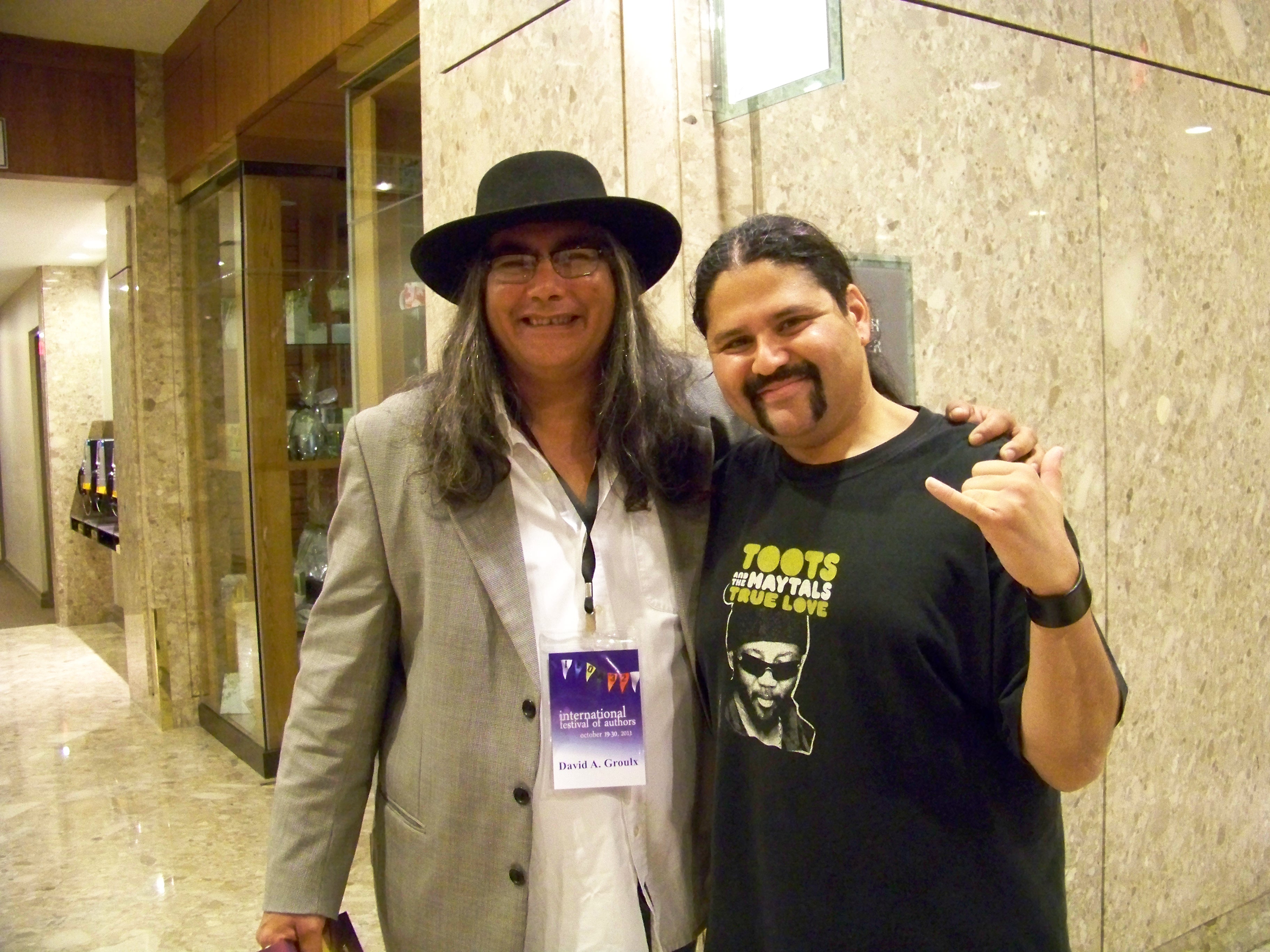
One of my main goals for the week was to meet Ojibwa/French poet David A. Groulx.  I saw his face, a Brown face, in the festival guide and read that he was a poet. 

“Perfect,” I thought.  “Someone I can meet and tape for blackcoffeepoet.com.”

It turned out to be way more than that.

I saw David across the room at a party.  It’s hard to miss a six-foot-something, 225 lb. Brown guy in a sea of white people. 

“David Groulx,” I said with my hand out to shake his.  “I’m Jorge Antonio Vallejos. I run blackcoffeepoet.com.” 

“Oh, you’re Black Coffee Poet!  I watch your site!” said David. 

Music to my ears!

We chatted, laughed, met a couple of other rejects in the room (Brown South Asian poet Sheniz Janmohamed and her friend K Rock who the rest of the room would probably label as white trash), and parted ways. 

The next day saw us talk on the phone and we made plans for the following night.

I attended his reading which also featured my writing mom Lee Maracle

David’s poems told stories of uranium mines destroying Indigenous land, racism, cops killing Native men and getting away with it, appropriation of culture, and warnings to white folk. 

I was home again.

It was again my Indigenous side, the Mestizo in me, jumping up.  You could argue it was my Basque roots too since they are Indigenous to the lands now called Spain and France. 

There were no rice and beans and malt, nor a colonial Spanish name, but there was a mixed race Brown face reading good writing, challenging colonialism, and showing pride in who he was and where he came from. 

Another party followed the reading that saw David, Lee, and I chilling in a corner as the white literati sipped wine and made connections.  A Brown guy from Trinidad walked up to us and said, “I thought I’d join the Brown corner.”  We welcomed him with open arms.

One more party happened, as did a dinner, but more importantly I got alone time with David.  We talked Fanon, Alexie, colonialism, peoples with white privilege who don’t come from white backgrounds, being Brown with long hair in a society that sees that as a threat, and our love—poetry.

I felt like I found an older brother.  Someone a little older, who I look like, and who not only has similar history but who has similar day to day experiences when walking the rough terrain that is this white run society.

People of the dominant class don’t understand that. 

I was telling a white writer on the weekend how I was so happy to have met David.  I mentioned all the reasons listed above.  He looked at me like I was nuts.

On our last day together David gave me a copy of his first book, The Long Dance, and a three page bio.  I noticed that he was published in 191 different places!  I thought I was doing good.

This year alone David has had 3 collections of poems published.  He showed me his latest, hot off the press, at our last dinner together.  His big smile gobbled shrimp as he had his new book on the table.

While in bed that night I thought of David and how happy I was to meet him.  A Brown guy who was humble, kind, funny, had bang on politics, and who was published in almost 200 places, and who published three books in one year.  If he could do that so could I.

David signed his book for me:

To Jorge,

I’m really glad we met.

Your friend,

David A. Groulx 

Kind words to match a kind Brown face who some label scandalous.

David, I feel the same!

Jorge Antonio Vallejos

Black Coffee Poet

Posted in Poetry | Tagged , , , , , , , , | 5 Comments

SHENIZ JANMOHAMED READS HER POETRY

Meeting Sheniz Janmohamed was amazing!

Janmohamed is funny, smart, and very well read.  Her interview has been widely read and appreciated as has been her video ghazal poetry workshop, the first video workshop featured on blackcoffeepoet.com.

Enjoy Sheniz Janmohamed read from her book Bleeding Light.

Tune into BlackCoffeePoet.com Monday October 31, 2011 for a review of “Unearthed” by Mohawk poet Janet Marie Rogers.

Posted in Poetry | Tagged , , , , | 2 Comments