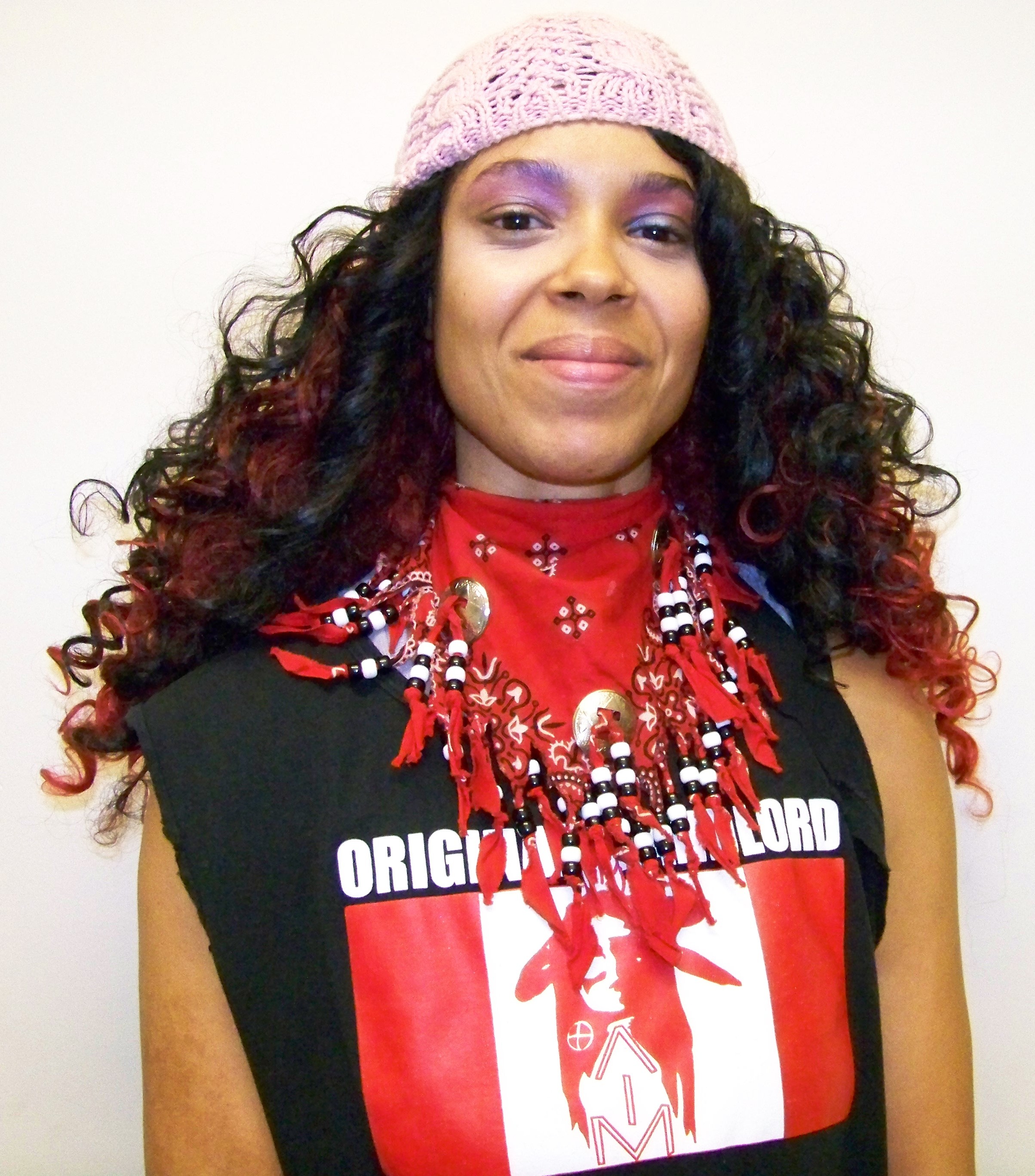
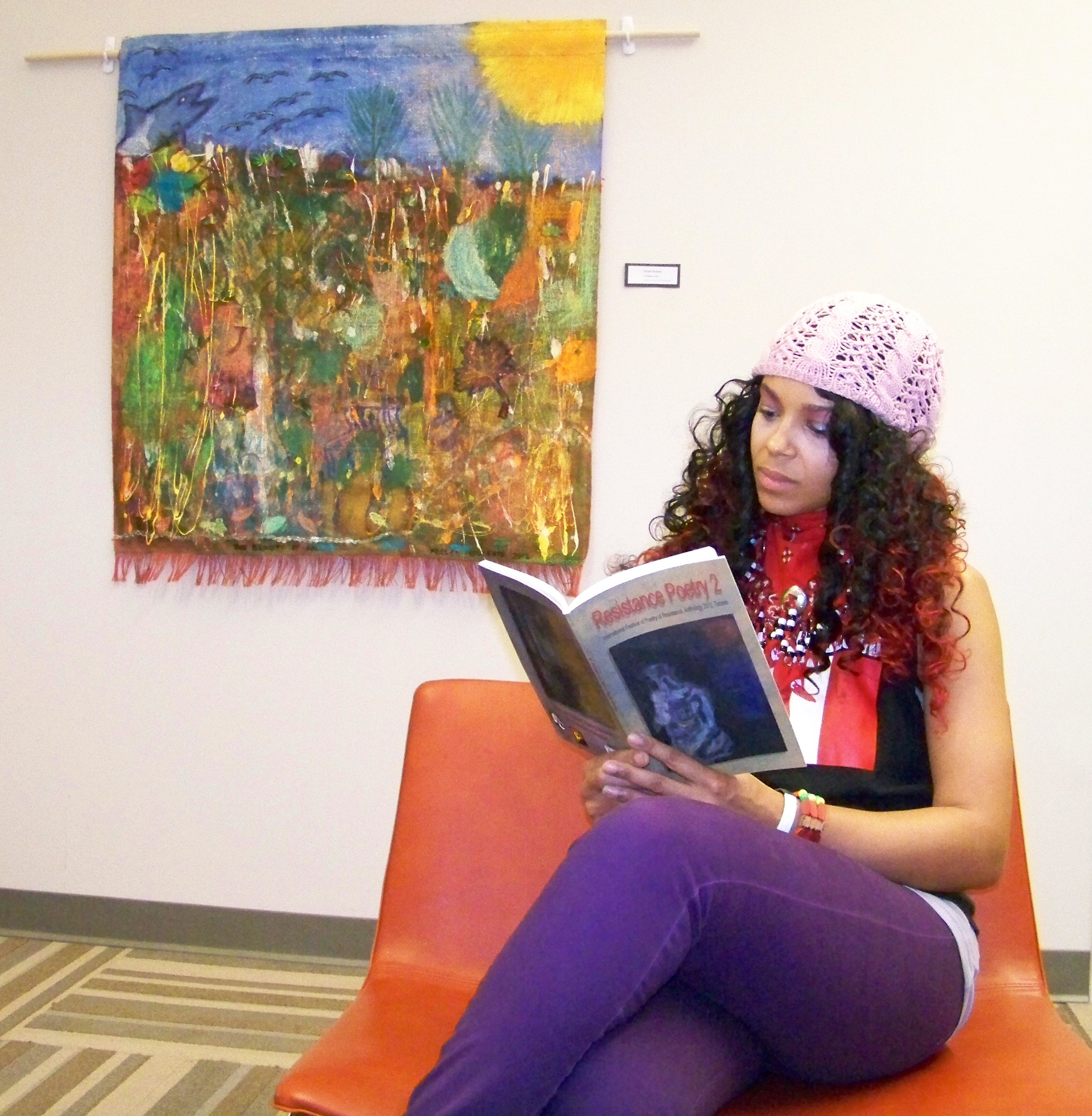
Meeting Malikah Awe:ri to tape her reading from Resistance Poetry #2 was great. I was a guest on her show with Dane Swan; we talked poems, read poems, and learned about poetry from each other. My interview with Malikah was just as great!
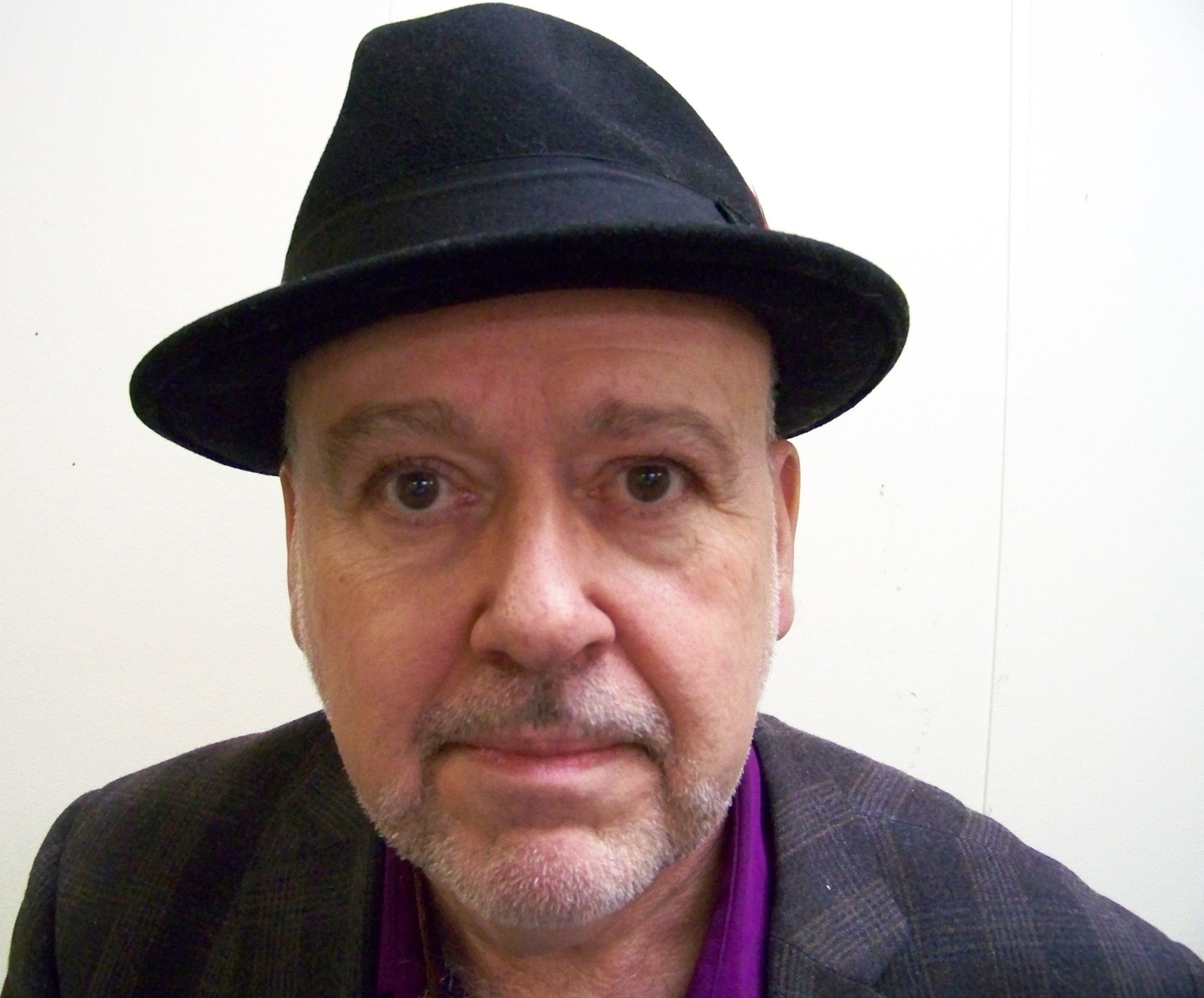
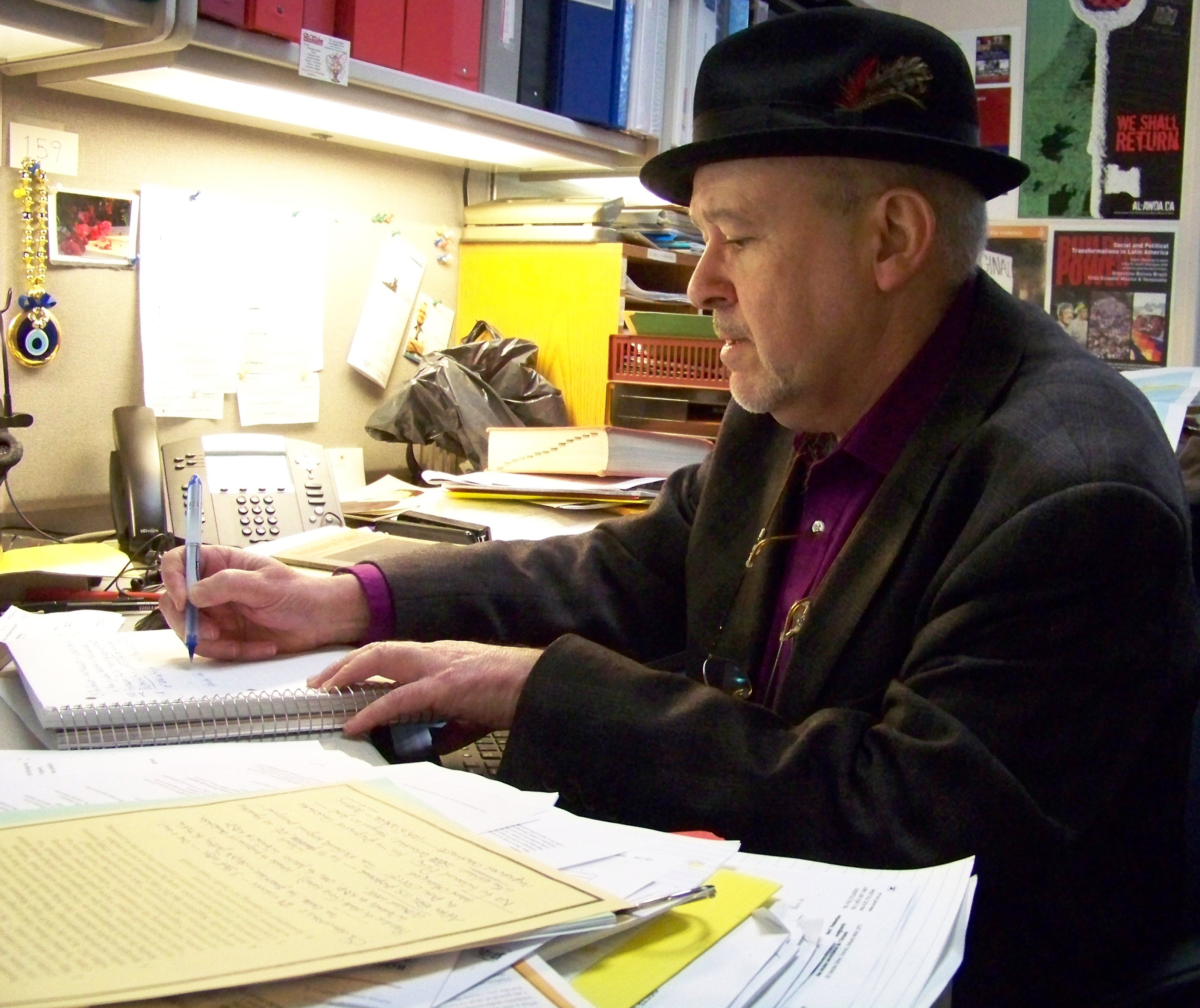
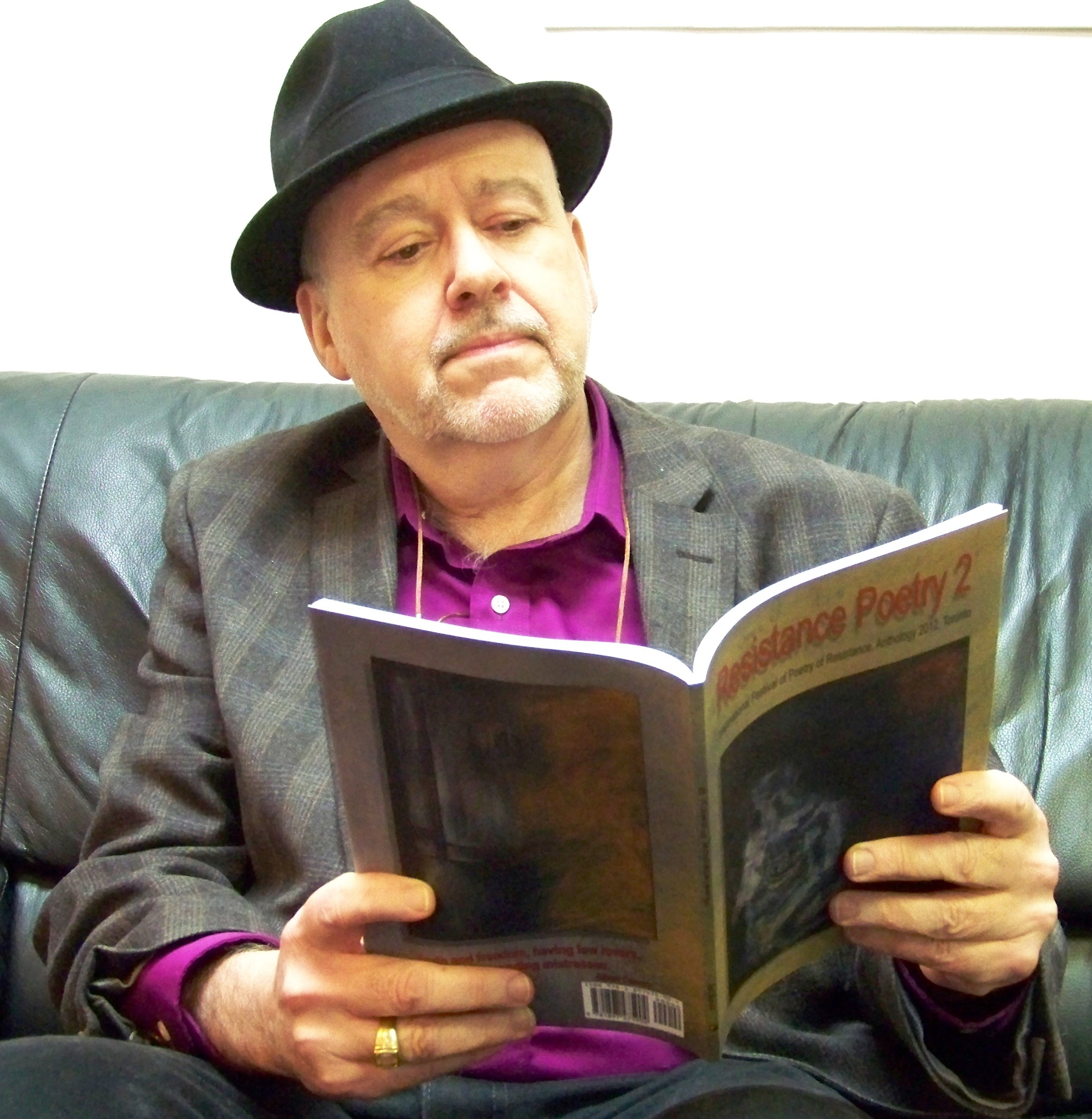
Roger Langen is the Editor of Resistance Poetry #2. Meeting him for this taping was quick and easy: hellos, chit chat, and on to the taping. In my interview with Roger he shared much insight into poetry. He’ll be editing Resistance Poetry #3 so look out for that in future. Enjoy his poem on video below.
Mahlikah Awe:ri a drum talk poetic rapologist of African-Canadian/Mohawk (Kahnawá:ke) & Mi’kmaw (Bear River) heritage, with Nova Scotian roots, based in Toronto. Mahlikah is a founding member of Red Slam Collective a Hip Hop Fusion Band, of diverse indigenous artists who also deliver 4 Direction Urban arts based community engagement projects with youth across Ontario. In 2011 she released the EP Serpent’s Skin and 2 Dream In Colour was published in the 6th Edition of Diaspora Dialogues TKO. In 2012 Malikah was published in the International Festival of Poetry of Resistance anthology Resistance Poetry #2.
BCP: How did you come to write poetry?
MA: I started speaking rhymes and creating oral poems as soon as I could talk, my first full length written pieces began developing in grade 5 after a poetry unit. The pieces were so sophisticated, according to my Principal that he needed to be sure it wasn’t plagiarised from Shel Silverstein. These accusations actually turned me off from it for a bit, but I still found myself doing it; writing rhymes cuz I loved rap music and writing poems cuz I needed to unload my unhappiness with my home life; feelings of insecurity, not fitting in, and the longing to be anywhere but where I was at. By the time I was in High School I began performing my pieces in ciphers, community events, church, school assemblies…I was hooked!!
BCP: What is your writing process?
MA: Poems come from everywhere so my process is majorly curvilinear. Some poems are inspired by an incident; a memory; a picture; a piece of music; a conversation; one word; silence….then it takes one of three possible paths:
1. I start writing that poem down, go through some drafts and then test it out at a poetry show or as a potential Red Slam piece; and could eventually become a written piece for publication or a recording.
2. I just start spittin’ ideas off the dome and eventually the freestyle becomes a structured piece I am able to apply to memory; which may or may not ever become a written piece; but just one of those poems I spit.
3. I record the piece then write it out and then it could end up developing into a Red Slam track, a slam poem or a written piece for publication.
BCP: Which writers have been your main influences?
MA: John Trudell, Janette Armstrong, Sonia Sanchez, Nikki Giovanni, Climbing Poetree, Saul Williams, Ntozake Shange, Nina Simone, Erykah Badu, Common, Mos Def, Robbie Robertson, Duke Redbird, Black Elk, George Elliot, Afua Cooper.
BCP: What does resistance poetry mean to you?
MA: It means to speak out and up. It means to take a stance even when the odds are against you. It means to draw upon the strength of your ancestors in order to overstand why you write what you write. It means evolution, change, representing to the fullest, and really keepin’ it real. It means unearthing the truth even when it hurts others to do so. It means survival. It means love.
BCP: Your poem Dying Breed is about Missing and Murdered Aboriginal Women in the land now known as Canada; it’s hard to listen to. How did you come to write Dying Breed? Can you describe being in that space?
MA: Dying Breed is one of those pieces I never expected to write. However, as I mentioned earlier, poems can manifest from anything. In 2011 while doing community arts facilitation and performances with Queen West Health Centre and the Aboriginal Youth Sexual Health Network I became more conscious of the crisis affecting First Nations women across the nation around domestic violence, rape. I began researching the missing person’s cases involving indigenous women across Kanta; which were going unsolved. I found myself reflecting on this and began writing. I decided to write from my own eyes instead of the eyes of these women because I am not them; but I am me and I could have been them; any woman could have been them. I am hiding somewhere in this poem until the very end when I tell you:
and I
I have passed her by
many a millennia
on busy intersections
and random street corners
our eyes meet
I pull away
towards the East
I’m walking away from my sister
away from my sister
away from
My
Sister
Why did I hide…because this poem is so hard; painful; cruel and raw…It reflects a reality, I like most women want to deny exists, even if it stares us right in the face daily. No one knows what to say or do when another woman is destitute; abused; drug addicted; mentally ill…cuz then we begin to see ourselves and our own nightmares begin to resurface. To be honest there is a part of me that hates this poem…because all the guilt and shame I’ve ever felt about not wanting to associate with women who are “surviving” is being dredged up. Then my stomach starts twisting in knots because I lived in a home where there was domestic violence, I involved myself in relationships with violent partners…how close did I become to becoming a Dying Breed??
BCP:Dying Breed is a poem of resistance. It’s also a poem that talks of the many harsh realities that Indigenous Peoples live. Have you faced resistance for writing such poetry?
MA: Living in the skin and gender I am in; in many ways almost guarantees that no matter what I do there will be resistance. So the answer is a booming YES!! Do I care, NO! This is my path. It’s in my blood. It does mean I won’t always be in that book, that magazine, in that festival or on that recording…but what it does mean is for every one person who ain’t feeling me…there are a dozen who are.
BCP: You run OneVoice Radio out of Regent Park. Radio in itself is an art form. Have the two forms of communication, poetry and radio, helped each other in your life as an artist?
MA: After high school I attending Ryerson’s Radio & Television Arts Degree Program and earned a BA. I knew I’d never work for commercial media; I’ve always been grassroots; so it’s awesome to now have the opportunity to merge my arts activism with radio broadcasting. Media is a powerful tool and when in the hands of the people, our thought, feelings and opinions can be transmitted around the globe in seconds. I appreciate Regent Park Focus giving OneVoice this opportunity, I’ve been connecting to Regent for 12 years and it is great to continue to build there through the power of the word.
BCP: When do you expect to have your own collection of poems out?
MA: When do you want it out, BCP?…Hmmm good question. My goal is to start after the release of Red Slam LP this Summer. It will probably be more than a publication though…my work is rooted in orality and poeticrapology so I might have to flip it into a recording project or even a cinepoem presentation. Def look for the manifestation to begin in 2014.
BCP: What advice do you have for aspiring poets?
MA: Do you! Draw from your flame; the centre of who you were, who you are, and who you aspire to be. Develop a network of support, so you can share your pieces in a safe, nurturing circle, and gain confidence. Write about anything and everything that sparks an idea; you never know what seeds will eventually blossom into poetic pieces. Read and listen to poems by other poets who are fiyah!! Keep a journal (audio or text based).
BCP: Do you have a recommended reading list?
MA: BCP, I don’t so reading lists, cuz honestly I don’t read that much but here is a list of contemporary spoken word poets who you can find on Youtube who inspire me to do what I do:
John Andrew Akpata; Truth Is; Lishai Peel; Kahsenniyo; Winona Linn; Sheniz Janmohamed; ArRay-of WoRds; Moe Clark; Tomy Bewick; JustJamaal ThePoet; Ritallin…
BCP: Thanks for writing honest and powerful poetry.
MA:Chi Miigwetch; Wela’lin; Niá:wenh ki’ wáhi.
Roger Langen was born in 1949 in Perth-Andover, New Brunswick; of Irish, French and Maliseet heritage. His early displacement to Toronto, then eight-year elopement to Newfoundland, created for him the sense of being an outsider. He converted sympathetic observation to teaching, human rights activism, and the editing of poems.
BCP: What does resistance poetry mean to you?
RL: That’s a good question. I guess my first thought is that poetry is a form of resistance in itself. It acts against the normal uses of language – to ask a question, give an order, explain something as I’m trying to do now, argue a point – by calling attention to itself as language, as a performer really. So it is conscious of itself as doing this, performing language, language enacting language, showing off, full of all the tricks of language, resisting sense but supercharged with it, a musician, a painter, a brat, an introvert, a lover, simulating reality or undermining it, but never just talking about it. So it is a rebel to communication, the leader of a band of words, organized into a network of cells called poems, a terrorist of common sense, seeking always to re-establish the language as a resting place for the human spirit; and not – as happens with the discourses of ideology or conventional wisdom – a fortress of lies or prison for the soul. So what poetry imagines, in a way, is the Unattainable. And in that sense, it is always in struggle, always resisting.
So back to your excellent question, which I can re-phrase as: what does the word “resistance” add to poetry, since poetry is already resistant? And my answer is that, in spite of poetry’s aloof and self-insulated attitude as a language rebel, it is ultimately engaged: with the world, with uncertainty, with our collective destiny, with the unsettling laughter of God – Dostoevsky’s unsettling proof that there is a God, or Devil at least! So there is really a passion to mean, to undo evil, to find love, that starts with the pulse of the personal, that may be blind at first but reaches out, the way an infant does, seeking touch, the other, the scent of its mother; no knowledge of the world, perfectly innocent, but with an innate wisdom for this groping or reaching out. And as all the religious, cultural, and personal stories tell, knowledge, experience, growing up, bring with it the revelation of suffering, the test of character, the lousy luck of no love, and the terrible reality of cruelty and injustice. So I find in the more mature kinds of poetry a sensitivity to the larger project of a common humanity, however personally expressed. It takes note of experience. It sings about pain, and in this way transforms it, positions it as an object for condemnation or solidarity, so that it may know what it is, and defeat it, forgive it, or be free of it.
The challenge of “resistance poetry” is that poetry is extremely sensitive, being a resistant medium, to an external content that is also resistant. A raised fist, anger, a diatribe, protest – these are turbulent spirits to place within the delicate vessel of poetry. A poem is not a cargo plane. Load it with the wrong freight – it sinks. So that’s the challenge I enjoy, finding poems that carry the burden of a social or political message, and watching them travel with lightness and grace, even fly. As I myself have written in one of my own poems: poetry is the beautiful bullet that kills no one / the sword of the spirit that slays ignorance and despair / an arsenal of words to break the mind open / re-building hearts, as houses to put hope in. Note how “ignorance and despair” are kept out of the rhyme scheme. Of course, I called the poem, Insurgency.
RL: Well, I am part of a group called the International Festival of Poetry of Resistance. It’s not a pretty title, and in a way makes my point in the first answer above: I can feel some kind of revolution in my mouth, but not the poetry. (I think the title was a compromise and so became this big set of antlers.) Anyway, I was invited to become a member of the organization shortly after it was incorporated in 2008, and of course, being a human rights activist and having started writing poetry fairly late in my life, I said yes. I didn’t have too much involvement through the first three years, just offering poems, organizing a little financial support through my contacts, attending the festivals.
I think I was a little critical of some of the poetry that was being published, but I understood that it was a writers’ collective, self-publishing in order to get started. So my attitude was also forgiving; and anyway, I kept my opinions to myself. But in our going toward to IFPOR 4, I accepted an invitation to be on the Editorial Committee reviewing the poems being submitted. We worked mainly by e-mail. I took a lot of interest in responding to the poems, especially the performance-based submissions, and often identified critical problems. Eventually, I was asked to take up the role of editor. I have had some experience with this kind of thing and … well … someone had to be found to do the work.
BCP: Was it difficult switching hats from creative writer to editor?
RL: No, I am a far better editor than I am a poet. So the problem for me is the other way around.
BCP: How long was the editing process?
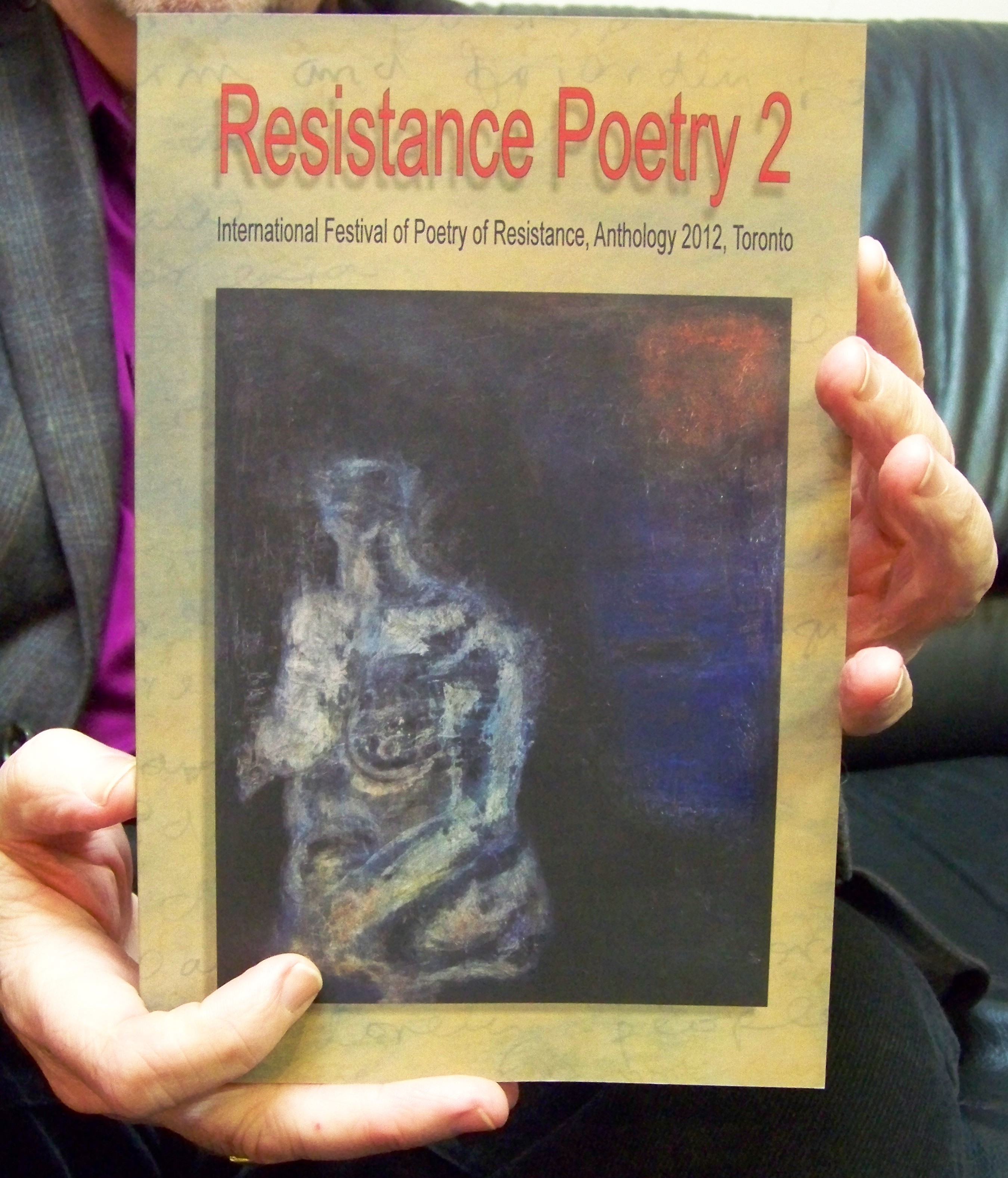
RL: Well, we started in January or so of 2012. I took over as editor in late March. The poems were ready for the Editorial Committee to review in late May, then brought to the Board of Directors in late June or early July. We settled on a publisher at the same time, Richard Grove, who runs Hidden Brook Press. And we found a great artist, Gabriele Brossard, to provide art for the front and back cover. Richard and I then worked through the summer putting poems to paper. I learned a lot from him about publishing, and he learned that I was … well … a pain in the ass – change after change after change. I worked through my entire one-month holiday, ignoring the ocean in Nova Scotia and the pubs in Newfoundland. Finally, we had it ready for printing at the beginning of September. The Festival was in October. We launched the anthology at Q Space on October 13.
BCP: Most writers are influenced by other writers. Were you influenced by any editors? Edwidge Danticat is a writer I like who edits (puts together) great anthologies such as The Best American Essays 2011. Were there any anthologies that you used as a guide?
RL: That’s a fairly erudite question. The only editor I feel influenced by – if that’s the right word – is Lewis Lapham, the longtime editor for Harper’s Magazine. His magazine has a strong identity, based I believe on his strong sway and vision for it. That’s what makes a great magazine. I’m not influenced at all by editors of poetry magazines because in my mind the magazines are all the same. I flip through the pages of Arc and I’m not sure what I’m reading. To be fair, I stopped reading poetry magazines a long time ago. If there is a good one on the go, it will find me; I won’t have to look for it. I don’t think anything has come along to replace The Tamarack Review, which finally quit around 1982, but was a great finder of Canadian talent. So no, I used no anthologies as a guide. I did have a guiding principle, though, and that was to ensure that the poems were daisy-chained or garlanded to a natural order of sorts, clustering along themes. So Resistance Poetry 2 starts with a meditative walk through the Halifax ghost neighborhood of Africville, followed by other poems that in one way or another touch on race and class. Through the shift to Aboriginal perspective come themes of gender violence as well. Then prison experience, border crossings, Canadian privilege, immigrant exile, followed by a section on Cuba, including two poems by the Cuban Five. The anthology moves then to more broadly political concerns, then finishes on personal notes of mental illness or wry philosophizing.
Thanks for the name, Edwidge Danticat. I did not know it. Haitian feminist sensibility organizing an anthology of Best American Essays – I like it! My only worry would be that she has made the Oprah Reading List.
BCP: You have edited poems for magazines in the past. How was this process different?
RL: You are referring to the Newfoundland poetry magazine, Scruncheons (1971) and The Canadian Literary Review (1982-83). Both those magazines involved working with other editors, and we did not see eye to eye. I lost the Newfoundland argument, won the one in Toronto. Typos are a nuisance. There were only two in the inaugural issue of CLR, but one was in Margaret Atwood’s poem. She was reading it to several hundred people at the launch at the Brunswick House Tavern in Toronto, June 21, 1982. She announced the typo to the whole room, mentioning my name in that dry voice of hers. I think I had already introduced her as the Darth Vader of Canadian poetry. We had left the “h” off the word, “hedges,” in her poem, rendering it “edges.” If you had to guess between those two words for an Atwood poem, wouldn’t you take “edges”?
I guess what goes around comes around. There was a solitary typo in Resistance Poetry 2. But it was in the name of one of the Cuban Five poets. On the evening we had the anthology available, the wife of this same poet was in Toronto speaking to a large crowd about her husband’s imprisonment. We couldn’t give her the anthology in order to mention or even read the poem her husband had written because of this gremlin typo that chose to show its face in this worst of all possible places and moments.
What else? I guess I am much older now, so I am not afraid to be much more hands-on in editing the poems. It was more work per poem, but less work overall, as I worked mostly alone and with fewer submissions.
BCP: Every editor has a vision. What were your goals for Resistance Poetry 2?
RL: I think I have covered this question in my earlier answers. What I would like is to see RP2 as the basis for an ongoing project. I think there’s room for a resistance poetry anthology as a literary form in its own right.
BCP: There’s always a back and forth between editors and writers that can at times be a difficult process. How was it working with writers who identify as resistance poets?
RL: Well, as I said, I was very hands-on. I made it a condition of accepting the editorship that we could not take the self-publishing, writers’ collective approach and just publish whatever was on offer. That is where I had been critical before – too much dead space going on. So the two conditions were: poems don’t go in unless they are somehow connected to the resistance theme; and poems were subject to extensive editing. The Africville poem, for example, was twice as long when it was first submitted. The author was very gracious about the downsizing of the poem, as were so many others. Even the Cuban Five poet whose name we botched was grateful for the small changes made to his poem – “much better,” he said. Only three poets walked away.
BCP: What advice do you have for future editors out there?
RL: None.
BCP: Would you edit another anthology?
RL: I will be editing the next one in our own series, absolutely. I think we have a very valuable product.
BCP: Can you give a brief list of anthologies you recommend?
RL: Most of my reading is of past writers, not anthologies.
BCP: Thanks for helping put a great collection together.
RL: Thank you! One final comment: I read A Short History of the World in Drink for you. You will have noticed it mentions coffee. I drink a lot of black coffee. I’m drinking it now.
Tune into Black Coffee Poet Friday March 1, 2013 for poems on video by Malikah Awe:ri and Roger Langen.
It’s not always that I read a book with a smile. Do you know that feeling? There’s a smile on your face, your hands grip your book tight, and you move around in your seat because of excitement.
It’s a good time.
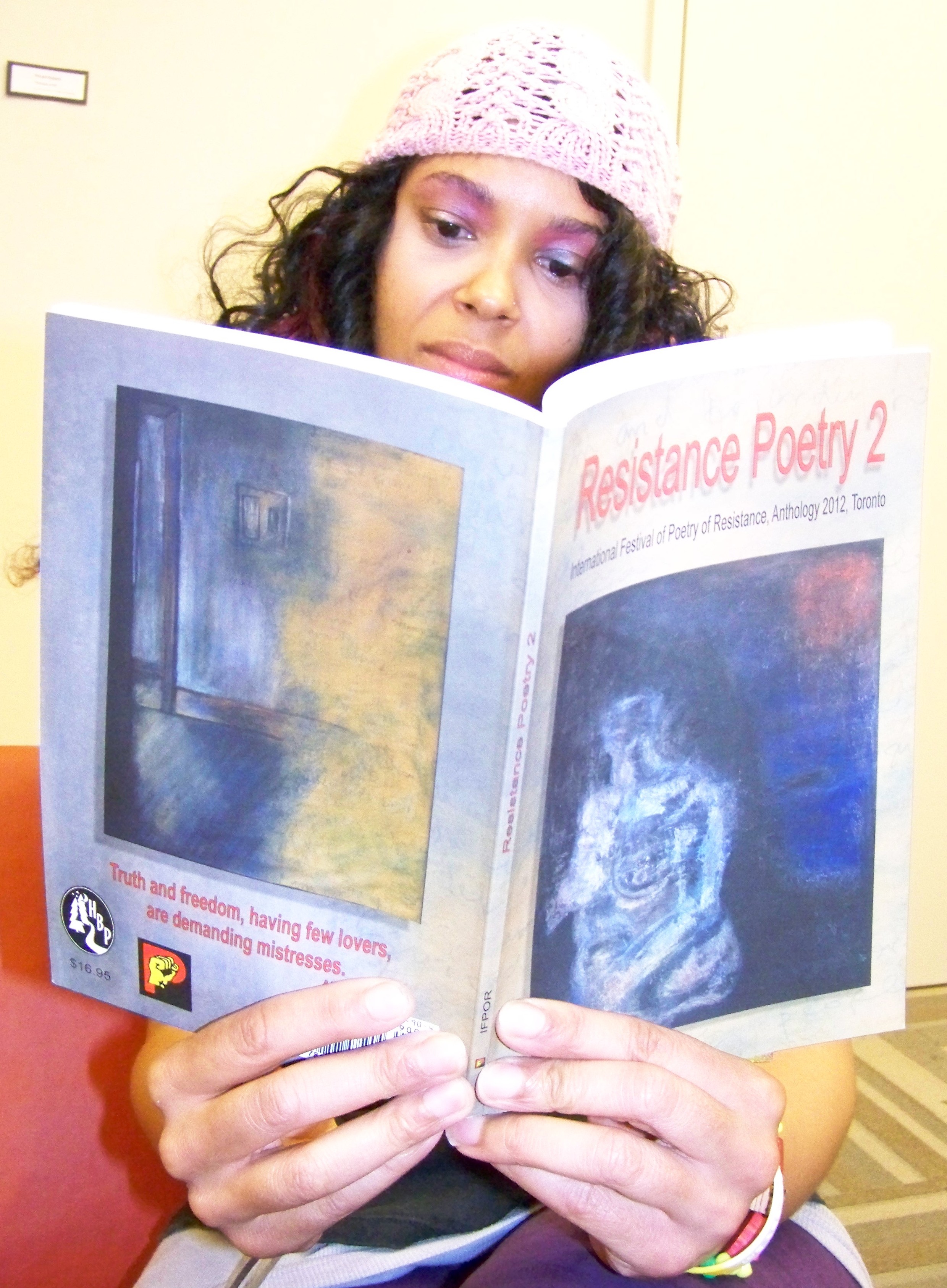
I experienced such a good time last night while sitting on my black leather single seat couch at midnight while reading Resistance Poetry 2. It wasn’t that the poems were funny; it was more about familiarity; someone gets it! Someone gets me! I’m not alone.
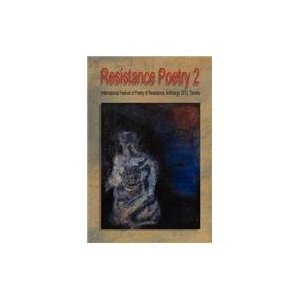
Some writers argue that all poems are a form of resistance. That’s bullshit. Lots of poetry is bullshit. Resistance Poetry 2 is filled with poems that mean something, say something, and do something.
The doing being the writer leading the reader to engage in thought after each title, line, and completed poem.
Twenty-seven poets, including editor Roger Langen, fill the 71 pages that make up one of the best poetry anthologies I’ve ever read. From the first poem to the last you are taken on different journeys in places you’ve never been and might never go:
Africville, Nova Scotia
Prisons all over the United States and Canada
Cuba
The Middle East
The contributors are just as diverse as the places you are taken: Indigenous poets, Latino poets, Asian poets, Black poets, and poets of the dominant class. And they all bring a different experience, interpretation, and poetic form of resistance.
No Canadian Experience by Michelle Mae Sutherland is about trying to find a job as a Black person in an anti-Black society. A certified and qualified computer programmer/ analyst working as a telemarketer, Sutherland writes of interview after interview and facing the same question that masks racism: “Do you have any Canadian experience?”
Computers are computers. Why does a programmer need Canadian experience? If you’re a person of colour you have to be better than everyone else and need years of Canadian experience just to be on even playing ground.
Overqualified, underpaid, and eventually unemployed, Sutherland writes:
jobless, moneyless,
heading down the street to join the homeless.
No Canadian experience = countless experiences by Canadians of colour!
In Metro West Ariel David takes you with him to the Metro West Detention Centre in Toronto. You ride in the paddywagon (police van) and feel his “privacy is strangled” as claustrophobia starts to kick in. Hypermasculinity is revealed as David sits in the hole (solitary confinement) due to talking with his fists—all part of a day in jail.
Three lines that could be a food for a much larger poem stuck with me. David writes of his blue shoes—“blue flaps—that stick to the floor. I remember those shoes and the unbreakable plastic cup that came with them when I was in the West and later the East Detention Centre.
As a Brown man I felt David because I literally have been in his shoes, those shoes, our shoes:
a sorry excuse for a shoe passed down from man to man
god only knows what stories go with them, the sad stories
originating from prison to prison.
David continues, “I’ve walked miles but ended up at the wrong place.”
Like Sutherland, you can walk and walk in this racist society and still end up nowhere. David writes of his journey, a sad journey, one that sees shoes match his feelings, ending up in a horrible place within a horrible place called “the hole”.
Veronica Eley writes of her Grey Blanket and how it travels with her in the back seat of a car as a child, in a hospital bed when she battles pneumonia, at the beach with her mom, and sadly, at the police station after being raped.
Eley’s blanket is her constant companion through the good, bad, and the ugly in her life. A grey cloth is forever loyal, at her side no matter what, keeping her warm inside and out.
Resistance Poetry 2 is a blanket in itself. The poems aren’t always nice. They aren’t about flowers and weddings, but they bring a truth that comforts, a comfort in the form of letting the reader know they are not alone and that someone cares and can relate.
Twenty –seven poets take you into their lives. Malikah Awe:ri writes “Dying Breed” a poem for Canada’s Missing and Murdered Aboriginal Women; Alys Skel writes an “Ode to Mumia Abu Jamal”; Patrick Connors writes “An Open Letter To The Prime Minister”; Katherine Beeman writes a “RAP for the [Cuban] Five”; Ramon Labanino Labanino writes “Poem To A Brother” for Roberto Gonazalez; and Lisa Makarchuk writes “Lets We Fortget (A Chat With Hilary Clinton about U.S Policies)”.
Resistance Poetry 2 is a book of journeys. Whether you are on the job hunt as a Black person in an anti-Black society, or wearing sticky blue shoes in a detention centre that houses men of colour, or wrapped in a blanket through various points in your life, you are taken on a ride through verse.
Everyone has a story to tell and everyone is different. Elizabeth Hill reminds us in her poem Assumptions Are Made:
It is assumed we are all men
That we all speak English
And drive cars
And eat meat
And walk up stairs
And we go to church on Sundays
And sleep with the opposite sex
And have “flesh coloured” skin
But the reality of our world is not the assumption
And we are all better for it.
We are also better because of poetry that resists and the brave souls who write it, Resistance Poetry #2 being one part of this important whole.
Tune into Black Coffee Poet Wednesday February 27, 2013 for interviews with Resistance Poetry #2 contributors Malikah Awe:ri and Roger Langen.
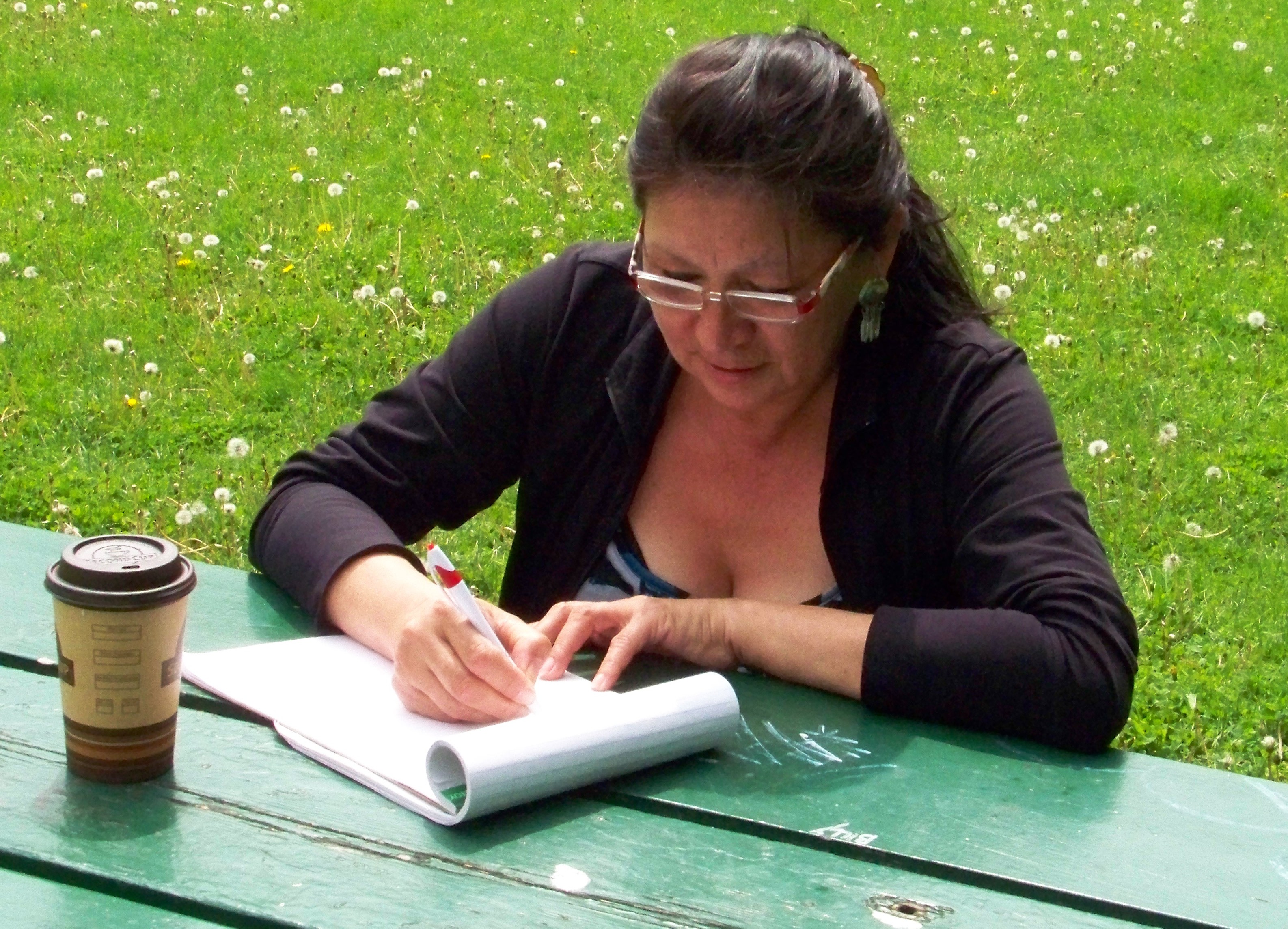
Photo: Ojibwe poet Joanna Shawana free writing at the park
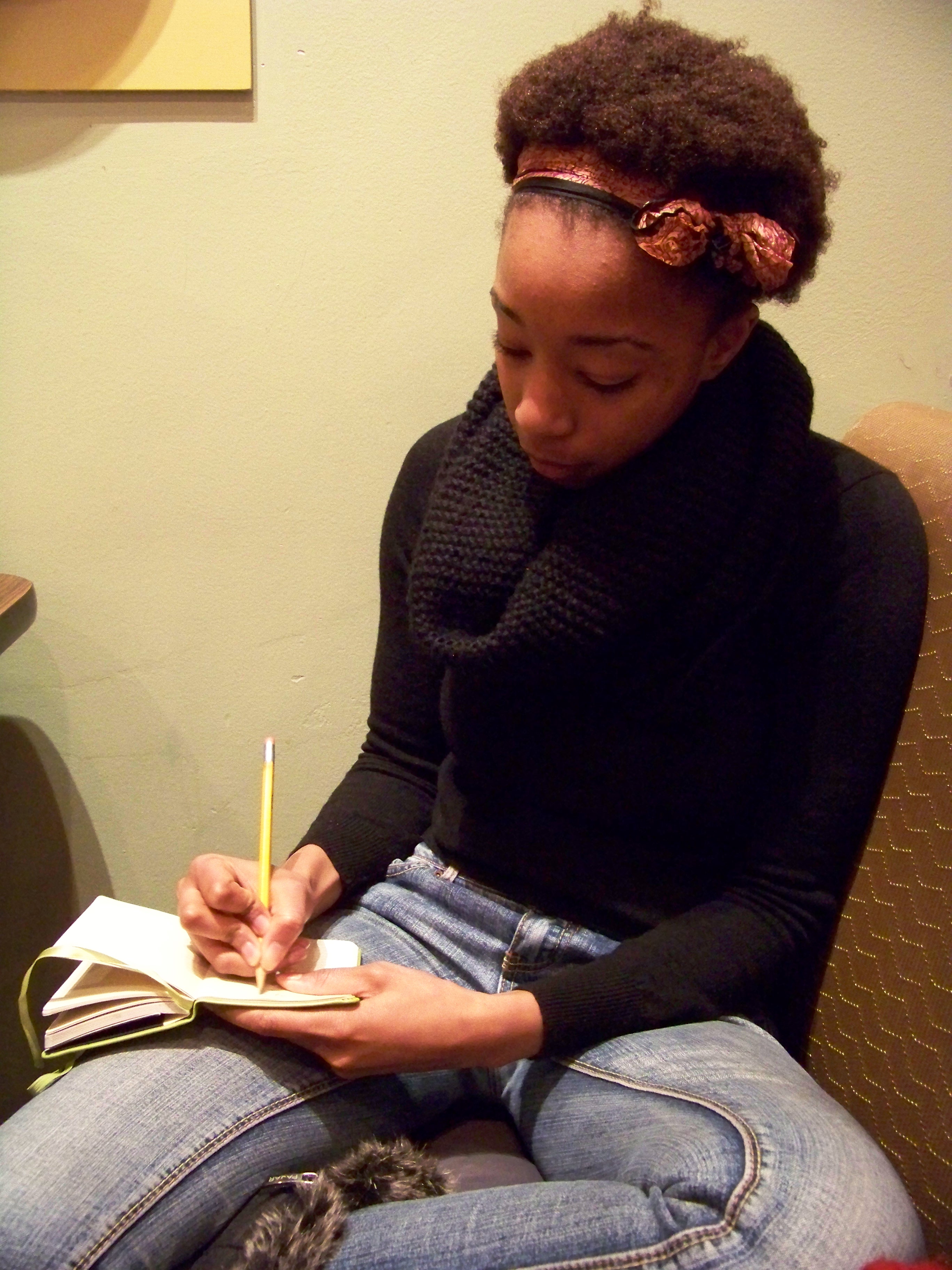
A lot of my writing happens in coffee shops. I try to choose independent coffee shops but if I can’t get to one I write at a Canadian chain as opposed to an American one.
I sit with coffee at my side and I write. I prefer pen to pad as I love the feel of paper under my hand and a pen in between my fingers. And there’s nothing like seeing ink form lines on a page like small waves in the ocean.
Sometimes I know what I’m gonna write. Often times I don’t.
It’s a practice called free writing. You hit the page or keyboard and write for a certain amount of time or page length without stopping. I generally write for 3 pages. Or sometimes I write past three pages until I want to stop, and I never leave a page unfinished. The most I’ve written in 9 pages single spaced, non stop; at 10 to 15 minutes a page it took a while, a long while, a great while.
Free writing became famous when Natalie Goldberg’s book Writing Down The Bones: Freeing The Writer Within came out in 1986. Goldberg’s rules for free writing are:
Keep your hand moving. (Don’t pause to re-read the line you have just written. That’s stalling and trying to get control of what you’re saying.)
Don’t cross out. (That is editing as you write. Even if you write something you didn’t mean to write, leave it.)
Don’t worry about spelling, punctuation, grammar. (Don’t even care about staying within the margins and lines on the page.)
Lose control.
Don’t think. Don’t get logical.
Go for the jugular. (If something comes up in your writing that is scary or naked, dive right into it. It probably has lots of energy.)
The only rule I don’t follow is #3. I capitalize and write commas and all that. But that’s me. And I stay within the margins. My journals are my thoughts and I want to go back to them. So, although my writing is like chicken scratch my journals are somewhat legible.
It’s unbelievable what comes out of free writing. I’ve had ideas for articles, essays, and poems come out of my free writing practices. I’ve had life revelations. I’ve had therapeutic moments. And I’ve had complete garbage come out, and that’s OK!
You don’t have to come to the page knowing what you’ll write.
Be open, give yourself room, and give yourself freedom.
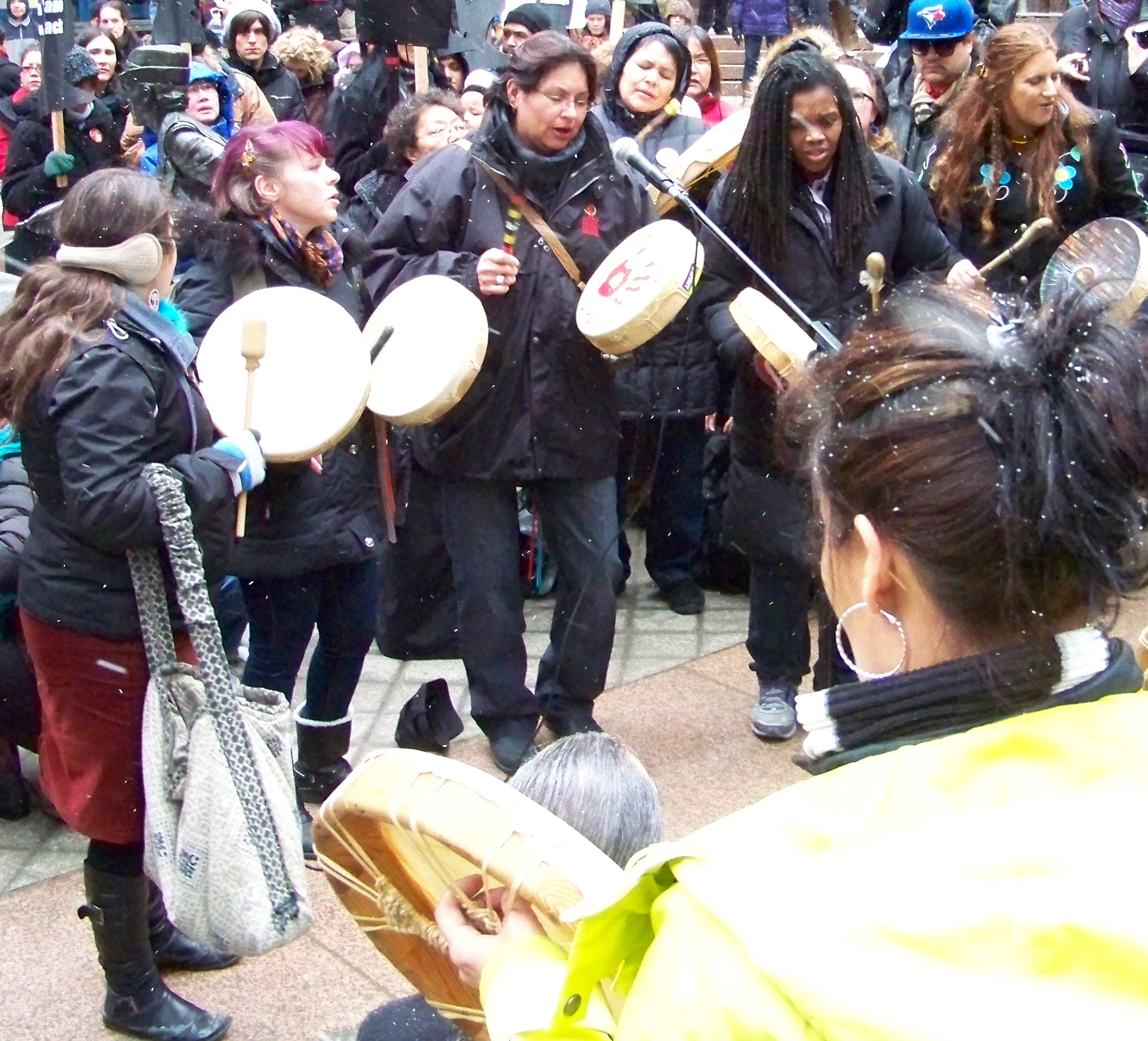
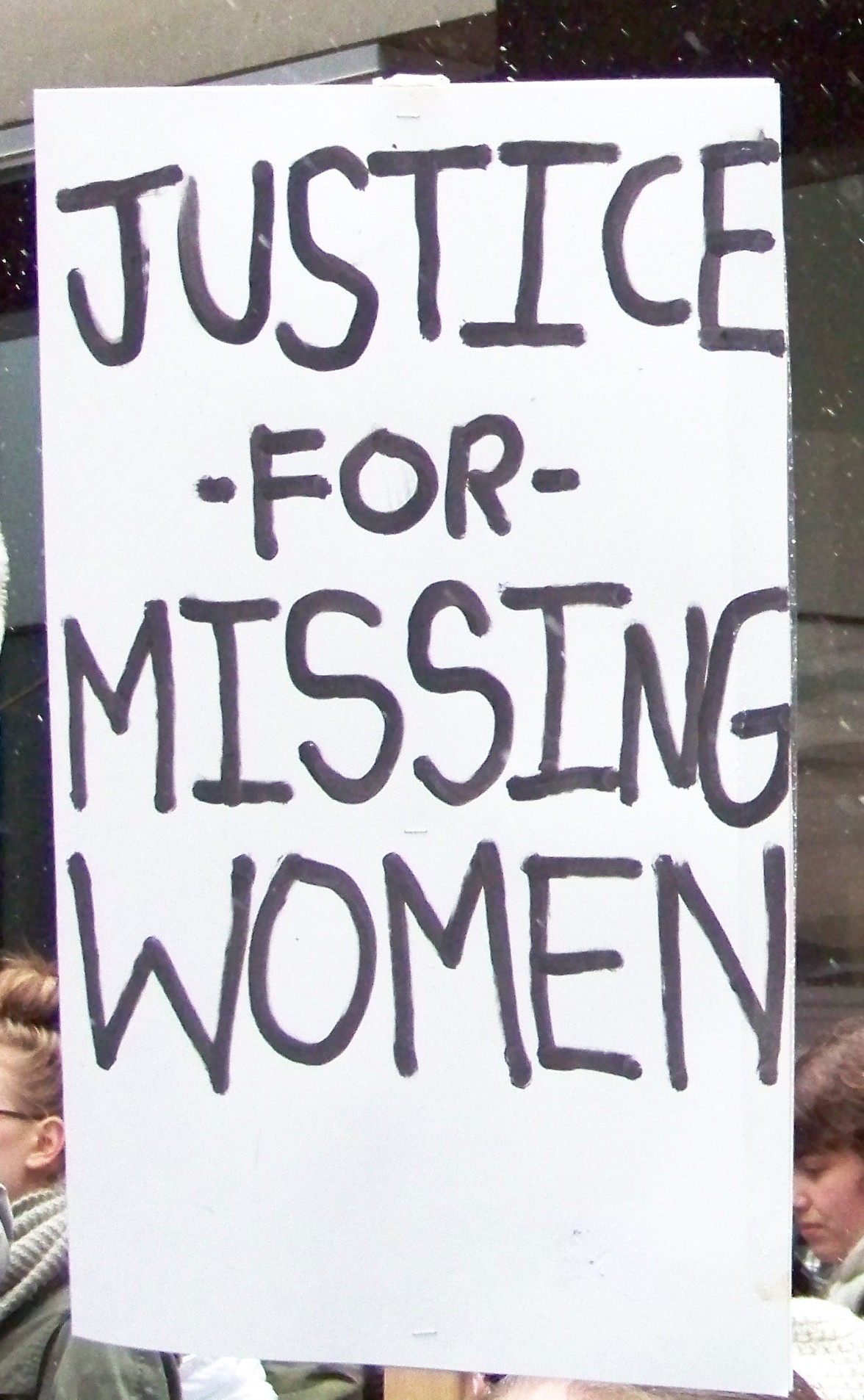
This week on blackcoffeepoet.com we brought attention to the Epidemic of Missing and Murdered Aboriginal Women in Canada via an Opinion Editorial by Anishinaabe Kwe Christine Luza, a Letter by Cindy Bourgeois to her Transgender sisters asking them to care about and act on the epidemic, and an interview with Anishinaabe Kwe Naomi Sayers accompanied by a photo essay of the For Our Sisters rally in Toronto. We end the week with powerfull poems by Native women speaking out against violence!
Tania Carter is a Native woman from British Columbia living in Toronto who is finishing her master’s degree in Indigenous performance. The proud mother of a beautiful daughter, Tania has been surrounded by activism and artist all her life. She believes activism and the arts are not separate entities and says, “I believe this is an Indigenous rooted belief. I was born to writers and would like to carry on this tradition to help young women that I once was. I love poetry and the analysis of everything that touches me.”
Sâkihitowin Awâsis is a Didikai Métis Two-Spirit of the Carré Clan. They are a spoken word artist, community organizer, and writer who currently resides in the Anishinaabeg, Haudenosaunee, Wendat-Huron, and Attawandaron Peoples territories of Southwestern Ontario. You can read and hear more of their work at awasis.blog.com.
Dumont is currently working on her fourth collection of poems which is focused on Metis politics, and the life of her relative, and Indigenous revolutionary hero, Gabriel Dumont.
Subscribe to the Black Coffee Poet YOUTUBE Channel: 147 videos to view: Poetry, song, interviews, VLOGs, workshops, readings, and roundtables.
Naomi Sayers is an Indigenous Feminist from the Garden River First Nations, just east of Sault Ste Marie ON. Currently, she is in her third year of studies at Western University for the honors specialization in criminology program with a minor in women’s studies.
Her motto is: Tell me I can’t and I will show you I can.
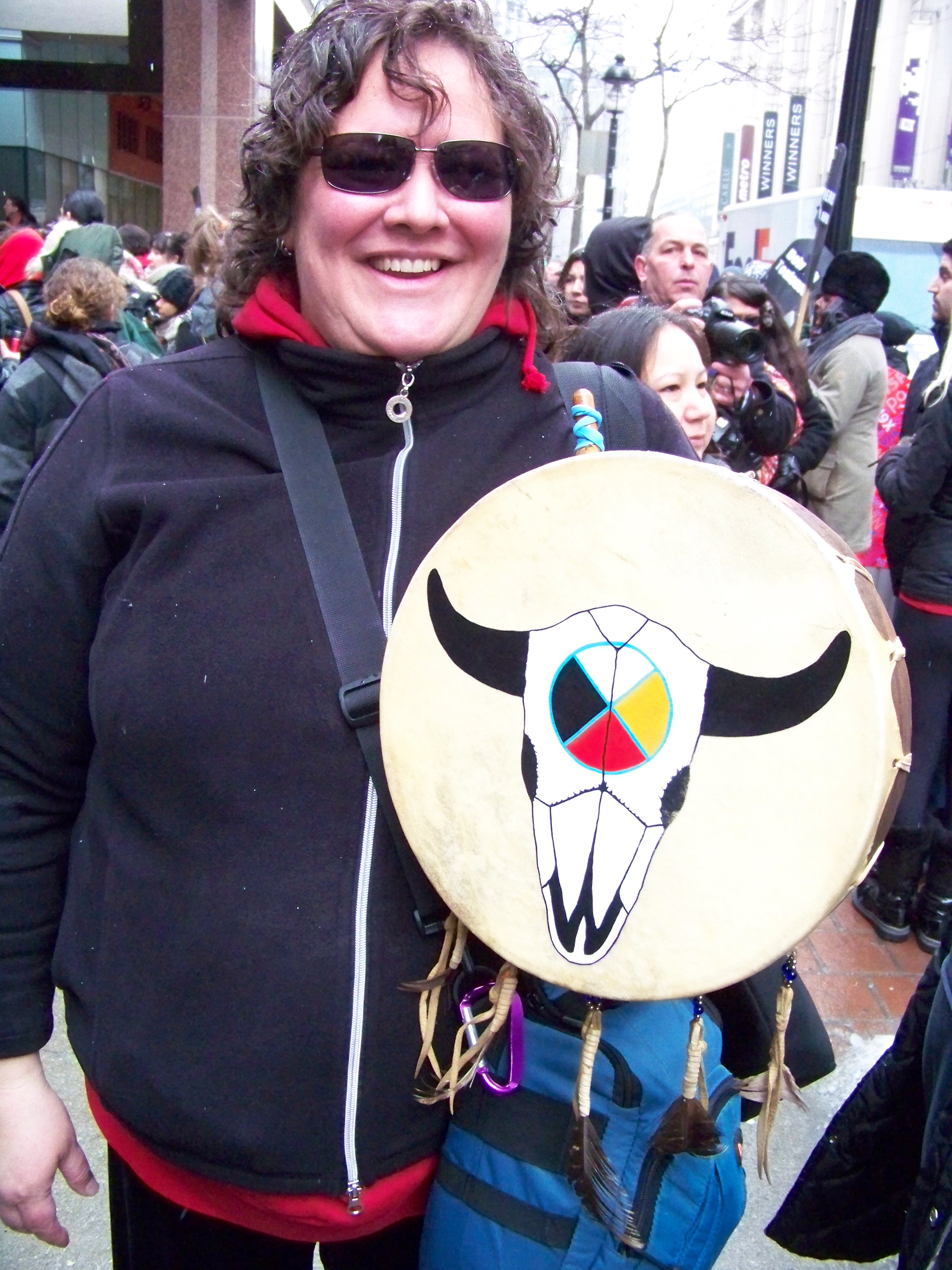
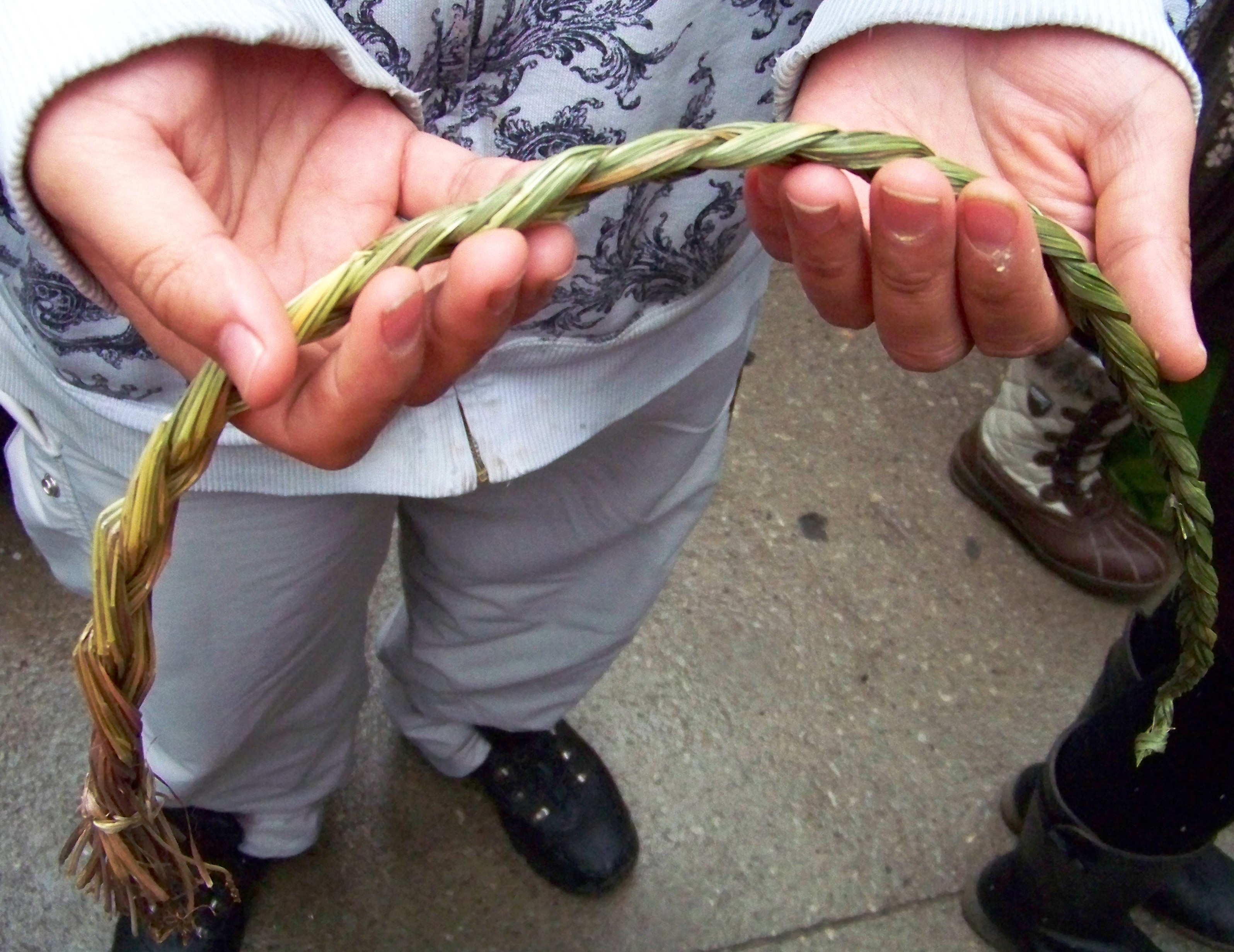
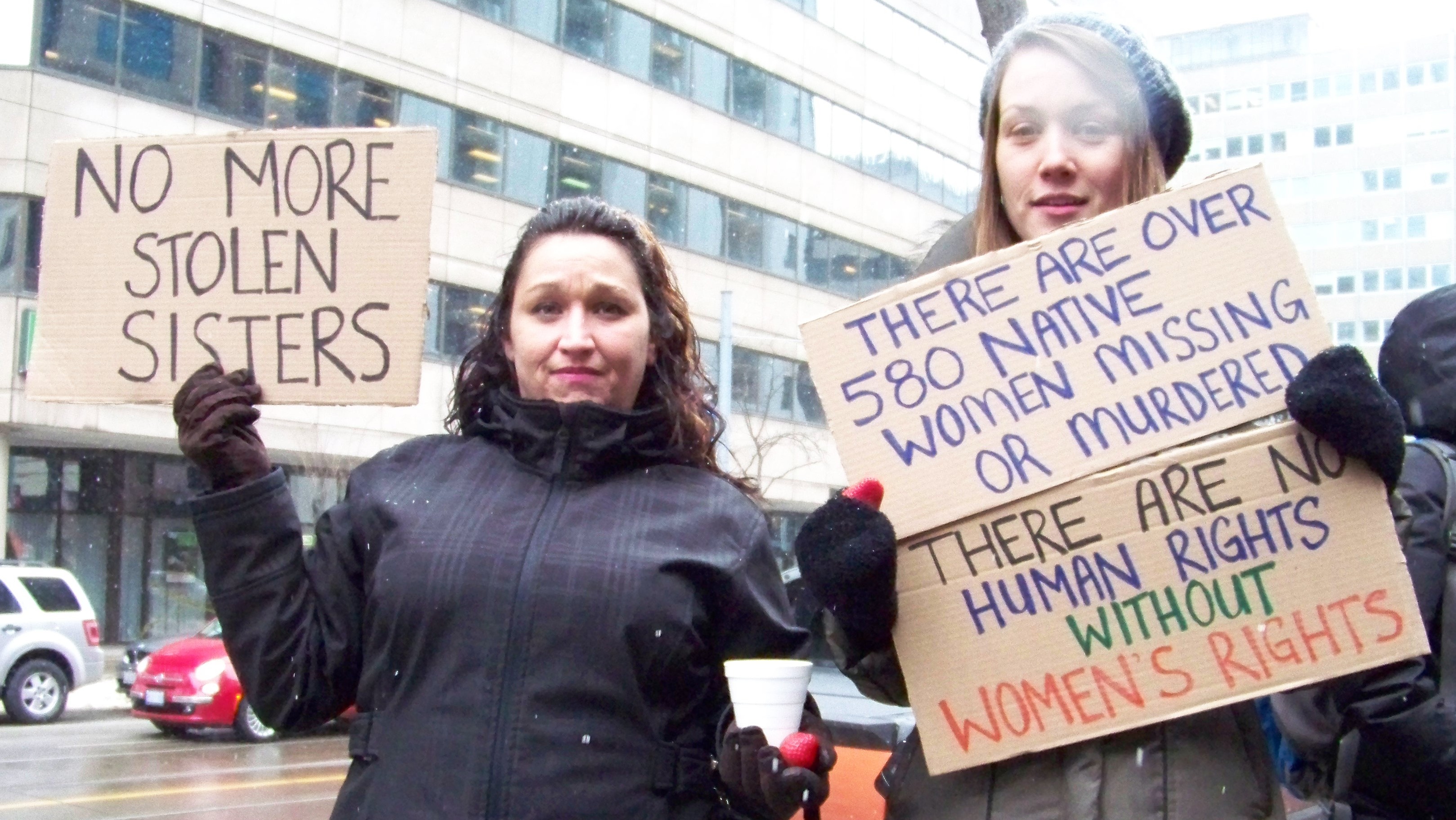
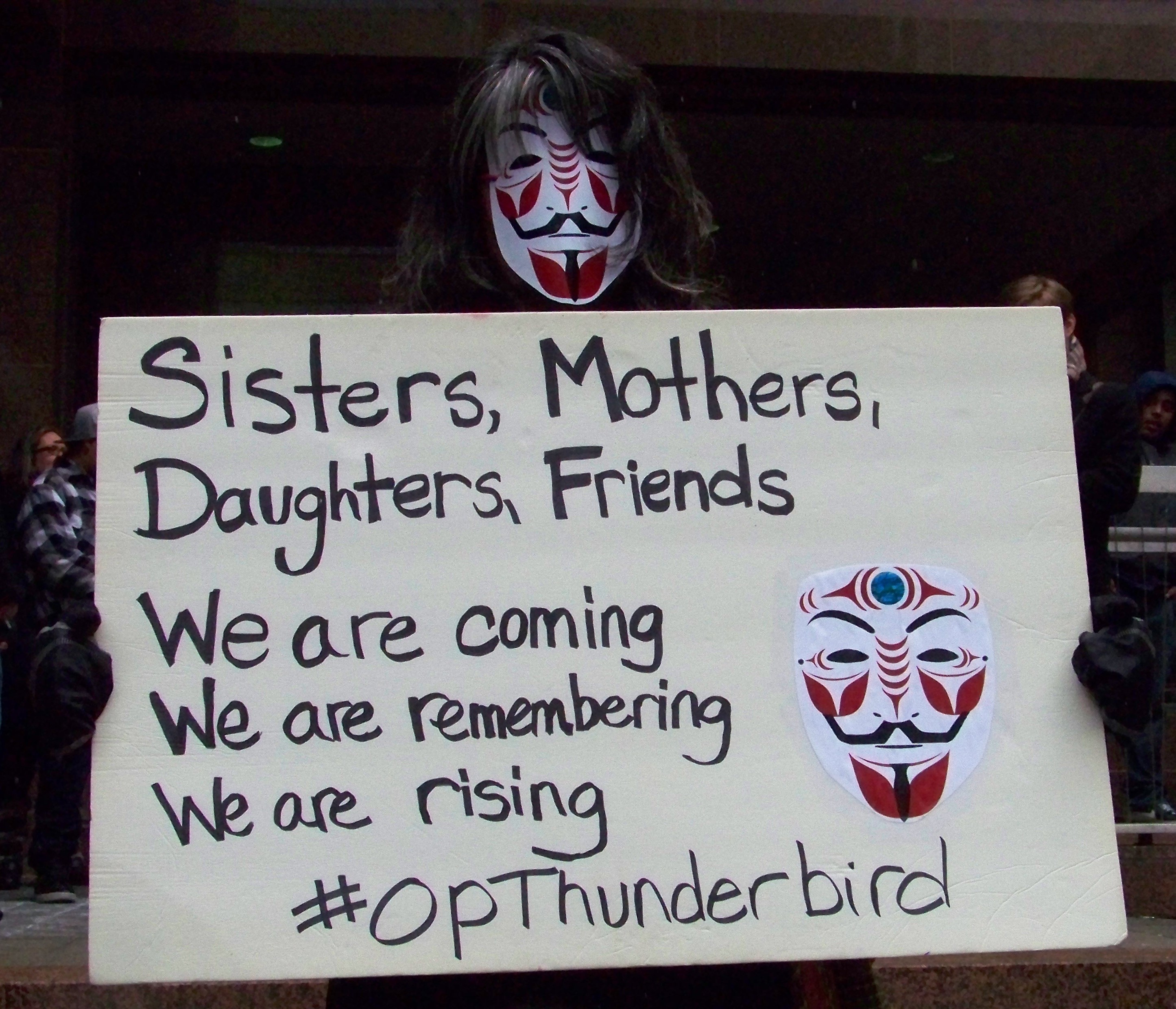
All photos in the essay below taken by Jorge Antonio Vallejos aka Black Coffee Poet @ No More Silence Rally Toronto February 2013.
BCP: What does today, February 14th, the day to remember Aboriginal women who have gone missing or been murdered in Canada, mean to you?
NS: For me, as a young Indigenous woman, it means many things. Namely, it means that we must continue to fight for the justice of the missing and murdered Aboriginal women. This is something that can’t just be swept under the rug, so to speak.
BCP: Across the country there are rallies and vigils held followed by community potlatchs. Is there anything you would like to see happen on this day that has not occurred in previous years?
NS: Something that has not occurred in previous years is the acknowledgement of the issue of missing and murdered Indigenous women/girls by the larger Canadian society. While this issue has been acknowledged by international organizations like the United Nations or Amnesty International, the extent of this issue are largely ignored by Canadians and Canadian institutions. I think in the future, I would like for this day to be recognized as a national day of remembrance. With respect to the rest of Canada, I know that this will require more than just staking a claim on a specific calendar day. It will most certainly require RE-education on the issues that Aboriginal communities face and why these issues are endemic to Aboriginal peoples.
BCP: You are an Aboriginal academic who used to do sexwork. While thinking of these questions I wondered, “Will people listen to her more now that she is an academic? Would they take her thoughts into consideration if she was still doing sexwork?” I’m talking about all peoples: my regular readers, the larger public, Aboriginal peoples and their allies.
Do you think academia has given you a more ‘credible’ voice? Did people listen to you about political issues, in particular violence against women, when you were a sex worker?
NS: I don’t think academia has given me a more “credible” voice. I think academia has given me a different platform to speak about the issues that matter to me and to reach various types of audiences like my peers who may or may not have any knowledge about the issues that Aboriginal people, specifically Aboriginal women, experience. I think the questions that you have pondered while drumming up these questions are important to highlight because I don’t really subscribe to any one identity like “academic” or “sex worker.” I think my identity was and is as fluid as my lived experiences, just like how all sex workers or Aboriginal persons’ experiences are not static across identities. I also feel that my experiences and skills that I built upon as a sex worker, like dealing with different personality types, has made me more intuitive as a non-sex worker which helps me to navigate within the social realm of academia. One might also suggest that even being Aboriginal in academia is very political or that sex work, itself, is a job often situated at the center of politics or very politicized. When it comes to the discussion of credible voices in or around politics, I think it is all about perspective, self-reflexivity, and being critical of how you interpret your own location within the social (or political) world.
BCP: Violence against women and Aboriginal peoples also occurs in the academic world. Another thought that came to mind was, “She is Aboriginal and she is a former sexworker. That’s two strikes against her in the academic world.” Am I being paranoid?
NS: As a mental health advocate, I don’t like the word paranoid when used out of its context. I am sure you are not paranoid 😉 Also, as an Aboriginal and former sex worker, I don’t think these are strikes against me. Rather, my identity as an Aboriginal woman allows me to better understand potential barriers that I may face simply for being who I am, Aboriginal and woman. By understanding these potential barriers, I am better prepared to plan to succeed not only as a woman but also an Aboriginal person!
BCP: I often hear and see non-sexworkers speaking for, and about, sexworkers and the violence they face. What do you notice is missing from the discussion?
NS: The obvious answer: the voice of sex-workers. Sex workers are a diverse group (just like any other social group). Not all sex workers identify as such and when it is suggested that more sex workers should just come out to help aid in the discussion (this happens by the way), that is violence in itself. In addition to this, sex workers may not be silenced because they are sex workers; rather, they may be silenced because of their race, sexual orientation, gender, level of education… just to name a few. It is important to include a spectrum of voices when addressing the issues a broad group like sex workers may face because all voices are necessary… not just the voices that are considered to be important by dominant discourses and discussions.
BCP: What will it take for sexworkers to be fully welcomed into the discourse and speak for themselves?
NS: Sex workers are already speaking for themselves! In order to be fully welcomed, the public needs to begin to address the stigmatization that sex workers face that imposed by the public themselves. There is a term for this: whorephobia which is simply defined of as the fear of sex workers (where fear often incites violence). By labeling the violence and stigmatization that sex workers face as such, we can address the violence and stigmatization as not being inherent in the work itself and we move away from the idea that sex workers “deserve” the harm done to them (which often, the public agrees with the whorephobes who inflict harm/violence on sex workers). Like I said before, being critical of how you interpret your own location within the social (or political) world. Non-sex workers especially need to be able to understand their own position and privilege in the social/political world.
BCP: Why is it important that former and current sex workers (with good politics) be welcomed into the discourse?
NS: Good politics? Is that an oxymoron? Joking! By limiting former or current sex workers who have “good politics” to be welcomed into the discourse, we may be limiting other voices that need to be heard. Like I said before, one might suggest that sex work, itself, is a job often situated at the center of politics or very politicized. By limiting ourselves to a certain type of politics in a very politicized career, we limit these very important voices that are often silenced.
BCP: The stigmatization of sexworkers in terms of the epidemic of missing and murdered Aboriginal women has many sides to it. When the media writes of the epidemic they paint the women as sexwokers, and not in a positive way, it’s a non-pro sexwork view. Many Aboriginal community members are upset about the women being labelled sexworkers; again, resulting from a negative view of the trade. When I’m confronted with this I often say, “What difference does it make what work they did? These women were people first.” I use the word “work” and I emphasize the woman’s humanity.
Has this been your experience? If so, how do you deal with this stigma?
NS: I once had an RCMP officer come in and do a presentation on human trafficking in my class. He focused on northern reservations because the RCMP defined Aboriginal women/girls from northern reservations as most likely to be trafficked, work in escort agencies, and often unable to leave the agency. I pulled him aside after his lecture and I told him that I used to work with an escort agency up north. He asked where and I said near Sault Ste Marie ON which has THREE reservations near by. I also emphasized that I made the conscious decision to work with agency and also made the conscious decision to leave the agency. He dismissed my story and said that it was further up north than Sault Ste Marie ON. In other words, my story and I didn’t exist. This story is in relation to your question because it draws attention to the fact that when Aboriginal women/girls are often mentioned within the discourse of sex work, they rarely have agency. The definitions of human trafficking victims by the RCMP removes agency from Aboriginal women/girls. When Aboriginal women/girls are missing or murdered and then labeled as the “drug addicted hooker” (as the media often does), it removes the ability for Aboriginal families and communities to speak for their beloved family member. This effect of silencing Aboriginal families and Aboriginal communities is nothing new—this silencing of Aboriginal peoples is embedded in a colonial country, like Canada. It says, “we don’t matter” and that “we don’t exist.” I don’t think that me as an individual can answer definitely how I addressed the stigma I experienced. However, as citizens within our colonial country, we need to become address the effects of colonialism within Canada and not just the effects on Aboriginals. Colonialism affects everyone, including non-Aboriginals, and it affects our education systems, our justice systems, and affects how we frame issues like violence against women.
BCP: How much of a role does the stigma play in the epidemic?
NS: With respect to Aboriginal peoples, stigma is almost always at the center of any issue that we may experience. Often times the argument for the violence that Aboriginal women face is that it is because of our “culture” but violence never was and never has been a part of our culture. Some people blame alcoholism or drugs (which some people say it is our “culture” but that never was or never has been the case). Some people also blame Aboriginal men. This is all related to stigma. However, this is also related to colonialism. Aboriginal people did not experience these issues before colonization.
BCP: What can allies do to help stop the stigma?
NS: Educate, educate, and educate! The work of one ally or a hundred allies won’t help stop the stigma tomorrow but what will help in getting rid of the stigma is when allies use their position in a particular social/political class to educate non-Aboriginals on these issues. Education (formal/informal) lasts a lifetime and when you change one person’s perception on an issue, it has a domino effect across generations.
BCP: Do you do any activism around sexwork or the epidemic, or both?
NS: I would say that I do a bit of both. I try to use the spaces or conversations that mention sex work/Aboriginal women and girls/violence against women as opportunities for public education. I think that is just as important. I also do a lot of writing because I personally feel that writing things down is important. It says, “I was here and I matter.”
BCP: Many people believe that white men are the main perpetrators in this epidemic. Do you agree?
NS: I think this is a difficult question to answer because the violence I experienced has always been at the hands of a white man, and I don’t want to generalize. So while I can’t speak to every other Aboriginal women’s experience, I can say that perpetrators often hide behind their race as a privilege especially in avoiding blame and responsibility, and Aboriginal men (or other racialized/indigenized men) do not experience this same privilege as white men.
BCP: How much of a role do you think police play in the violence against Aboriginal sex workers? What were your relations with police like when doing sexwork, if any?
NS: Again, this is a hard question to answer because I don’t want to generalize. I think that Aboriginal police forces, like when reservations have their own police forces, the harm done to Aboriginal women, sex workers or not, is significantly minimalized. In terms of my involvement with the police, I cannot name one positive experience, sex worker or not. My identity as an Aboriginal is most often the identity that police see first, and when they see that first, they often make generalizations about me as an Aboriginal woman before anything else.
BCP: Does your academic work touch on the epidemic or sexwork, or both?
NS: Definitely both! I can say that I am more vocal today within classroom discussions about sex work(ers), Aboriginal women/girls, and violence against women. I used to care in my earlier years about what my peers may think of me or what other people might say but I quickly found out that just left me feeling tired and drained after lectures/discussions. Often I would bite my tongue when I would hear racist or stigmatizing remarks. Now I just say what ever comes to my mind. Sometimes it is beautiful and other times, I think to myself, “whoa, Naomi, breath!” LOL!
BCP: How can allies be supportive of sexworkers?
NS: As I mentioned before, it is all about perspective, self-reflexivity, and being critical of how you interpret your own location within the social (or political) world. Allies need to be critical of their own location and acknowledge that they need to use their (often) dominant positions of power and privilege to speak out against things like stigmatizing remarks about sex workers and/or whorephobic statements. It may create uneasy feelings for some allies, but allowing one self to experience those feelings helps an ally to potentially be more supportive and understanding of sex workers.
BCP: Can you recommend some reading material for readers (and me) to educate themselves on sexwork?
NS: My, yes. I really love the materials on these following sites:
powerottawa.ca (sex work activist organization)
maggiestoronto.ca (sex work activist organization)
BCP: Is there anything of importance that I’ve missed that you would like to add?
NS: I think you forgot to ask me about my blog 😉 Check it out www.kwetoday.com!
BCP: How will you spend this special and important day of remembrance?
NS: Unfortunately for me, I am spending it in class 😦 I will, however, try to see if there are any events on my campus in between my classes. On a more personal note, I will definitely be keeping the missing and murdered Indigenous women, along with their families/friends and the families/friends who continue to fight for their justice, in my thoughts and prayers.
BCP: Thank you for your words and your time
NS: Anytime! It was great to *virtual* meet you! We should have *real* coffee one day 🙂
A Trans Woman Calls On Her Sisters To Act In Support Of Missing And Murdered Aboriginal Women
By Cindy Bourgeois
Wednesday February 13, 2013
My Dear Sisters,
I am writing you today in solidarity with Missing and Murdered Aboriginal women in Canada. Since the 1970’s over 800 Aboriginal women have been murdered and disappeared, an alarmingly inordinate number of crimes. The response from the Canadian authorities has been a travesty. Way too many of these crimes have gone unprosecuted.
We should all be outraged.
We should all be outraged at the loss of daughters, mothers and aunties. We should all be outraged at the ongoing genocide of the First Peoples of Turtle Island, especially of our Aboriginal sisters.
I believe that as trans women we have particular reasons to be outraged…and to empathize. We know what it is to face discrimination. Granted, the discriminations we face are not identical but we know the psychic damage it causes to be sexualized and fetishized by the broader culture. We know, especially my Aboriginal trans sisters and trans sisters of colour, what it is to be deemed disposable by society. We know, especially my Aboriginal trans sisters and trans sisters of colour, what it is to be considered less than human.
When we live in a world where this kind of violence is wreaked upon our Aboriginal sisters (trans and non-trans), what conclusion can we reach but that we consider them to be less than human? This violence that is perpetrated affects their actual humanity. More than that, I think this violence affects all our humanity.
Our shared humanity is crucial here. Nobody can be fully human while this violence continues. It affects all of us. Martin Luther King Jr. described this well when he said, “All I’m saying is simply this, that all life is interrelated, that somehow we’re caught in an inescapable network of mutuality tied in a single garment of destiny. Whatever affects one directly affects all indirectly. For some strange reason, I can never be what I ought to be until you are what you ought to be. You can never be what you ought to be until I am what I ought to be. This is the interrelated structure of reality.”
King is lifting up our shared humanity. My actions don’t just have consequences for me and those with whom I come into daily contact. My actions affect everybody. The violence being perpetrated on our Aboriginal sisters affects me; it prevents me from being fully human. And the only way for me to increase my humanity in this respect is to take action. And I owe this to all my Aboriginal sisters both trans and non-trans. As trans activist erica ascendant, writer of the blog inchoaterica, says, “we all deserve nothing less than equality, safety, and to be valued for the treasures we all are.”
So I must take action.
That is why I am so grateful to Black Coffee Poet for giving me this opportunity. This is an opportunity to take action. It is a small thing but it is something. I try to do the best that I can. I educate myself on Aboriginal realities. In my role as a Minister in the United Church of Canada I preach regularly on the oppression of the First Peoples of Turtle Island while confessing our participation in genocide, especially through Indian Residential Schools. I acknowledge colonialism and I acknowledge my settler status. I speak up against racism. I try to engage Aboriginal folks where they are, especially those who have borne the brunt of colonialism.
If it sounds like I am great person, I’m not. I just try to be an ally. I try to do what I can to take action.
I urge you to take action. It can be anything. You can attend a rally in support of the murdered and missing Aboriginal women. A list of rallies can be found here: womensmemorialmarch. You can write to Prime Minister Stephen Harper demanding an inquiry. You can call someone on their racism.
Any action is good. We cannot stand by and let this continue. There is too much at stake. For you, for me, and especially for our Aboriginal sisters.
Love,
Cindy
Cindy Bourgeois is the first known out and proud trans person to be ordained to ministry by a mainline Christian denomination in Canada.
Anti-Violence Against Indigenous Women and Resurgence
By Christine Luza
On February 14th, Anishinaabe voices will be heard clearly and loudly across Canada. When most would be settling down for a special evening with their beloveds, Indigenous women, men, Elders and allies will gather in vigils, marches, and memorials. Our intention for gathering also comes from a place of love. We want to eliminate violence against Indigenous women.
Over the past ten years, I have been able to bear witness to powerful acts of strength and leadership. Women Elders have traveled to prisons to sing the Women’s Warrior song to inmates, moments of silence have been held in Vancouver’s downtown east side, and women have shared the intimate stories of their lives in talking circles. This organizing is tirelessly carried out throughout the year in every day ways, and on specifically chosen days of action to grieve, celebrate, and demand justice for our stolen sisters.
The violence directed towards Indigenous women is racialized, sexualized, and resultant from colonialism. In fact, violence against women is the primary means through which colonialism has occurred. Indigenous feminist and Cherokee scholar Andrea Smith identifies this ultra-violent logic of colonialism in relation to Indigenous bodies; Indigenous lands are considered to be inherently rapable, exploitable, or there for the taking by colonizers, and by extension so are Indigenous bodies, particularly the bodies of Indigenous women.
Indigenous people resist colonialism through building anti-violence movements that are anti-patriarchal and anti-oppressive. This is important because colonialism has come into being through patriarchy and interlocking systems of oppression such as homophobia, transphobia, able-ism, etc. One form of oppression enables the experience of the other, and this is why intersectionality plays a key role in understanding and dismantling the oppressions of Indigenous women.
Importantly, Indigenous peoples resist colonialism and violence by reclaiming our own traditions. Anishinaabe-kwe writer, educator, and activist Leanne Simpson calls this return to Indigenous meaning resurgence in her book Dancing on Our Turtle’s Back. I think that ending violence against Indigenous women is an intrinsic act of resurgence.
As Leanne Simpson shares, the practice of restoring relationships is central to the idea of resurgence. Taking care of our relationships across genders creates equity, and this in turn enhances our relationships with the spirit world, ancestors, and medicines – all of which are the foundations for Anishinaabe governance. Within an Indigenous resurgence, anti-violence against Indigenous women has broad and holistic meanings and implications. When we restore women’s relationships we restore all relationships in our nations.
Again, as Simpson conveys, resurgence calls for a restoration of Treaty relationships with Canadians. Our Treaties are sacred promises made before Anishinaabe spirits and ancestors, which were intended to be upheld for as long as the sun shines and the rivers flow. They are, in fact, a moral foundation for Canada that instructs our shared responsibility to one another.
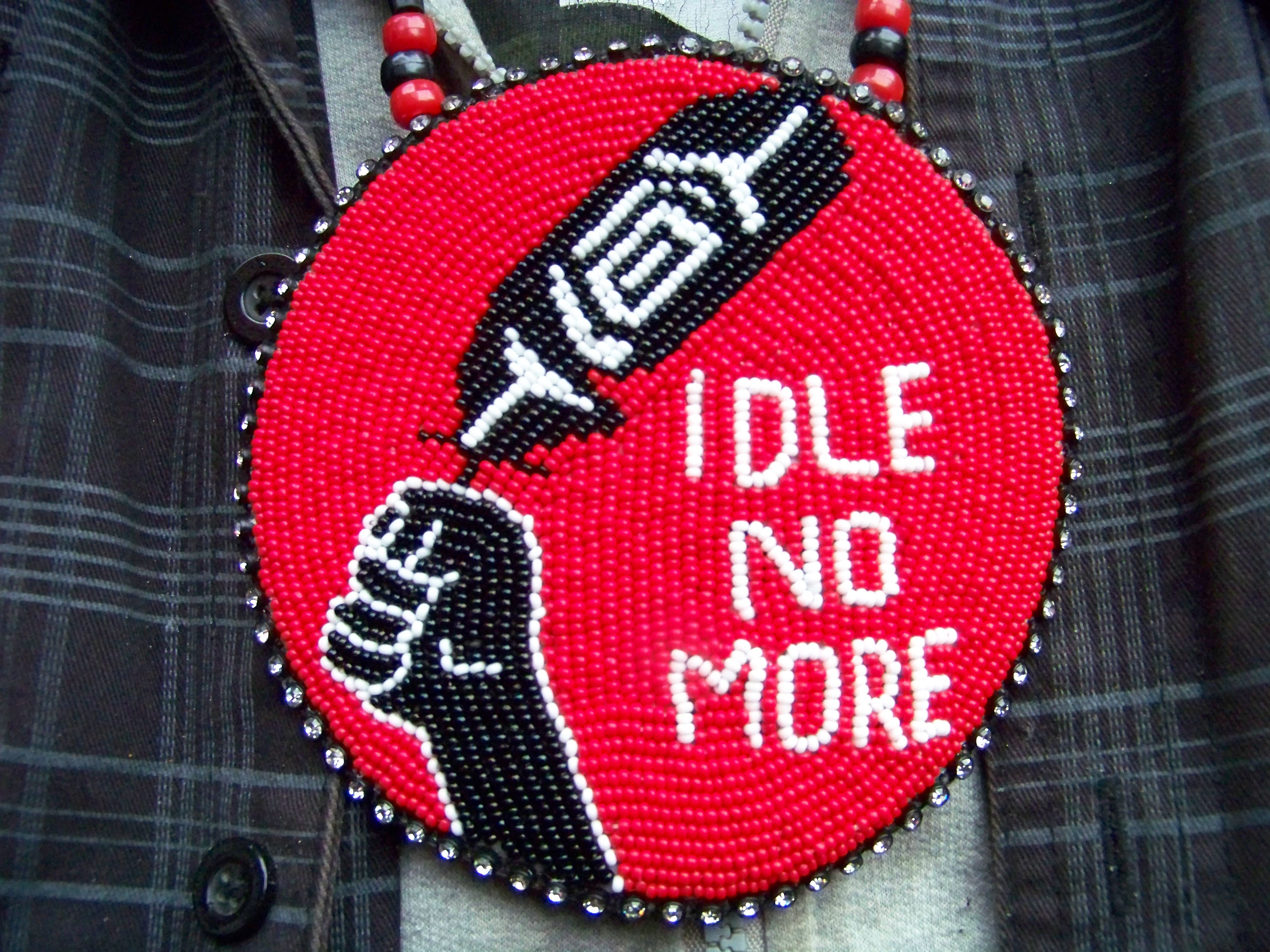
Idle No More draws attention to these broken Treaties by demanding Indigenous sovereignty. Anti-violence against Indigenous women here intersects with sovereignty issues because, as Haudenosaunee reproductive rights advocate, Jessica Yee, puts it: sovereignty over Indigenous lands extends to sovereignty over Indigenous bodies.
That is, our nations will experience autonomy when all Indigenous women experience safety, integrity, and choice in our own bodies. Our nations will resurge when we have both healthy relationships to the land, and healthy respect for our women. As violence against Indigenous women has been facilitated through settler colonialism, non-Indigenous allies, or Treaty Canadians, should also work for gender justice as part of the resurgence of their relationships with Indigenous peoples.
As a response to the settler violence which has displaced Indigenous peoples, anti- violence against Indigenous women works to bring missing and murdered women home. By the act of speaking their names, the silence surrounding their deaths is broken. The often undignified disappearances are re-humanized as important losses. Their identities as Indigenous women are valued as they are re-embedded in a web of social, cultural, and spiritual relationships.
This work of restoring the broken relationships is resurgent because it is the first step to re-creating the world we want to live in. A world without violence against women and colonialism. A world that has recovered and birthed Indigenous consciousness. The movement to end violence against Indigenous women presents us with a vision to be actualized. When we speak of this vision we give voice to passion, intention to language, and practice the pathways of our Indigeneity.
Christine Luza is an Anishinaabe-kwe scholar, activist, and defender of Indigneous rights.
Canada is seen as a safe haven for many peoples. When Canada is talked of it is described as a melting pot and as the most diverse place on earth. Often, it is made to sound like a utopia.
It is not.
One of the main things that is not talked about is that Canada is stolen land. It is a colony that has not honoured many treaties with the original peoples of Turtle Island now known as Canada. And the many different peoples from different Aboriginal nations who were here before Canada was formed are still here, and they are often forgotten, as well as vilified, by the larger Canadian society.
One of Canada’s main dirty secrets is that 800 Aboriginal women have been murdered or gone missing since the late 1970s. And Canada is doing nothing about it!
Every February 14th thousands of Aboriginal peoples and their allies hold rallies, talks, and many other events to bring awareness to the epidemic. Join them!
Below are three video resources for you to find out more about the epidemic of Missing and Murdered Aboriginal women in the land now known as Canada.
Here is an interview I did with Haisla writer Eden Robinson. She breaks down this epidemic quite well:
I had the privilege of being on Indigenous Waves Radio last year. We talked about the epidemic and actions to stop it:
Community Elder Wanda Whitebird shared her knowledge on the epidemic and how it all started!
Take action!
Educate yourself and others on this epidemic. SHARE these videos, attend rallies and talks, and remember the 800+ Missing and Murdered Aboriginal Women in the land now known as Canada.

 Meeting Malikah Awe:ri to tape her reading from Resistance Poetry #2 was great. I was a guest on her show with Dane Swan; we talked poems, read poems, and learned about poetry from each other. My interview with Malikah was just as great!
 Roger Langen is the Editor of Resistance Poetry #2. Meeting him for this taping was quick and easy: hellos, chit chat, and on to the taping. In my interview with Roger he shared much insight into poetry. He’ll be editing Resistance Poetry #3 so look out for that in future. Enjoy his poem on video below.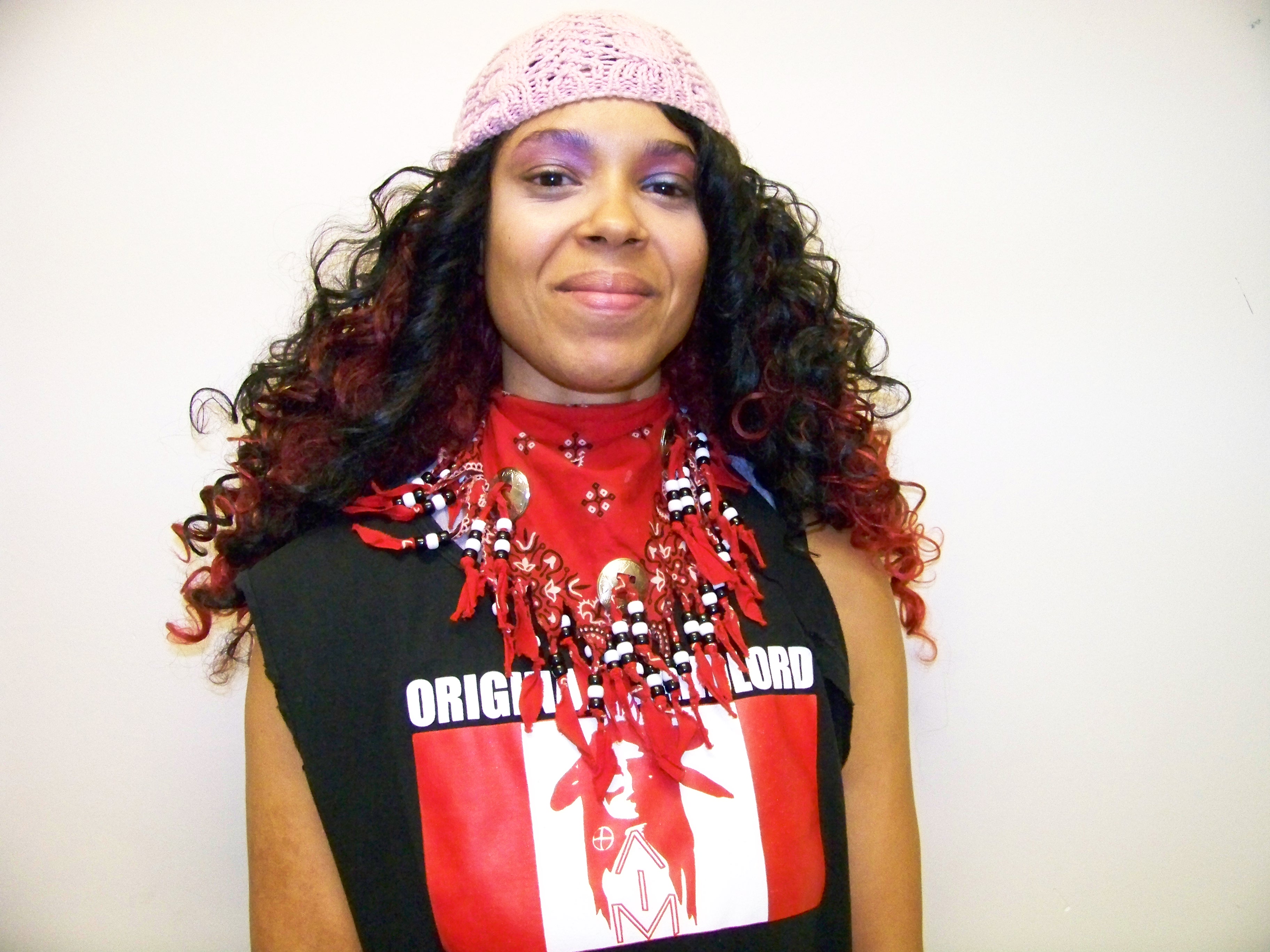







 Black Coffee Poet