ELI CLARE READS HIS POETRY

I first met Eli Clare in March 2008.  He was in town for a talk at the Ontario Institute for Secondary Education and agreed to be interviewed.

I heard Eli’s footsteps before seeing his smile. Once in front of each other, we said each others names simultaneously and then shook hands.

Before I could sit down and press record, Eli was already spewing off knowledge: the intersection of ableism with racism, how not all disabilities are visible and therefore ableism is experienced in different ways…

I was wowed.

It was Eli’s poetry that got my notice first.  I have heard his essays are amazing.  I know his talks are unbelievable. But it’s Eli’s poetry that speaks to me, holds my attention, and teaches me something new every time I re-read his book.

Eli is a kind soul whose words feel like a punch to those he is challenging: ableists, racists, homophobes, and all those who keep their company.

This past August (2010) I was given the pleasure to hang with Eli again.  I interviewed him for XTRA! and asked if he’d read some of his poetry for the magazine.  Please enjoy Eli’s inspiring words.

Tune in to Black Coffee Poet next week for a review of Maya Angelou’s poetry collection, and an interview and reading with local artist Zainab Amadahy.

  
Posted in Poetry | Tagged , , , , , , , , , , | 1 Comment

INTERVIEW WITH ELI CLARE

Eli Clare Talks Trans Pride, Disability and the History of the Freak Show

By Jorge Antonio Vallejos

Originally published August 12, 2010 in XTRA!

As Eli Clare stood among a crowd on Church St at Toronto’s Trans March this year, his smile reached from the top of Bloor St to the bottom of Carlton St. Dressed in his usual button-up shirt, runners and backpack, you could see Clare was content among kin.  Always a positive person, Clare’s smile was one of joy, satisfaction, victory and long-overdue recognition.

“Pride has a long history going back to the Stonewall riots in New York City, which was led by trans people of colour. So to have a Trans Pride parade now, 40-plus years later, is a way of saying, “trans people are here and part of this community. And in a way, that’s been a real struggle to be part of the LGB community,” says Clare.

Clare’s life has been one of struggle but also an example of how to thrive through surviving adversity. His hard-hitting poetry collection,The Marrow’s Telling: Words in Motion, reveals a narrator with a disability who was sexually abused by his father for years, his life as a white trans person who became a disability activist, and his growth in becoming a strong ally to indigenous peoples and people of colour. His third, and most recent, trip to Toronto was one of business, celebration and the feeling of coming home to one of his beloved communities.

“Trans Pride is a way of saying, ‘We’re here. We’re here not just as individual trans people; we’re here as community.’ Community means allies, means families, means partners in addition to trans people,” says Clare. One of his fondest memories of Trans Pride 2010 is seeing a sign that read, “I’m family to a trans person.”  
 
“I adore Toronto because there’s a great queer community here. There’s also a really big, local disability community, as well as a really radical community: to mobilize 25,000 activists on the street for a weekend of protest [the G20] is amazing,” says Clare.

Horror stories of disabled people hidden in backrooms or tortured in medical facilities are a large part of why Clare fights for disability rights.  

 “Isolation is built into ableism.  Part of ableism is the isolation of people with disabilities,” says Clare. “Where I live in Vermont, I know five disabled people — five disabled people who call themselves disabled, who have some politicized notion of what that means.” Clare cherishes the experience of spending time with many disabled people in Toronto.

“There aren’t many places that have a real concentrated population of politicized disabled people who have enough access to be able to spend time together,” says Clare.  Not only do disabled folk in Toronto have more access than many other places, there is also a great dynamic of able-bodied people interacting with, dating, befriending and supporting disabled peoples. Clare describes Toronto not as a utopia but as a place that has many things to teach other cities.

“What I would take from here [Toronto] and bring somewhere else is I see there being a lot of queer, disabled people who are seen as movers and shakers, as leaders, people who are fully integrated in the disability community, who aren’t put at the margins of the disability community because of their queerness,” says Clare.

In Toronto this summer on a two-week contract with Ryerson University’s Disability Studies Institute, Clare taught a course named Freak and Bodily Difference Using Disability as a Lens: essentially, the history of the freak show. 

Clare brought 15 students through an emotional roller coaster that followed the history of the freak show to the present, outlining the implications of the freak show and how it affects certain people today.  

“The freak show’s not just a thing of the bad old days; there are parts of the freak show and dynamics from the freak show that still really influence today,” says Clare. With trans people referred to as freaks, Clare teaches from lived experience.

“When I was walking at the Trans March, I was thinking about how much has changed in 40 years and how much hasn’t,” said Clare. 

Tune in to Black Coffee Poet Friday September 24, 2010 for a video recording of Eli Clare reading his amazing poetry

Come support Black Coffee Poet as he reads at the launch of DESCANT 150: Writers in Prison 


Posted in Poetry | Tagged , , , , , , , , , , , , , , , , , , , | 2 Comments

THE MARROW’S TELLING

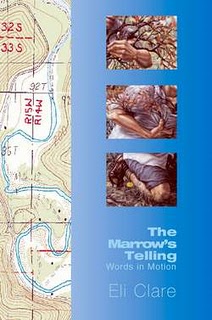
The Marrow’s Telling: Words in Motion 

By Eli Clare

By Jorge Antonio Vallejos

I remember when I first saw Eli Clare’s collection of poetry The Marrow’s Telling: Words in Motion.  I was checking out the poetry section at Toronto Women’s bookstore (one of only two women’s bookstores left in the stolen land called Canada).

Clare’s book stood in the middle of a shelf with its cover facing me: a painting of his thick, strong arms pushing aside branches as he walked through the bush; a map of his home taking up half the cover; and his very catchy title.

Many writers say they want to cut through to the bone of things.  Natalie Goldberg’s classic Writing Down The Bones teaches writers how to do so.  Clare goes past that.  He goes for the marrow.  As someone who has broken a few bones, Clare’s title got me, fast.

Published in 2007, The Marrow’s Telling is a collection of fifteen years worth of poetry.  The inside cover shows a listing of the many publications where Clare’s poems first appeared: nineteen publications in all; many being zines and activist magazines, others being queer anthologies, some being very respected literature journals such as the Michigan Review and Hanging Loose. There is also a lengthy acknowledgement section, a preface (not common in poetry collections but much appreciated by this writer), and a warning.

Clare cautions readers in his Author’s Note about seven of his poems that explore and illustrate “child sexual abuse, ritual abuse, and/or torture and include graphic, but not gratuitous, details.”  Clare tells his readers, “As such, they may contain triggers.  Please take as much care as you need.”  Not all poets are as thoughtful and considerate.  Not all poets write from experience.  Not all poets are as brave.

Before you begin the text, Clare asks his readers to digest his poems differently than they would other collections:

In the United States, too many of us have been

taught to fear or avoid poetry, to feel bored or

stupid in its presence.  As an activist poet, I

want this book to be a door held wide open.

Read it like a demonstration, a riot, a late

night spray-painting action.

Clare’s words are all three: demonstration, riot, and subversive paint imprinted on your psyche.

In Cleaning Dead Birds Clare brings you back to the days of his surviving sexual abuse at the hands of his father.  Growing up in the country, Clare partook in many different land based activities such and hunting, fishing, and berry picking.  A child to an abuser, Clare learned such skills from his father throughout years of abuse. 

Cleaning Dead Birds is about a child who at the same times feels anger toward his father while wanting to be at his side.  With a new marriage soon to happen, a new child entering his father’s life, Clare explores the relationship of abuse, the fear of a new child soon to be in danger around his father, and the jealousy of the new child possibly replacing him.

The girl soon to be his stepdaughter:

will she walk the logging roads

with him, learning the shape

of rocks and forest, books

and music, only to wear

his semen nearly

transparent against her body

as I once did.


Spend hours in the woodshop

watching as he sands and oils

bird’s eye maple, then together ,

cleaning dead birds.

Clare shows the power an abuser has over the abused, the building up of a person and then breaking them down.  The classic hook em in, gut em, and sow em back up; the time spent in making the survivor feel the need for their abuser; the false love; the broken relationship made to feel strong; the hate for an abuser that is accompanied by the want for them in the life of the abused.

Clare brings readers to the wedding, the relationship building between father and new daughter through laughter at the dinner table, the fear of birds soon to be cleaned, and the dying urge to tell his stepmother of what is to come. 

I warn my stepmother,

tell her the stories

he denies, pitting

memory against memory,

proof lodged in my body.

Earlier in the poem, Clare describes the birds being cleaned, the cooking of them, how they are a gift from his father’s students (showing that his father is a respected man in the community); sometimes biting down on the ammunition lodged in the dead birds, and later, his emotion around the possibility of a new child experiencing the same horrors he did for years.  Clare writes from memory, “Fear tastes like buckshot.”

In Last Refrain, found later in the collection, Clare continues his sharing of the sexual abuse he survived:

For years we’ll live,

my father and I,

python and prey.”

Like a true survivor, Clare not only writes of the abuse, he writes of overcoming it and thriving afterward.  Seven of the poems are graphic details of some of the worst things that can happen to a person.  Many of the poems are of celebration, strength, and solidarity.

No Longer Small and Lonely is a poem displaying all three.  A prose poem spanning four pages, Clare uses repetition, crisp descriptive sentences, and questions to keep his reader engaged.  It’s ending is the end of not only the poem but of the abuse itself:

The man I used to call father, let him tumble

forever.  I have stormed his bunker, picked the lock,

found my heart amidst the rubble, laughed him off

the edge of the world.

No longer small and lonely, I live among the

furious and joyful.  We dance, sing, drum, limp, roll,

walk, swish, howl, our way through the world. 

Clare, a white transgendered male with a disability, writes of survival as well as the life of a white man in a world that honours skin privilege, and at the same time vilifies trans people and people with disabilities.  The Marrow’s Telling is an exploration of a man who is privileged and not privileged at the same time.

In And Yet Clare demonstrates his walking in many different shoes:

Crip skin marked,

white skin not.

The two lines above are at once the taking back of a harmful word—cripple, now used as “crip”—and the acknowledgement of walking as a member of the dominant class, the most dominant of all, white men.

The activist poet, ally to Indigenous Peoples and people of colour, acknowledges his whiteness and challenges it in later poems.  Battle Rock is a tour of white celebration that masks real history.  Using the personal letter of colonizer Captain J. M. Kirkpatrick, Clare tells the real history of his home from the first landing of the white man, to the present day celebrations, of what was rape, theft, and murder in 1851. 

The poet writes of “white boys dressed as Indians” jumping around a fire; white men carrying loaded rifles and a cannon while re-enacting the “founding” of Port Orford; fire crackers joined by shouts of victory.       

He ends with:

every year

we dress ourselves

in mockery.

Clare does not look for pity or pedestals, he uses his experiences, many being horrific, others beautiful, to educate readers on the complexities of his life, and to show those who share those experiences that better days are possible, and there are better days to come.

Living with Cerebral Palsy, Clare takes readers into his daily life in Tremors. The constant shakes his body performs are written on the page.  He then shows the results of his uncontrolled movements:

Kids call cripple. Bank tellers stare silent.

Doctors predict arthritis.  Joints crack

in the vise grip: my hands want

to learn to swear.

Tremors takes you on the at times rocky road that is Clare’s daily life and then has you walking on a smooth plain at its end.  The activist poet brings you through the mud and cleanses you with images of desire and acceptance.  His shakes that wish to speak violence early in the poem, end with kind whispers of intimacy:

Late at night

as I trace the long curve of your body,

tremors touch skin, reach inside,

and I expect to be taunted, only to have you

rise beneath my hands, ask for more.

Some of Clare’s poem are long yet they don’t waste real estate.  Scars and Gawking, Gaping, Staring span several pages, the reader realizing this after they are finished reading.  This happens throughout Clare’s expository, memoir like collection.

Taking the advice of a friend, “Don’t write it pretty,” Clare throws hooks at, then hugs his reader, as he softly advises: 

By itself, story isn’t enough. We

need to tell, talk, translate the marrow.

Translate it as history, policy, fierceness,

rebellion, civil rights, a poem sung in

the streets.  Let the story be that kite,

wild blue of sky, tug and beckon,

dialogue and demand.

There is no overwriting in The Marrow’s Telling.  Living true to its title, Clare’s collection takes you deep with just enough air to breathe.  You read, re-read, contemplate, and give thanks for his words with no want to rise up from the depths of his inner bones of the page. 

Tune into Black Coffee Poet next Wednesday September 22, 2010 for an recent  interview with Eli Clare! 


Posted in Poetry | Tagged , , , , , , , , , , , , , , , , , , , , , , , , , , , , , , , , , , , , , , , | 1 Comment

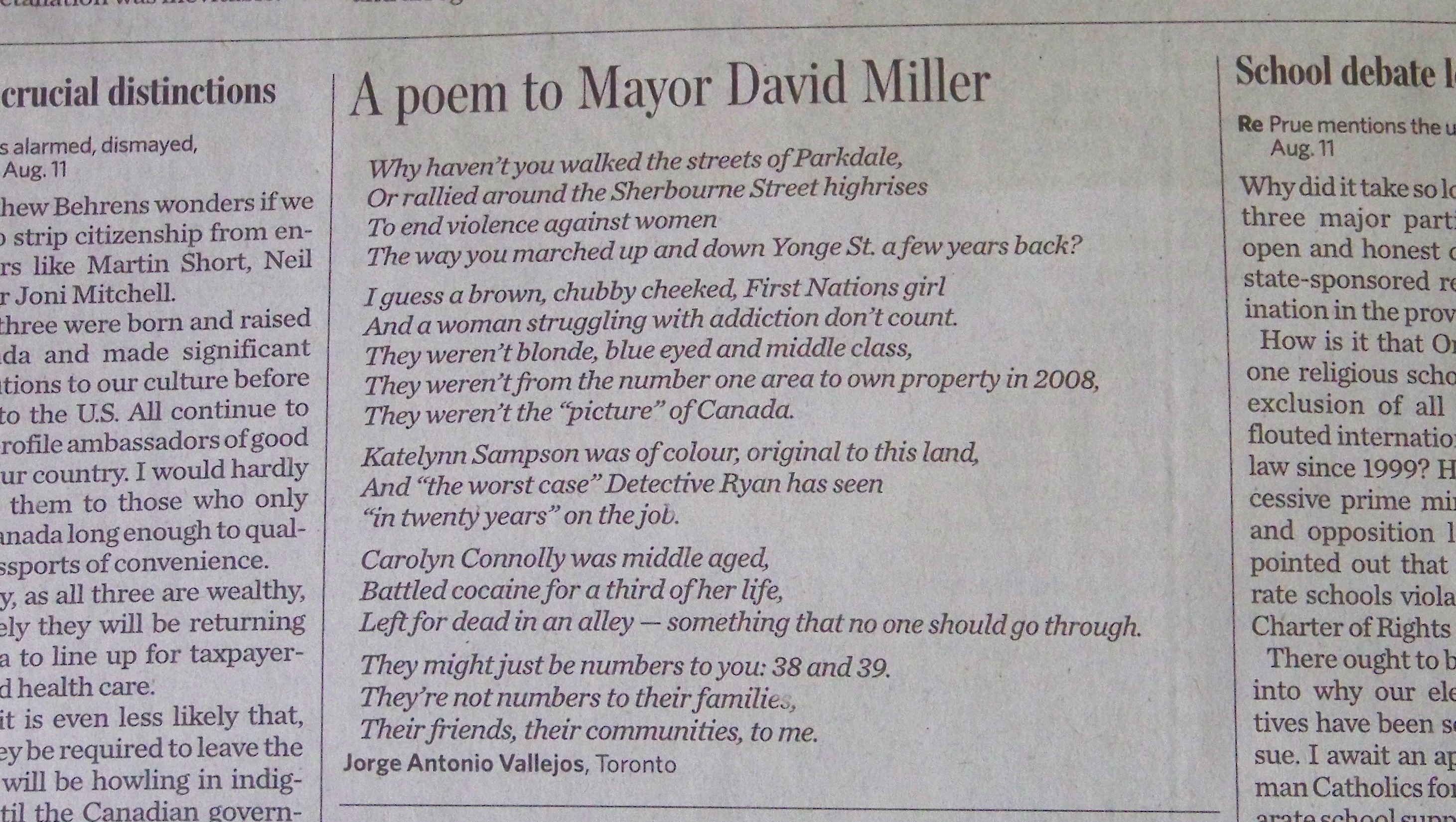
Over 500 Aboriginal Women Have Been Murdered Or Gone Missing In Canada: A Poem To Mayor David Miller

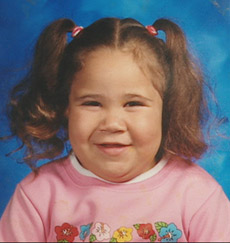
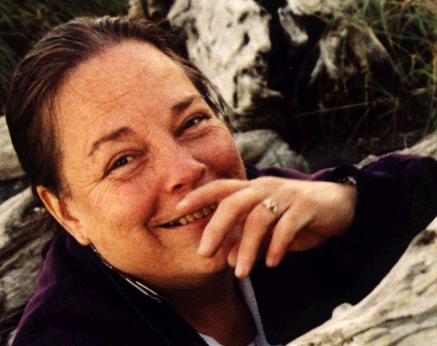
In the summer of 2008 Carolyn Connolly and Katelynn Sampson (pictured left), two Aboriginal women, were murdered days apart in two different neighbourhoods in Toronto.  Local newspapers reported the murders, but no real action from police and government was seen, and still hasn’t been seen.

As I read the news of the two murders in the same issue of the Toronto Star I remembered seeing David Miller on the news after Jane Creba was killed on Yonge St. in December  2005.  Miller walked up and down Yonge St. in front television cameras claiming to march against violence; really, he was there for votes, white votes.

The Jane Creba tragedy is not the only tragedy that has happened in Toronto.  Many women of colour go missing and are murdered without any media attention or care from society.  Over 500 Aboriginal women have been murdered and have gone missing in Canada in the last twenty years and most Canadians don’t know or care about this.   When a white woman is killed it’s a tragedy and the whole country mourns.

As a writer, my words are my activism.  I wrote a poem to Mayor David Miller and submitted it to the Toronto Star.  Two days later it was published in the Letter to the Editor section of the Toronto Star (August 13, 2008).

After the poem was published I was invited by local activist groups to read the poem outside of the coroner’s office in Toronto.  I was also invited to read at the first vigil for Carolyn Connolly at the site of her murder.  Since then I have read A Poem To Mayor David Miller at various activist events.  The video below is part of my YOUTUBE channel: Black Coffee Poet.  (The Friday portion of the Black Coffee Poet magazine is always a video of a poet reading their work.)  The video is of Black Coffee Poet reading at the rally to STOP VIOLENCE AGAINST ABORIGINAL WOMEN (2009) that happens every February 14th.  

The video is from 2009 and was shot and edited by Zoi de la Peña.

Posted in Poetry | Tagged , , , , , , , , , , , , , , , , | 9 Comments

INTERVIEW WITH CHRYSTOS

Menominee poet Chrystos is a warrior, writer, and arrow in the throat of colonization. Publishing five volumes of poetry, Chrystos is an important voice in the world of literature showing that Native Peoples and Peoples of colour can write, they write well, and they can’t stop from being read and heard.

Chyrstos’ poetry is described by Gloria Anzaldua as, “Her words slide into our throats, feed the hungry soul, fill the lost and homeless heart.  Her voice binds into wholeness our severed selves with self-esteem. It calls away from the death of invisibility, insists that we be seen and accounted to, no longer banished, no longer vanishing.  She leaves her howl inside us.”

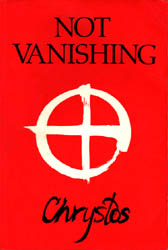
Chrystos’ first collection of poetry, NOT VANISHING, published in 1988, became the highest selling book of poetry in Amerika at the time.  No longer in publication, you can read a review of NOT VANISHING.

Read a recent interview between Black Coffee Poet and Chrystos (September 12, 2010) below.

BCP: Why poetry?  How did you start writing?  What is your process?

CHRYSTOS: My father taught me to read (otherwise, I might still be illiterate) and he had a rich, diverse library which I had complete access to – books floor to ceiling in the hallways. He was self- educated; with only a night school high school degree (I am also self-educated). I was not very well liked by other children (& I thought they were too violent and dumb), so I grew up with my father’s books, many of which were poetry.

I read Plato (though I don’t think I understood him as a child) and Shakespeare. Poetry seemed to be easier than a play or a novel or philosophy. I thought, “Hey I can do this!” I was nine, an age when the stars are closer. My first poems all concerned the virgin Mary (I was razed catholic- not a spelling error), in rhyming couplets. I thought I wanted to grow up to be a nun. I wrote in secret, in bed, by the street lamp. I created a world in my journals (alas, all destroyed by my mother when I was 18) where I could exist, no matter what insanity was flailing about in the exterior world.

Poetry, writing a journal and drawing are still my closest friends. I am not so graceful with actual humans, who betray, can’t comprehend, and are attached to colonizer thought and so on. I would admit that I’m addicted to blank paper, (particularly Belgium rag, which is hard to find).

A long time ago, I had to try to write (high school).  But since my 20’s, when I saw the need to address social justice issues in words, my work just “pops out “. A newspaper story, an incident from my life, a book, a song, a garden snake, a sad face I see- I have no idea, actually, how these become poems. A line begins in my mind and won’t leave me alone. I’ve learned to sit and write it down and the rest just flows. I’ve never edited very much-a few words here and there. Generally, I read a new piece to several audiences before I publish it, and I’m grateful to them for their assistance in the editing process.

My forte` is in the oral realm, although I usually play with puns, clichés, double meanings and so on when I type a piece up (I write in longhand). I don’t use a computer because, by now, the link between my writing hand and my mind is seamless. I usually write 2 or 3 poems a week. Some I mail out to friends.

I have not been a part of the publishing industry for some time, because, as my friend, Anne Cameron jokes, “All publishers are pimps”. As a former whore, I’ll comment that no john ever gave me as much trouble as most printing presses. “Editing” is frequently censorship. Ghastly contracts are common. There is, in my experience, very little support for writers. This reminds me of being a single mother supporting three children with no family help.

In order to write, the most important task is to quiet your little mind, to allow the universal to enter and be welcome.

BCP: How long were you putting together the collection that became Not Vanishing?

CHRYSTOS: I was ignored by feminist presses in the usa for many years, about 10, I think. I dragged around to thousands of free readings. Not Vanishing was published by a Canadian press, which embraced (naturally) my hostility to the usa government. I actually put the collection together, all over my living room/dining room floors in about 2 weekends (I worked during the week). The writing of those poems spanned 12-15 years. As an aside for unpublished writers, I was only published to quell the complaints of Canadian women of color (the press until that time had an “all white” list), which I didn’t find out about until much later (&felt badly). The same problem happened with Fugitive Colors which was supposed to be for unpublished writers, but the call flyer didn’t say so.

BCP: Sadly, many of your poems still hold true today.  There Is A Man Without Fingerprints, In The Brothel Called America, and Dear Mr. President are some of your poems that I read over and over.  Violence against women is still a huge problem (has been since invasion); drugs are still the commodity that brings much suffering but does not suffer in an economic depression; and every world leader has to be sent Dear Mr. President.  It’s been twenty-two years since Not Vanishing was published, what do you think of all this?

CHRYSTOS: I had to laugh, because I didn’t realize Not Vanishing was 22 years old (& out of print, sadly). Seems like yesterday. I suppose if I had known that I couldn’t change a thing in the material world of trouble, I would not have bothered to publish. My hope then (& still is) to touch hearts and make change. I feel I have become an icon, whose words are used and not cited, as has happened to many writers of my time. As I said, I’m very uninterested in the publishing world, though I write more now than ever.

Speaking from a stage above a silent audience, is a very colonizer concept, which makes me increasingly uncomfortable. The part of this that does intrigue me is that most of my enthusiastic fans are much younger than myself. My comrades in arms have all died, which is an excruciatingly lonely tiny bit of sand on which to stand.

I don’t know what to think. I’m deeply sad that students are not taught history or herstory or critical thinking or logic. I was very blessed to have an intellectual father who asked me what I thought about what I learned in school.

BCP: How can we make the number of men who are allies to women grow?

CHRYSTOS: We cannot make any group of people do anything. Alas, alas. Otherwise, there would be no despicable posters of President Obama in a Hitler mustache, which is an insult to so many people and such an appalling rewrite of history that I can barely keep my head from spinning around and spitting green vomit. (I didn’t see this movie, The Exorcist, but everyone else has told me about it). He would have been one of Hitler’s first victims in the ovens which Mercedes Benz built.

Men are tortured by colonizers in different ways than women and that is why our society is so violent. I would love to see men mentoring young boys as happened in tribal society. I’m not sure we can re-humanize men of color (who have been used as “sitting ducks”), just as I don’t know if we can turn climate change around.

I suppose I continue to work toward a less abusive society anyway, even though my assessment is that almost everyone prefers some sort of dominance game. We women are the ones who raise our sons, a thought which haunts me. While peer pressure contributes to male violence, what can be our role to change these addictions?  I need to clarify that I don’t think euro-immigrant men can be re-humanized, as they don’t know how to avoid playing the master.

BCP: What advice do you have for men who are walking the path of being allies to women?

CHRYSTOS: Where are they?! (an Indian joke) I suppose reading women writers who are revolutionaries is a good beginning. Give a poor poet your car so she doesn’t have to walk with bags of groceries or laundry (another joke). Men are generally deficient in the art of listening (as they’ve been brainwashed into the John Wayne action role), of stepping back, of not having to be in charge, of caretaking themselves. The men I admire most work in an organization called “Men Against Rape”.

If rape ended, we would be in a different world.

BCP: Earlier this year I attended a Women’s Studies class at a local university that focused on Gender and Violence.  There was a huge divide between the white women and the women of colour that yelled your poem Maybe We Shouldn’t Meet If There Are No Third World Women Here.  The white women took up too much space, would not acknowledge their privilege, and would not listen to the women of colour pointing all this out.  I’ve been told this is a common occurrence in Women’s Studies classes and activist circles in North America.

It seems that in terms of white feminists interacting with feminist/womanist/progressive women of colour nothing has changed since before Sojourner Truth spoke in 1851, and since Not Vanishing was published in 1988.  That’s over160 years of the same problem.  Can things change?  If so, how?

CHRYSTOS: White supremacy has beams of support in every aspect of the media, academia, the government, laws, and social interaction. When a person perceives themselves as a victim (as I once did), they are very unlikely to see how they victimize others. My perception comes from my friend, Carmen Lane, that is, most  euro-immigrant women are in a fight with white daddy to have more privilege.

My interest has always been a concern for a worldwide end to all oppression, violence, hunger and land theft. Therefore, my political work has ranged over a very diverse area: Palestinian rights, abortion (a non-issue for most lesbians), wife battering, and prisoner issues and so on, which are of no “immediate benefit” to me.

I have no power to change white supremacy, more accurately, colonizer violence.  Only those who benefit from it have the power to change it.

I don’t do any anti-racist work anymore–seems a waste of time.

The majority of my efforts now are for Indigenous people (which I consider Palestinians) and prisoners. I think we’ve had the “same problem” for much longer than 160 years— going in back in history one finds continual violence in British suppression of Scots and Irish, Roman invasions, Alexander the Great, the current French attempt to expel Roma people, etc.

I believe there is a poison, similar to ergot in wheat (which probably caused the Spanish Inquisition, Salem witch trials, etc) which causes people to hate, to desire dominance, to insist they alone are right. Maybe it is an inherited mental or social disease. This is an Indian Joke (i.e., true & not really funny, but couched as humor so as to save my life). Everything is always changing—if we could learn to be horses running together in a herd we’d be better off. Still, the problem of that dominant stallion; I don’t suppose neutering would be a popular solution.

BCP: Can you please explain your amazing and very necessary connection of Mestiza (Indigenous and Spanish) women to Native American women?

CHRYSTOS: Much of what I say & write comes from my learning from others. I’m not sure who exactly first touched me with this issue, but I think this was my friend Josie, child of migrant workers, who was deported when I was 8. We were very close, as neglected children often are, and I’ve never recovered from the loss of her, or known how to find her. I had already had previous run-ins (at 7) with the “law” & “injustice”.

Gloria Anzaldua` & I had many intense conversations about this issue (her family were also “migrant” workers) and I would say my understanding (which is limited, I feel, by my inability to speak Spanish) is due to her wisdom.

BCP: Women like you, Gloria Anzaldua, and Audre Lorde broke amazing ground.  What new writers do you see doing the same today?

CHRYSTOS: Sadly, I am so out of touch with the writing world that I don’t know who is new. For the last five years, most of my reading has been an exhaustive education in foreign writers, particularly those of Africa, Japan, South America & Britain. I don’t mean to sound ageist, but many young people are not educated enough to attract me. By this, I mean they don’t know very much about what has occurred in my lifetime and who their ancestors & elders are. They believe they are “new”. I was fortunate, because of my Father’s library, to understand I was just the next warrior in line.

I apologize for my ignorance of new writers. This is partially because of my very negative experiences with slam poetry, which is more about ego than craft, at least, that which I was a part of—very briefly.

I’m 63 & I’m sure I seemed like an old grandma. I can’t help it if I don’t agree that “fuck” or ‘whore” or “bitch” repeated 15 times is a piece is poetry. I’ll make a lot of enemies with that statement. My attitude stems from years of hard work to decolonize my mind and educate myself, with no reward in terms of degree or employment. I fight bitterness and consistently lose.

BCP: Do you have a new collection coming out?

CHRYSTOS: I have no publisher. The work I am doing now is so transgressive (of conventional ideas of poetry, “seemliness”, subject matter) that I’m very unlikely to find one, especially in this political climate of neo- white- supremacy. My lover has gotten computer gear together to self publish, but so far, I’m not ready. I have been so frequently misinterpreted by white critics, so often not behaved like a nice compliant author, that I haven’t decided what I want to do.

BCP: What advice do you have for new writers who write about important and pressing issues and topics like the ones you write about?

CHRYSTOS: We live in an extremely abusive & repressive society, which constantly assaults us with garbage in the media. To be a great writer you have to turn off the television, the rap music (which, by the way, was a format taken from women’s Caribbean dub), the telephone & all your relatives’ voices in your head. The place to begin is silence, so you can hear your soul speak in (her) unique voice.

Write about what moves you out of the zombie space colonization would prefer you remain in. Use all 7 senses (the usual 5 plus: humor & psychic). Find an editor who loves your work, rather than is jealous of it. Study craft (grammar books, Babette Deutsch, thesauruses, other writers you admire).

Read your work publicly, as an audience will teach you what is boring, scary, unnecessary & so on.  Find an isolated bathroom (parks can be good), with tile walls above shoulder height in which to practice. Old gun bunkers also work –whatever will echo your voice to you. Use an old fashioned tape recorder to listen to yourself. Get a friend to video you.

Educate yourself about your people’s history, language, ancestors & how your particular version of colonization occurred.

Don’t sign any contract without advice from someone who knows the biz. Demand cover control.

Never give up honing your knife. Maintain good ethics & boundaries. And, pray for a clear voice to help others.

BCP: Thank you!

CHRYSTOS: Meegwetch.

Share and Tweet this page; Comment below; and SUBSCRIBE to blackcoffeepoet.com and the Black Coffee Poet YOUTUBE Channel. To DONATE visit my CONTACT Page. Follow me on Twitter @BlackCoffeePoet, and friend Black Coffee Poet on Face Book.

Tune in to BlackCoffeePoet.com  this Friday for a video of BCP reading poetry at the rally to STOP the violence against Native women in the stolen land called Canada, February 14, 2009.   

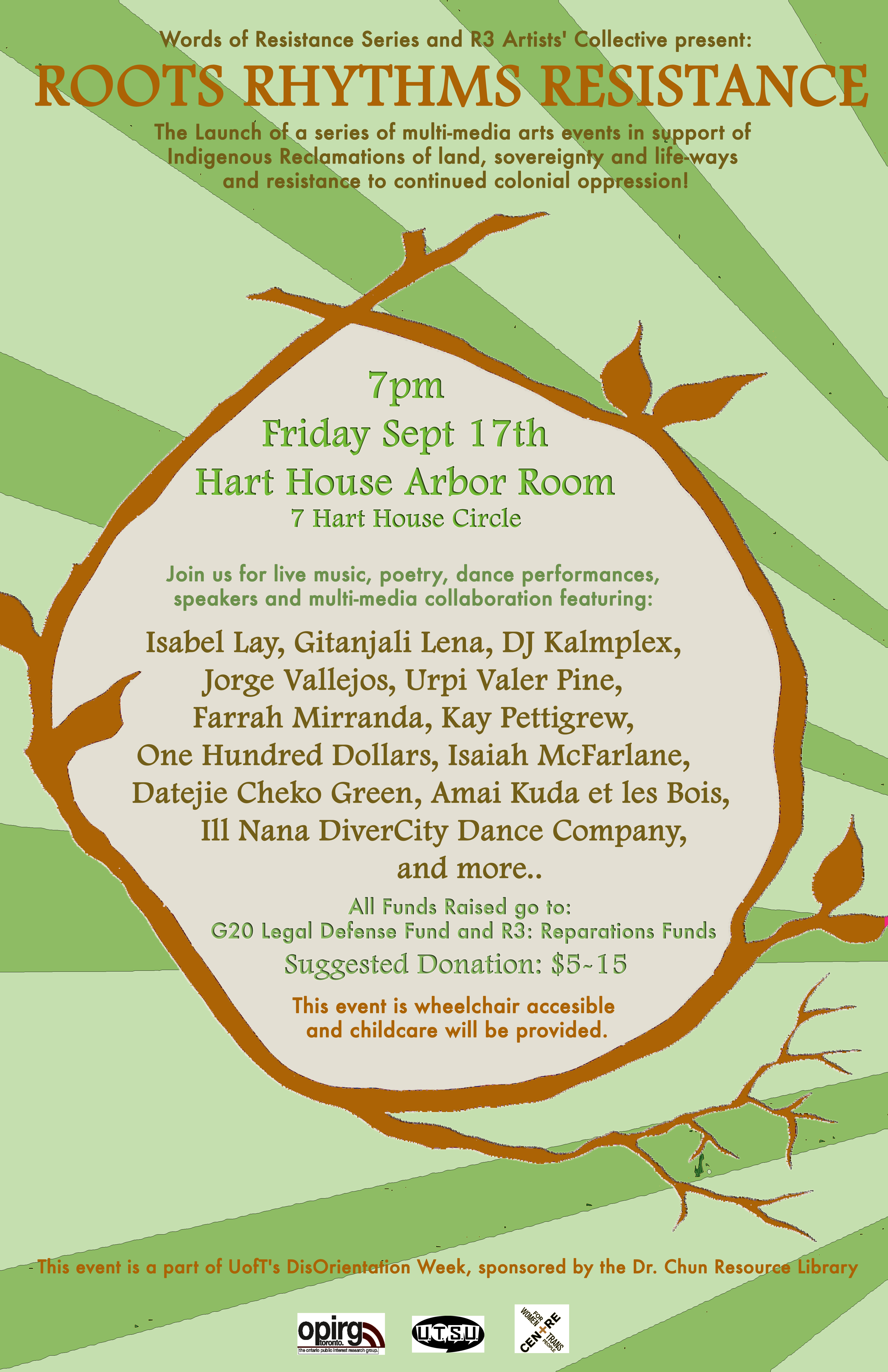
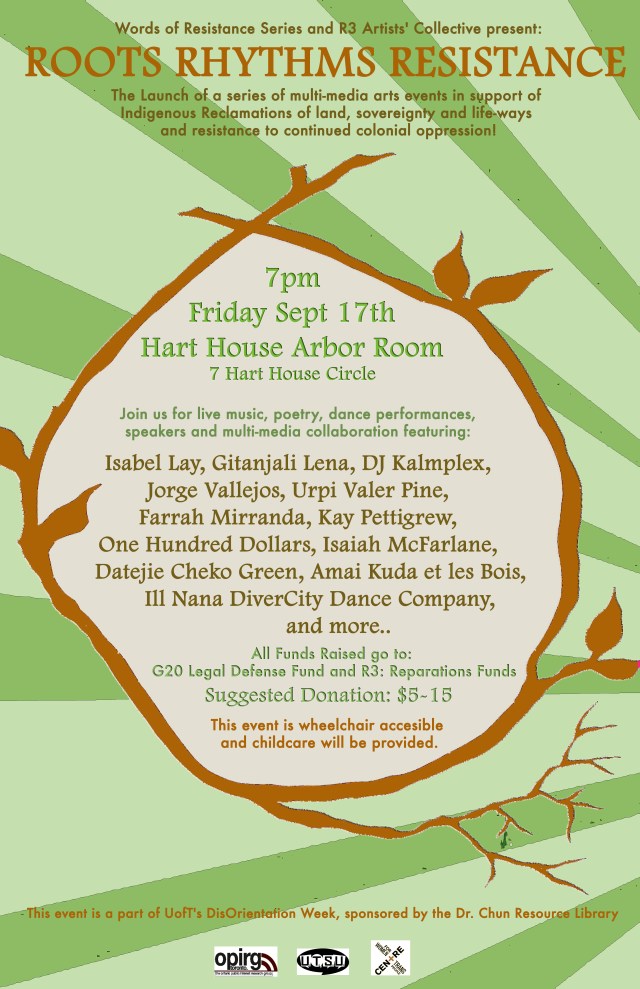
To see Black Coffee Poet read live come to the Hart House Arbor Room, Friday September 17, 2010 at 7 Hart House Circle on University of Toronto campus:

Posted in Poetry | Tagged , , , , , , , , , , , , , , , , | 13 Comments

NOT VANISHING

Not Vanishing by Chrystos

Reviewed By Jorge Antonio Vallejos

I first read about Chrystos in REDWIRE Magazine.  She was listed as one of the top ten Indigenous writers you have to read as an Indigenous person.  I remember the photo of  the cover striking me: a red background with a white medicine wheel and the words NOT VANISHING written above in black with her name written in black below.

Book covers are what attract readers.   Good titles do the same.  Chrystos had both in her first collection of poetry.  And what followed inside matched its outer form.

If it were not for Chrystos I doubt I’d be a poet.  Reading dead white men in school bored me.  Not understanding old English was frustrating.  The content in English lit anthologies had no relation to me.  I found myself many a time saying, “I hate poetry!”

“Find writing that speaks to you,” is what one of my mentors, Daniel Heath Justice, advised me on several occasions.

After reading about Chrystos in REDWIRE I literally found her: not in a used bookstore; not in an activist space; not even at Toronto Women’s Bookstore.  I found Chrystos at the First Nations House library years after visiting the space daily during university.

After seeing her book on the shelf, holding it for a while, looking at the cover, and reading some of the poems, I ran home to my stack of REDWIRE mags.  I looked for the list, mainly looking for Chrystos and her awesome cover, and there she was!  It all started from there.

Not Vanishing, my version of the Red Book, is autobiographical, challenging, confrontational, educational, sad, has poems in translation (Spanish to English), and leaves images with you, for life.

Stoh:lo writer Lee Maracle has often said to me, “Poetry is song”.  I’ve been taught by different Elders that song comes from Creator.  Chrystos sings sad songs, protest songs, songs of hope and rage, songs for change, songs that echo, songs of survival, songs that follow your heartbeat.

Chrystos’ poem In The Brothel Called America is a story, a song, a prayer.  To use her own words found in the poem, Chrystos “takes us on a journey of defeat”.  Descriptions of spoons used to heat up heroin, arms full of bruises and scars, the image of hitting what addicts call “rock bottom” are written in the poem/prayer.

“Pray for her” says Chrystos to her reader.  “Let our voices lead her to another way.”

Almost midway through the collection, In The Brothel Called America is about many women, not one.  After reading the critical and dark poems that precede it, you know Chrystos writes of her life and the lives of her many sisters of colour: red, black, brown, queer, poor, third world, isolated, dead, forgotten.

America and its false dream are exposed throughout Not Vanishing.  The brothel, still open today, is in need of a prayer just as much as it did twenty-two years ago when Not Vanishing was first published in 1988.

Chrystos uses clever word play to inform her reader of who she is critiquing.  Her prayer for her sister(s) is genuine and not found on faultfinding.  Although showing us her sister’s addiction and the lies that go with such a life, the Menominee poet uses biblical reference while practicing the empathy found in her spirituality: “No judgment in this lake of fire.”

Chrystos ends her poem/song/prayer by showing us some of her spiritual belief:

Stars give her strength

Sun turn her eyes

Moon guide her feet

Earth turning hold her

We pray for her

We sing for her

We drum for her

We pray

Most of Chrystos’ work points out the negativity that exists in our world.  Her poems look past first appearances.  Her words don’t just go to the root of a problem, they dig them out, hack them to pieces, separate them for dissection, and then display them on the page.

My Baby Brother and Vision : Bundle are placed beside one another in the collection (pgs 20 and 21).  Whether this is done purposely or not, the two poems compliment one another.  Again exploring the life of an addict, Chrystos writes of her brother’s riding the white horse—heroine—“my rent went up his arm…kills the pain of a white fence world        hard walls world   eat or be eaten world…his arms a map of war”.

The war Chrystos writes of is what the cover of her book tells: her people, Indigenous peoples, are not vanishing despite the continued attempts of colonial governments to erase them.  Vision : Bundle describes the taking away of language, killing of Mother Earth, and the perception of Native peoples by the world: “they say we are vanishing”.

“They have our bundles split open in museums

our dresses and shirts at auctions

our languages on tape

our stories in locked rare book libraries

our dances on film”

I Walk In The History Of My People follows the same theme.  Chrystos describes the aftermath of invasion that her peoples endure daily; yesterday, today, hopefully not tomorrow:

“In my marrow are hungry faces

who live on land that whites don’t want.”

The poem is short but uses the techniques seen throughout the collection: tabs (spacing) instead of commas; repetition; and clever play with words.

Chrystos writes “My knee is so badly wounded no one will look at it

The pus of the past oozes from every pore

This infection has gone on for at least 300 years”

The poet is referring to The Wounded Knee Massacre that happened 300 years ago.  The pus, the infection, are the after effects of genocide, colonization, the reservation system, the poverty seen through much of Indian Country.  Pine Ridge Reservation is still the poorest place in Amerika today.

“Anger is my crutch      I hold myself upright with it

My knee is wounded

See

How I Am Still Walking”

There is anger in Chrystos’ poetry.  Can you blame her?  Often, the anger in Chrystos’ writing is talked of in black and white terms.  Yes, Chrystos is bitter and angry.  At the same time, not all anger is corrosive.  There is a productive anger that people forget about.  Productive anger has seen people of colour fight and win for their right to sit at the front of the bus; end the residential school system in the stolen land called Canada; and forced restaurants to remove such signs as “No Mexicans Allowed” throughout the U.S.

Chrystos writes, and holds herself up with, different forms of anger in different situations.  Corrosive anger blinds people from thinking and acting rationally.  The poetic technique displayed in Not Vanishing shows a writer who thinks clearly before expressing herself; outbursts of ‘hysteria’ (a favorite word used by misogynists and racists) are not seen in Chrystos’ collection.

There is also bravery displayed in Not Vanishing that you don’t see in conventional poetry.  Bitter Teeth shows us years of sexual abuse.  As is common, a relative, in this case an uncle, abused Chrystos.  There are graphic scenes written accompanied by honest, understandable, sentiments.

“Each kiss taken…looking at too many ceilings  not enough air               I ache

for your funeral         Only place safe to see you again

I’ll spit in your face for once.”

Chrystos’ bravery also extends outwardly through her challenging of white feminists, police, and the President.

Maybe We Shouldn’t Meet If There Are No Third World Women Here takes the reader to a place all too common in activist circles and Women’s Studies classes: white people excluding people of colour, in this case, white women excluding women of colour.  This has been a problematic practice that has continued since before Sojourner Truth challenged white women in 1851, since bell hooks wrote Aint I A Woman, and since “Not Vanishing” was published.

Chrystos calls out white women on their racism: “How can you miss our brown and golden in this sea of pink     We are not as many of you

But we’re here              You’re the ones who called a community meeting & didn’t contact the Black Lesbians or G.A.L.A or Gay American Indians or the Disabled Women’s Coalition”.

Later in the poem Chrystos asks a question related to how people of colour and people with disabilities are often looked at many times in society.  It’s a reference to that stare you get when walking in a public place that has few, if any, people who look like you.  “Do you think we are martians” [?] asks Chrystos.

Toward the end of the poem Chrystos uses repetition like a four punch combo:

“Don’t look at me with guilt                   Don’t apologize            Don’t struggle

with the problem of racism like algebra            Don’t write a paper on it for me to read”.

In There Is A Man Without Fingerprints, a poem about a serial killer targeting women, Chrystos points out one of the many hidden practices of police.  “The police    who don’t like to be called pigs       are keeping him under wraps.”  Chrystos shows you who, where, when, and how the killer kills, and why he is able to do so.  She doesn’t mask what happens by using terms like sexual assault; she names what happens, “tortures        rapes                murders”, and describes scenes before, during, and after the crimes.

With such truth in what she writes, Chrystos states:

“This in not a poem       it’s a newspaper           a warning written quickly”.

Dear Mr. President is a must read.  Written thirty years ago, the problems shown in the poem sadly persist today.  The poem should be sent to every world leader.

“Hey Mr. Prez              My boyfriend was beating me and the kids so bad

I just had to get out before one of us was killed

The battered women’s is full & so is emergency housing

The worker said she’d already turned away 378 this month

We’re living in my car & cooking at my mothers studio apartment

In the old peoples housing         This is an emergency”.

There is an emergency in our world.  Twenty-two years ago Chrystos wrote about racism, genocide, violence against women, poverty, and homophobia.  Much has changed, but how much?  How much more needs to change?  Native Americans are still the poorest population in North America; the hunting of Mexicans is now law; rape is an accepted part of our culture; banks are bailed out while children starve and lose their homes.

We need poets like Chrystos who venture into the dark, bring it light, and show readers what is really happening in our homes, on our streets, in our world.

Poetry, often ignored, is seen as something of the past.  It is not published or taught enough, and the poets who are taught and published are of the dominant class.

Poetry is also in a state of emergency.

Chrystos might not have come out with a book in a few years.  She might not be, and probably never will be, taught in ENG 100.  She might even be off the ‘activist’ and ‘Native ally’ radar.  But she still lives up to the name of her first and always important book: she’s Not Vanishing.  Never was, never has, never will.

Share and Tweet this page; Comment below; and SUBSCRIBE to blackcoffeepoet.com and the Black Coffee Poet YOUTUBE Channel. To DONATE visit my CONTACT Page. Follow me on Twitter @BlackCoffeePoet, and friend Black Coffee Poet on Face Book.

Tune in to Black Coffee Poet Wednesday September 15, 2010  fresh (four day old)  inclusive interview with Chrystos. 


Posted in Poetry | Tagged , , , , , , , , , , , , , , , , , , , , , , , , , , , , , , , , , , , , , , , , , , , , , , , , , , , , , , , , , , , , , , , , , , , , , , , , , , , , , , , , , , , , , , , , , , , , , , , , , , , , , , , , , , , , , , , , , , , , , , , , , , , , , , , , , , , , , , , , , , , , , , , , , , , | 7 Comments