We all long for something: community, conversation, sex, love, friendship, and many other things. Most people do not express what they long for. Artists tend to be the bold of society who want to be heard and will tell anyone who will listen what is on their minds and in their hearts.
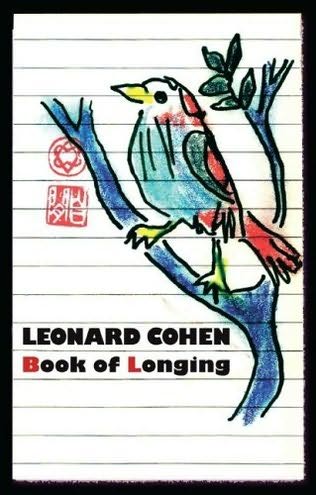
Leonard Cohen, one of Canada’s most famous singer-songwriters, is one of those bold artists who are talented enough to express themselves on the mic and on the page. And he doesn’t hold back. Although you are reading Cohen in his Book of Longing you can hear him too, and much of his poems are contemplative and about pain.
Many male artists sing and write of loves lost. Cohen is no different. There are many poems dedicated to the women of his past: Sahara, Sandy, Shirley, and Claire. But there is one poem dedicated to the most important woman in Cohen’s life—his mom.
You never find out Cohen’s mother’s name. He introduces her to the reader via descriptions of shared moments in the past, and through the emotion that is the title of his book.
In Who Do You Really Remember Cohen reveals that his mother died when he was forty-six. To most, that is not only normal, it is a good amount of time to spend with your mother. To Cohen it was nowhere near enough. You can see this in My Mother Is Not Dead. “My mother isn’t really dead” is the first line. He writes of fathers and relatives and goes back to his mother:
“Mother, mother,
I don’t have to miss you anymore.”
Cohen is fooling himself on the page. It’s a coping mechanism he does to make himself feel better. Other pages are filled with memories and the acceptance that his mother is gone.
In my My Mother Asleep Cohen takes you to a theatre in Athens where his mom fell asleep during a performance. Mandolins and great harmonies entertain an audience in an open-air theatre where the show started a midnight. Written thirty years after it happened, Cohen writes of being young and not having kids yet. You can feel his pain at the poems end:
“I didn’t know how far away
your love could be
I didn’t know
how tired you could get.”
It could be the absence of his mother that has Cohen fall in love and lust with so many women. His biggest fans admit that Cohen has a large ego and that he is a womanizer. Both could be attempts to fill the emptiness he has for his now gone mother. The title I Miss My Mother leads the reader to believe so. The loneliness written of on many pages is evidence of this as well. Cohen does not hide his loneliness, ego, or his womanizing; he writes cleverly about all three.
In The Remote, a five-line poem, Cohen writes in a minimalist style. The titles object is a metaphor for the loneliness that is the focus of the verse. Sitting in a room, T.V on, remote at his side, Cohen longs for a woman. Is it his mother? Is it a lover? Is it a daughter?
His mouth is “open” in the poem. Does anguish leave Cohen gasping for air? Is he yelling to himself, to Creator, to the woman? Is there a gun present? Is the poem about suicide?
“I think about you
when I’m lying alone in
my room with my mouth
open and the remote
lost somewhere in the bed”.
Cohen is entertaining and he leaves you with questions. A good writer does both. And Cohen knows he is a good writer. The problem is that he tells you he is:
“better than poetry
is my poetry”
With so much talent, and him showing you how talented he is, there is no need to tell the reader about his talent.
Cohen’s poems about love are erotic, emotional, and clever. Lines like “her nipples rose like bread” are accompanied by the writer’s art that compliment his words. Such artwork is seen throughout the collection giving the reader a break from words taking him/her somewhere other than the page.
Similar to The Remote, many Cohen’s poems have you guessing who he is writing of:
“Beloved, I’m yours
As I’ve always been
From marrow to pore
From longing to skin”
The Book of Longing is rhythmic, circular, and takes the reader on a ride from the past to present and back again. Cohen writes short poems, long poems, and prose poems that use detailed description. The poet rhymes a lot but never tires the reader. Poetry is song and song is poetry, Cohen shows this throughout; his music has influenced his writing and vice versa.
What is appreciated in Cohen’s collection is his honesty:
“I don’t want to be a friend to everyone
I haven’t got that much time.”
With dedications to great poets like Frederica Garcial Lorca, advice on keeping a diary, warnings of controlling ones anger—“don’t waste it in riots”—and his own philosophy (“life is a drug that stops working”), Book of Longing is a great read.
All good writers are good readers and Cohen shows why he is the writer he is and how Book of Longing and his previous collections came to be:
“Books lie open all around me
Despite my efforts
They keep coming into my room.”
Tune in to Black Coffee Poet Wednesday March 2, 2011 for an interview with Toronto poet Jenny Sheppard.
Dub poet Lillian Allen continues to define the form and explore its leading innovative edge. She has performed her work in many major venues in North America taking poetry to larger and larger audiences. She has produced Juno award winning recordings, critical acclaimed publications, and she has performed her work for television, film, radio, and print media across the world. Lillian is also a professor of creative writing at the Ontario College of Art and Design, inspiring students to claim space for their dreams in the world and to use their creativity to make revolution.
BCP: Why poetry?
LA: You ask why poetry? To that I would say, why not poetry?
Poetry is the deprogramming faculty we have as humans that they would like us to believe is, or should be the purview of only a few. With poetry we can create our own textures and our own picture of life, we can create community, name the nameless and put out a point of view, a way of seeing that says we are unique and we can think for ourselves.
Poetry is the answer to the roll call those in control have forgotten to do.
Poetry is the “present” to this imaginary roll call.
BCP: How did you come up with Dub Poetry? Can you please define Dub Poetry for BlackCoffeePoet.com readers?
LA: I was doing what I was doing from I was a little child, later when I did formal English Literature and learned about poetry in the Euro tradition, I love it! It seemed to me that poetry was already everywhere in my community.
In church, the preacher, my Grandma, my friends, the guys on the corner, even the sports commentators. I remember how joyed and elated my parents and their friends were when a certain radio commentator made a particular vivid commentary, filled with metaphors and simile. They would talk about the beauty of his verbal chops for days on end. I was inspired.
Later when I started to write my own poetry and listen to High School poetry, I yearned to make it my own, to put some of my culture and everyday language into it. The late great Jamaican Louise Bennett paved the way with her witty, intellectually flawless down to earth poetry in the Jamaican language. Bob Marley building on Miss Lou work emphasized the musical elements and did his thing. But it was the fabulous Oku Onoura who burst out on the scene and gave what himself and a number of compatriots were doing at the time, the name ‘dub poetry’. So when I met up with Oku, I saw that we were doing very similar things, so I figured that I was part of a movement, so I called myself a dub poet. From then on I set out to consciously develop both the form and the movement.
BCP: What is your creative process?
LA: My creative process has a lot of incubation; I like to think about things for a long time. I love warm round sound, and the sound of meaning. I like to write the kind of poetry I would love to hear. The musicality, the rhythms, pre language nuances and post language impulses. I go for creating a full experience.
BCP: Was it hard finding a publisher for your controversial book Psychic Unrest?
LA: Jill Battson invited me to publish with Insomniac Press, in Toronto. I gathered up a few pages, then spent a few weeks working to refine and finalize on the page.
BCP: In your video performance piece for BlackCofeePoet.com (to be posted Friday February 25, 2011) you sang a lot of African based notes and rhythms. How much does your spirituality and ancestry play a part in your writing and performances?
LA: My spirituality and ancestry is core to my writing. It is a site where all these things get connected, my special ‘cathedral’, so to speak.
BCP: Do you see poetry as a form of prayer?
LA: My poetry is definitely a form of prayer and ritual and communion.
BCP: As a woman of colour was it a difficult road for you in the poetry scene?
LA: I identify as a feminist woman.
BCP: The poetry you have shared with me is history based and focuses on dismantling colonialism. Is a lot of your poetry like that?
LA: A lot of my poetry focuses on opening up possibilities, to counter the veneer of the ‘God given norm’ and empowering ideas and people to assert and fight for what is just.
BCP: What does Black History Month mean to you? What changes would you like to see happen for future Black History Months?
LA: Decolonizing our minds, and fighting those structures and systemic social relationships that justify and keep oppression in place. We have to fight oppression in all its forms, not just colonialism.
BCP: What are you working on now?
LA: I’m just getting ready to make the old recordings available to the public. I am planning on doing some recording this year and am writing all the time.
BCP: What advice do you have for other writers out there who are having difficulties with their writing, or who have yet to see their work in print, or who are afraid to perform their poetry?
LA: For young writers who want to, and are afraid to, perform, I say practice and attend readings, network, do open mics, join up with a group of writers, take a course, whatever you can do to get going; and many writers today self publish their own work.
Tune in to Black Coffee Poet Friday February 25, 2011 for a video of Lillian Allen performing Dub Poetry.
All the great poets learned from those who came before them. Many young and aspiring poets have Walt Whitman sired. Willam Butler Yeats has influenced many. And Sylvia Plath is looked up to by young white feminists.
But who do poets of colour look to?
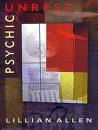
A good start is two time Juno Award winner, Lillian Allen, the Queen and originator of Dub Poetry. Naming her third collection of poems Psychic Unrest after a quote by Mesitza poet and academic Gloria Anzaldua, you see that Allen had contemporaries to look toward and listen to:
“Living in a state of psychic unrest, in a Borderland, is what makes poets write and artists create…”
Aptly named, you read through Allen’s collection the unrest that is a result of living in a society that has so many wrongs. Allen is one voice of many who sees change as a need and not a want. And the Jamaican poet does not hold back. Psychic Unrest has poems challenging racism, violence against women, and apartheid.
Before taking her readers on a social justice journey, Allen first defines what a poem is. Like Audre Lorde who boldly challenged the literature elite by saying, “Poetry is not a luxury,” in her essay with the same title, Allen shares with readers her beliefs on what a poem is in The Poetry of Things:
“Poetry is that dialogue between the world inside of us and the world outside…Poetry brings into focus the sharpness of one’s mind’s eye”.
Allen goes further by defining who and what the work of a poet is:
“The work of the poet is that of midwife and birthmother.”
Allen backs her statement by giving life to images, harsh realities, and positive dreams on the one hundred and two pages that fly by as you read them.
Published in 1999, Psychic Unrest is somewhat a book of recent history. Poems about the Oklahoma Bombing, the O.J Simpson trial, and South African Apartheid are seen.
Allen shines when writing of a topic that is fought hard by many yet never seems to end: violence against women. In Don’t They Know Allen tells the story of Elizabeth, a prisoner doing time for defending herself from her violent husband. Reminiscent of Menominee poet Chrystos’ Dear Mr. President found in her collection Not Vanishing, Allen shouts of “a war undeclared on women and children” and how police and government are doing nothing about it:
“Don’t they know there’s a war
there’s a war going on down there
United Nations won’t send no peacekeepers in
the Justice Department say its budget thin
There are things words don’t speak
rivers of tears don’t stop the pain
regrets and speeches don’t materialize change”
Don’t They Know reminds this writer of a button he used to wear that evoked the same message:
“STOP THE WAR ON WOMEN AND CHILDREN”
While in line for something one day a white male sarcastically asked, “What war?”
“Pick one,” said this writer.
It’s been twelve years since Allen published Don’t They Know and twenty-three years since Chrystos published Dear Mr. President. What has changed? How much more needs to change? How can poetry work with other arts and movements to bring this change?
Throughout the collection Allen shares her philosophy through one liners that take up entire pages:
“The myth of powerlessness is the TV of the masses”
“De root of all language is impulse”
“The mind seeks no permission. The poem doesn’t ask for approval”
The above lines can be used for hours of contemplation and conversation, quotes for essays, and writing prompts for poets. Not seen in many collections, the breaks given to the eye with these powerful one-liners are much appreciated. You also see the depth in Allen’s craft and thought; some of her one liner’s say more than many collections of poetry published today.
Psychic Unrest has odes to Newfoundland, stories of people of colour fighting for their rights, lines that you know Allen agonized over like all great poets, and love poems that are not only invitations but have you wishing you came up with them:
“Your smile provokes a poem in me
and I would love to make a revolution
with you.”
Tune in to Black Coffee Poet Wednesday February 23, 2011 for an inclusive interview with Lillian Allen.
Many blackcoffeepoet.com readers have commented on the email exchange between Alex Wilson, a member of Helen Betty Osborne’s community, and myself. In case you have not read it, here it is:
February 16, 2011
Thanks for posting the interview. Robyn sounds like a brave and intelligent scholar and activist.
I am from the Opaskwayak Cree Nation and The Pas. I just have to clarify that 60% of The Pas and community is of Aboriginal descent, so it is important to understand that the whole community did not know about the details or condone the silence around Osborne’s murder. While it is easy to say it is a brown and white issue, it is much more complex. I am confident that Robyn’s dissertation will go into this complexity.
Also, on another note, a couple of years ago Rose Osborne aka Calvin, Helen’s younger sibling was murdered in Winnipeg. The media attention devoted to the coverage focused on the fact that ‘he’ was Helen’s brother, which diverted from the fact that she, Rose, was transgendered, and a victim of a heinous hate crime. I think this is another example of how forms of oppression interconnect. Rose was a friend and I am hoping that people might consider her story as just as important to understanding and undoing and advocating for “Murdered and missing Aboriginal women in Canada”.
Alex Wilson, Opaskwayak Cree Nation
February 17, 2011
Dear Alex Wilson,
Thank you for taking the time to read blackcoffeepoet.com.
You are right in your clarification. I should have made it clear that the white people of the town started, condoned, and maintained the silence about Helen Betty Osborne’s murder for 16 years. And, as you said, it is a “complex” issue.
Respectfully, as you know, it was white folks who hid information about Oborne’s murder and protected the four white boys who did the killing by doing so. And the white controlled police agency and court system gave two of the white killers immunity, and an all white jury found a third white killer innocent.
In Monday’s review of Lisa Priests book Conspiracy of Silence I made all this clear.
I appreciate you calling me out on my mistake in wording. It would be great to continue this dialogue and discuss the complexities of this case and the many other cases that exist.
You are right in saying that oppression interconnects and that Osborne’s sister, Rose, is sadly another case of a Missing and Murdered Aboriginal woman in Canada.
You can see a photo of me on blackcoffeepoet.com holding a sign that says, “Aboriginal Women, Mesitza + Latina Women, Women of Colour, Trans Women are Loved”. To this cis-gendered writer, Rose Osborne and all Trans women matter just as much as Helen Betty Osborne and all cis-gendered women.
In November, blackcoffeepoet.com did a special week on Trans Day of Remembrance that might interest you.
Thank you for your words, time, and consideration.
Nicole Tanguay is a Cree and French Two-Spirited Poet, Playwright, and Musician. She has been playing music from the age of nine, and has been writing poetry and plays for over twenty years. She has been published in a number of anthologises. Her work speaks of ecology issues as well as racism.
Dana Wesley, Cree from Moose Cree First Nation, is currently working on an MA with a focus on urban Two Spirit youth. Wesley is not only an academic, she is a devout anti oppression activist who makes links between the struggles of Aboriginal peoples and many other groups fighting oppression.
Tune into Black Coffee Poet Monday February 21, 2011 for our end to honouring Black History Month with a review of “Psychic Unrest” by the Queen of Dub Poetry Lillian Allen. It’s an ALL Lillian Allen week next week!
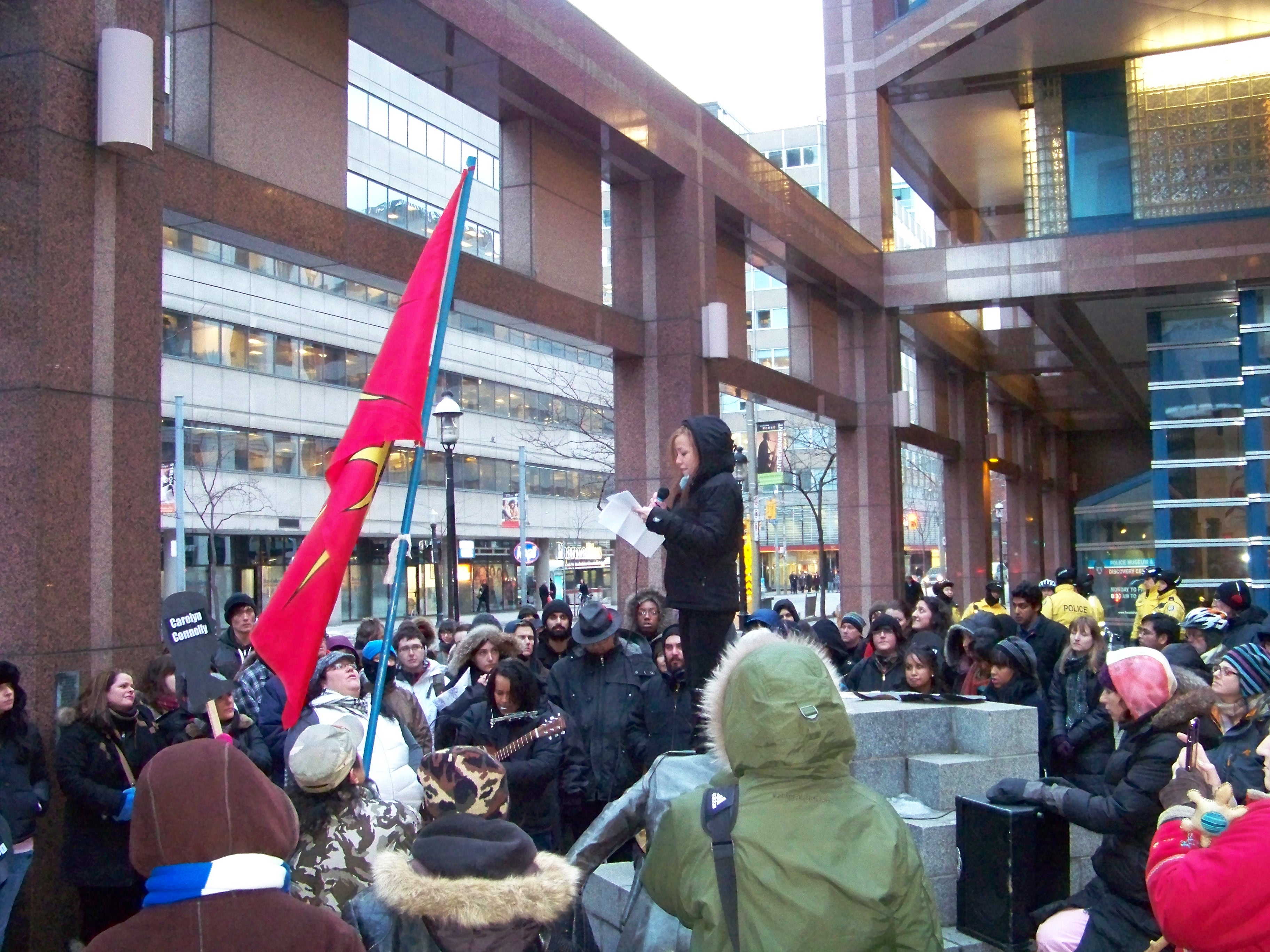
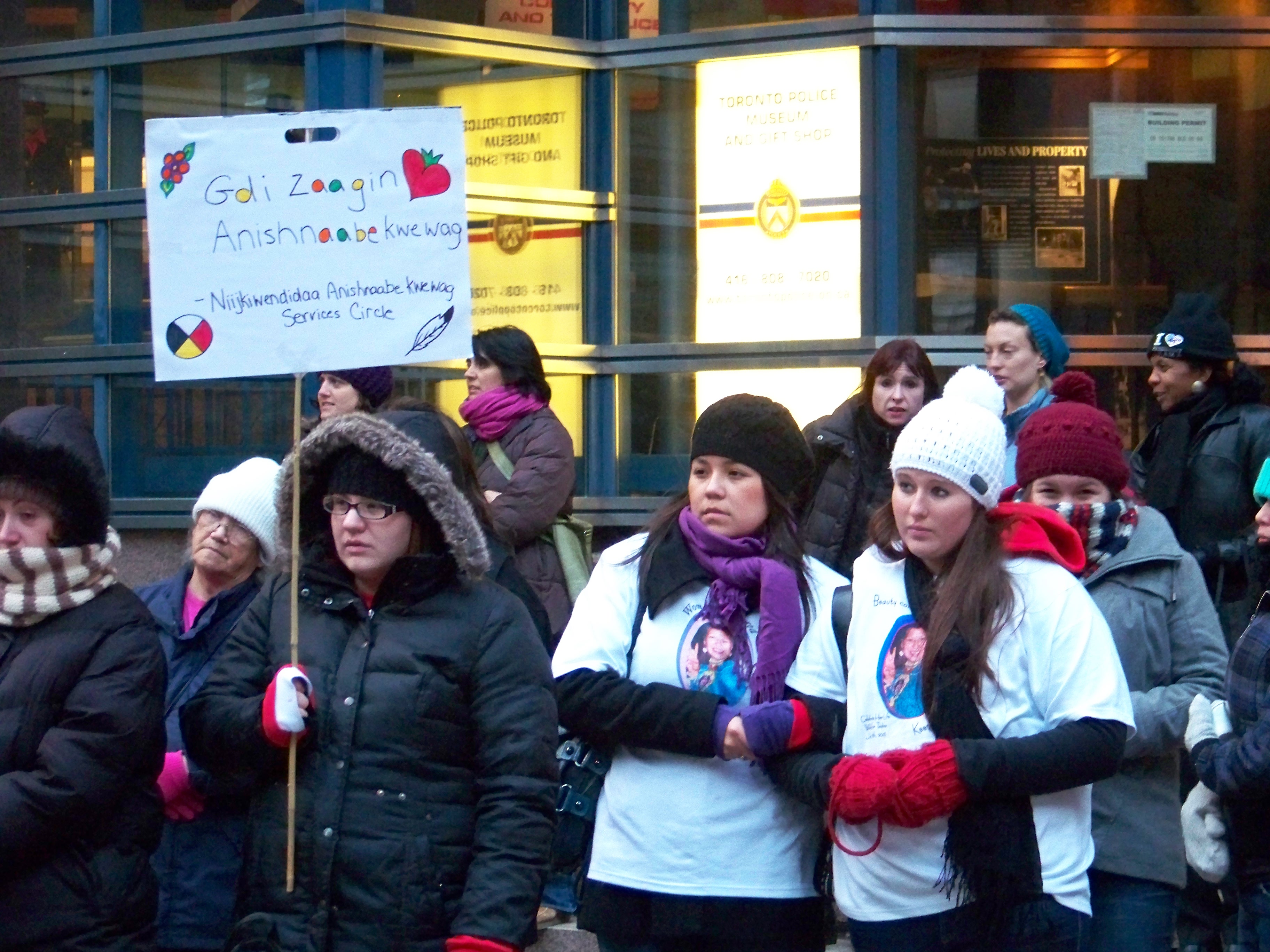
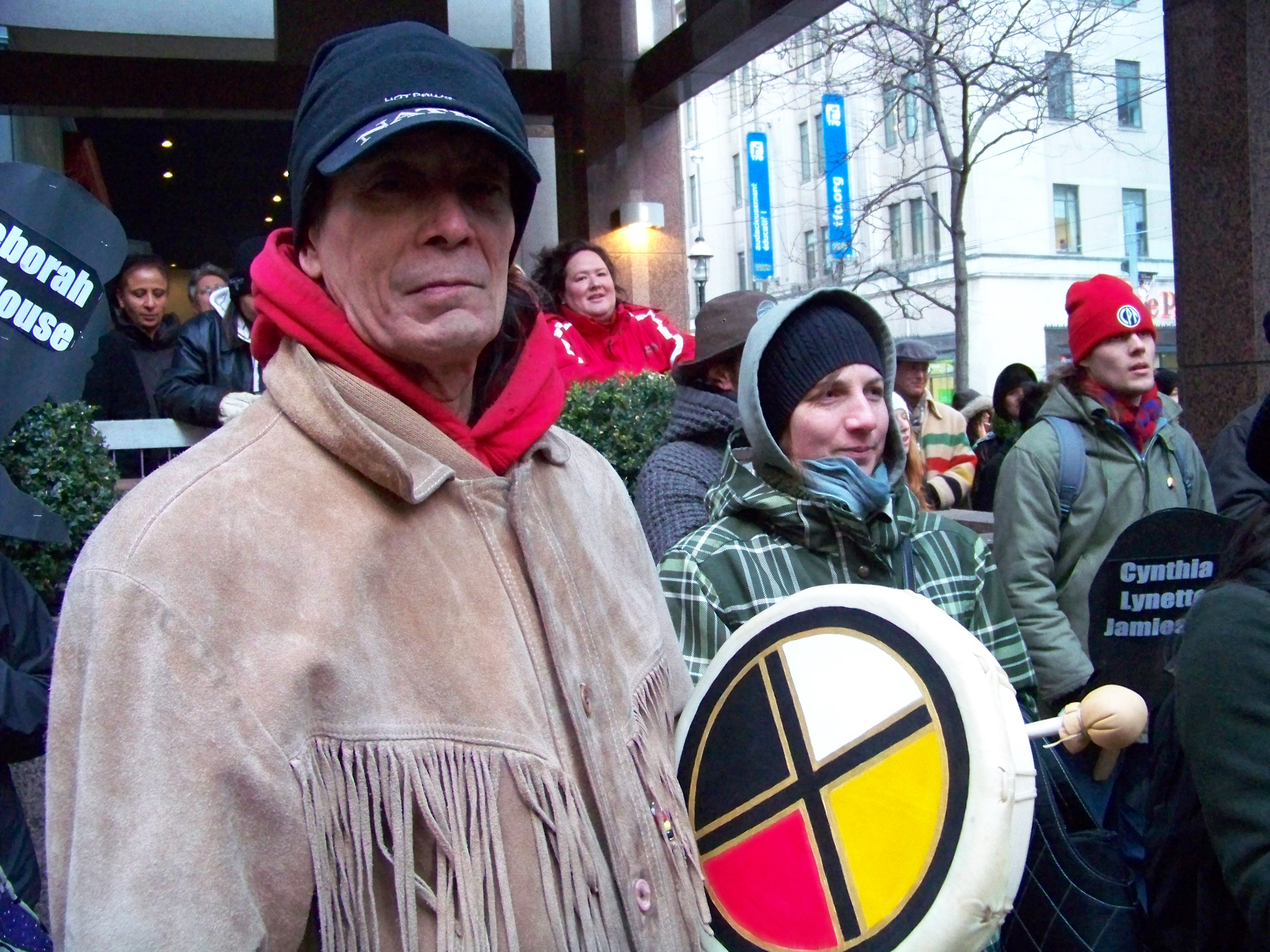
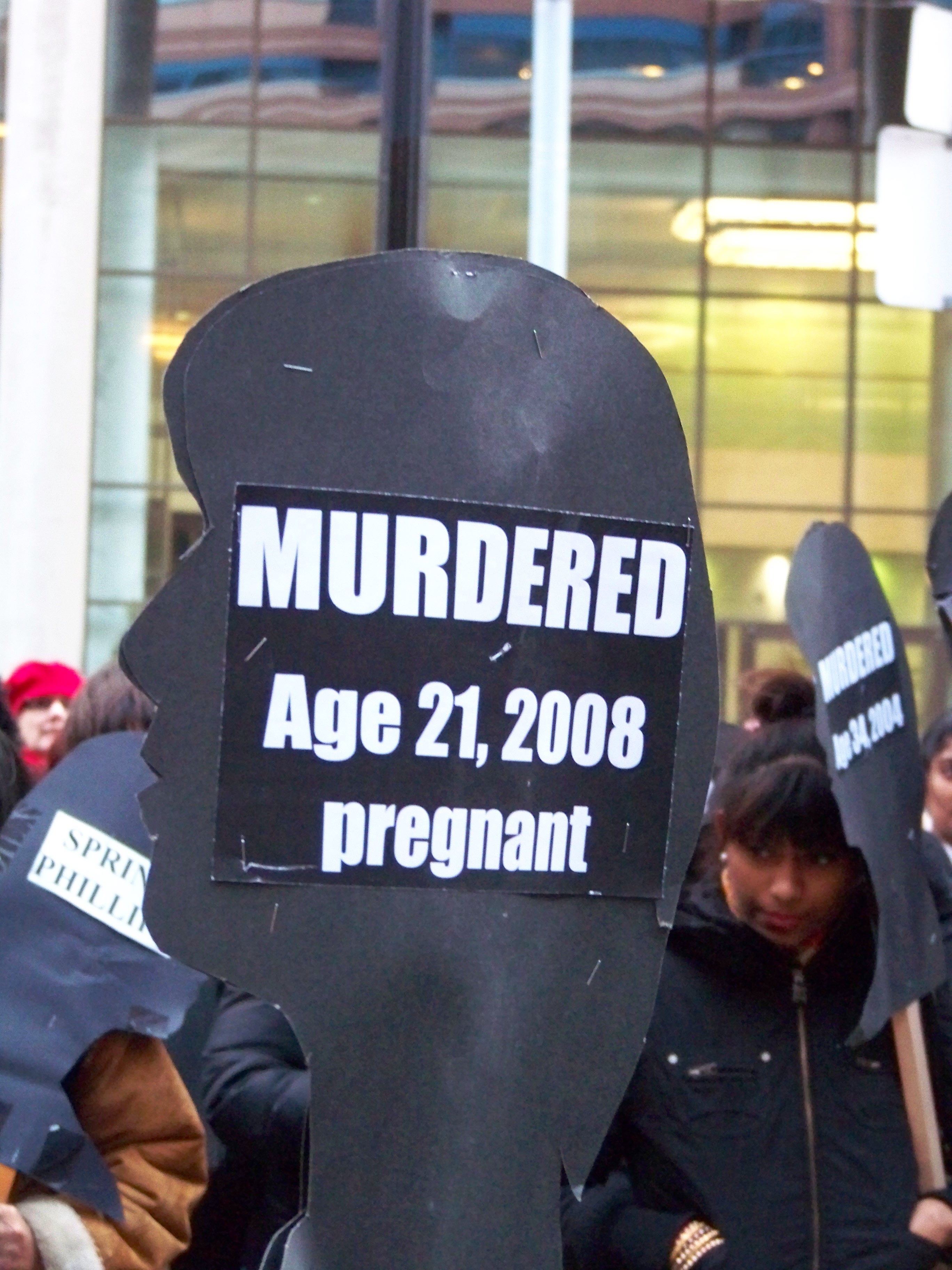
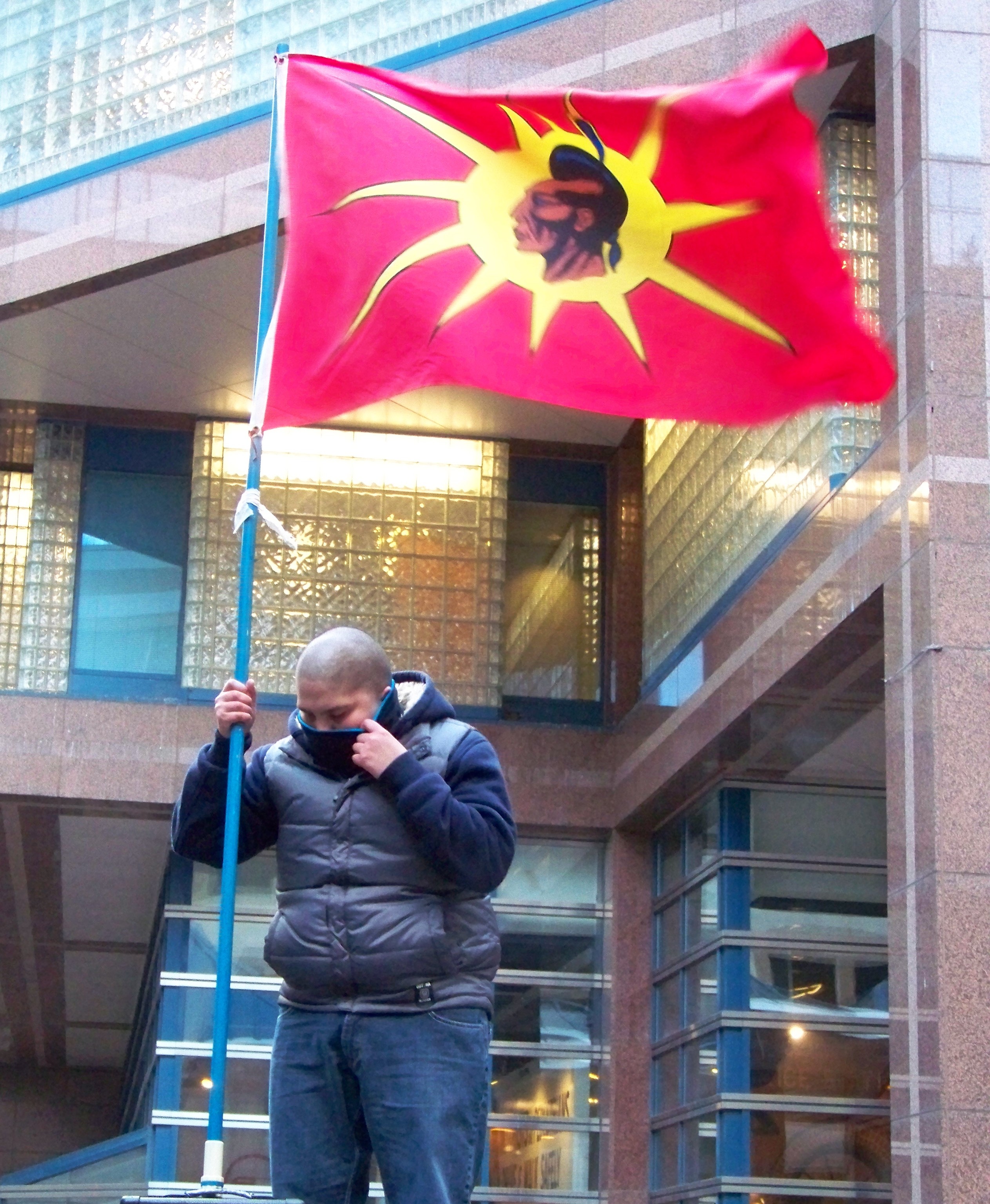
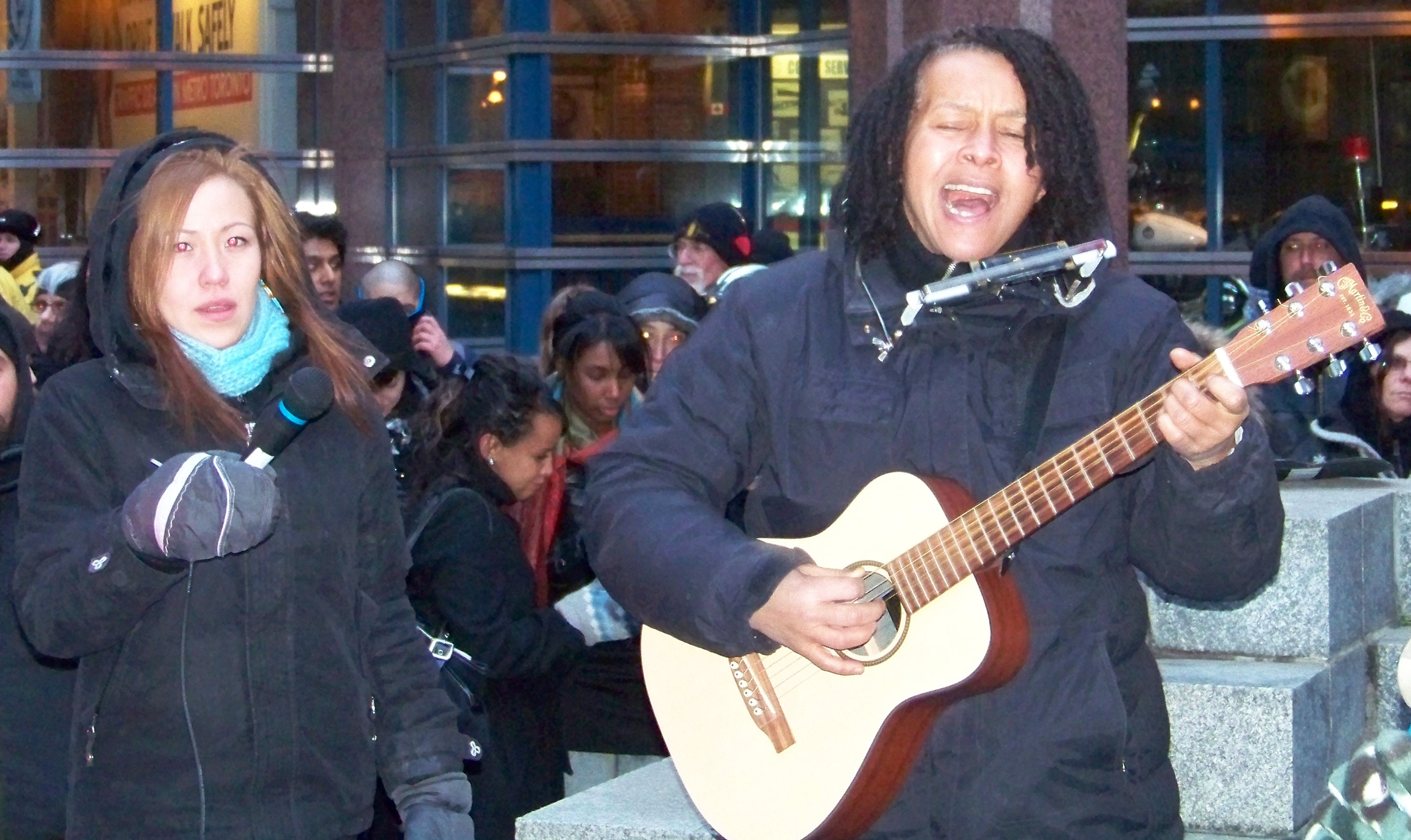
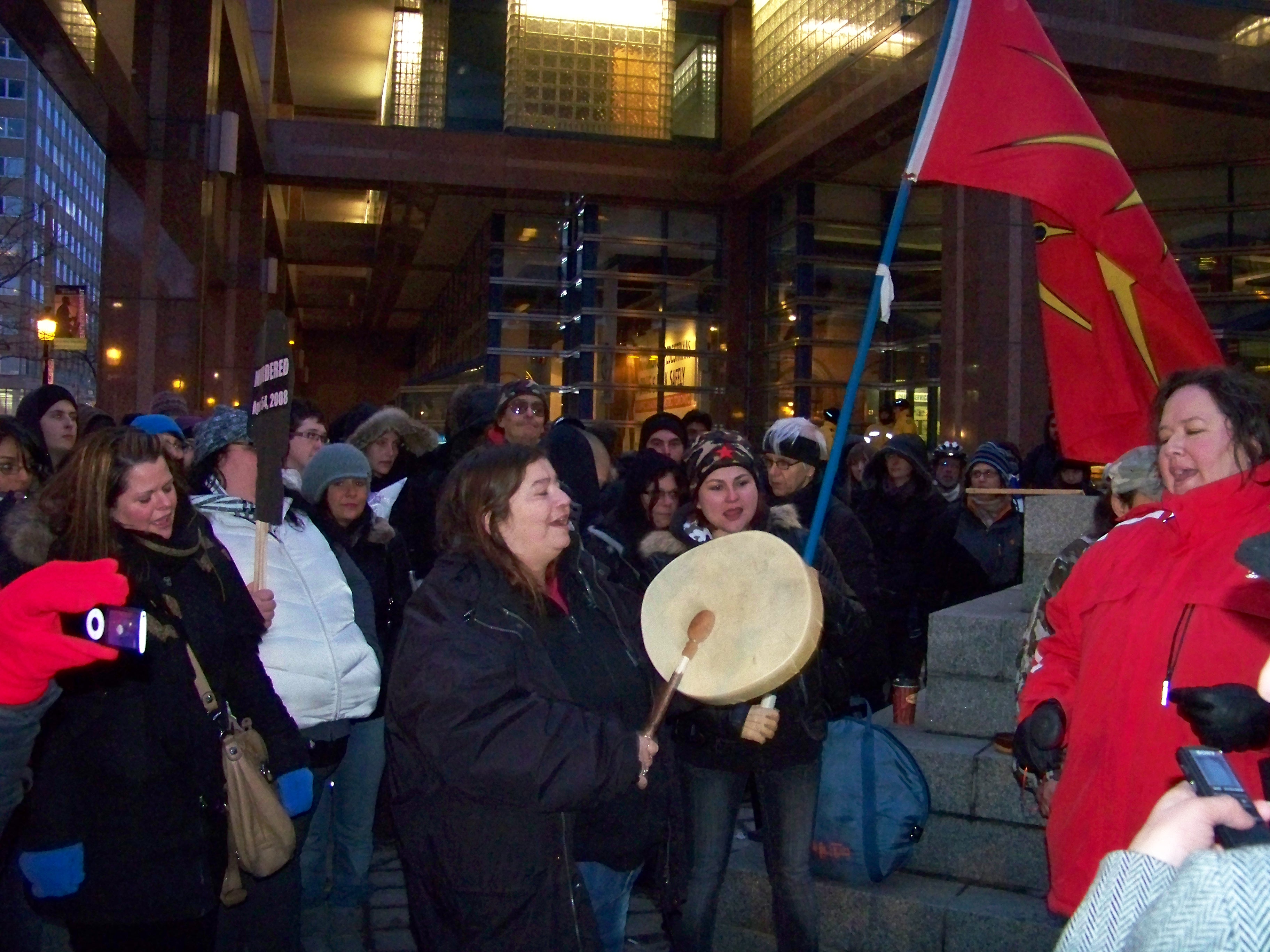
ALL Photos of the Rally Taken by Jorge Antonio Vallejos Feb. 14- 2011 Toronto
Robyn Bourgeois (Lubicon Cree) is a Ph.D Candidate at OISE/University of Toronto.
Her dissertation, “Pathways of Resistance: The Politics of Addressing Violence Against Aboriginal Women and Girls in Canada, 1980-2010,” is a critical social history of Aboriginal women’s resistance to violence in their lives.
She is currently living and working in the Okanagan Valley, British Columbia.
BCP: Robyn, please share the focus of your work with BlackCoffeePoet.com readers.
RSB: My focus of my work, broadly, is violence against Aboriginal women and girls in Canada. My dissertation work, more specifically, deals with Aboriginal women’s resistance to violence against Aboriginal women and girls in Canada over the last thirty years. Ultimately, my focus is on ending this violence.
BCP: Why did you choose to focus your studies and activism around the 800+ Missing and Murdered Aboriginal Women of Turtle Island?
RSB: Because as an Aboriginal woman, myself, my life has been continuously marked by violence. And the lives of the women around me are marked by violence. So it’s practical – a survival strategy. I also recognize that I have a tremendous amount of privilege in this White western colonial world, and I have pledged every ounce of it to ending this violence.
BCP: What is the process of your work?
RSB: This is a good question. I think my process varies depending on what I am working on – dissertation versus activism versus work with families. But there is a central impetus to my work no matter what: I HAVE TO DO THIS. As an Aboriginal woman, I am taught that I am accountable to 7 generations before me and seven after. For whatever reason, I survived tremendous violence and now find myself in a place of tremendous privilege. So I have committed every day to using that privilege to address this violence. I owe it to the women who came before me, and the women who were with me, who lost their lives to violence. And I certainly owe it to the women before me, including my nieces and my daughters (someday), to change this messed up world. So, in many ways, this work isn’t mine – it’s driven by Aboriginal women – past, present, and future – who deserve better.
BCP: How long have you been working on this epidemic?
RSB: For almost ten years now.
BCP: Who are your mentors and influences?
RSB: Wow….this is a huge question. I have so many. I am, of course, influenced by my supervisor Sherene Razack. Her commitment to social justice and anti-violence has pushed me everyday to be a better scholar. I have also been hugely influenced by Andrea Smith, Patricia Monture, Albert Memmi, and Foucault. Right now, I am tremendously inspired by David Suzuki. I know this seems strange, but I find his ferocity in defending Earth and the sanctity of our water, land, air as the lifeforce of our human species – and not as resources to be controlled and manipulated – truly inspiring. He’s really pushing people to consider our common humanity and the common good – something I feel undergirds the need to end violence. When will we recognize our common humanity and preserve the sanctity of life? We claim to believe in the alienable human right to life and a life free from violence – yet this is far from what we practice.
I also have to say that my sisters and brothers involved in this battle to end violence against Aboriginal women and girls inspiring. I am continually inspired by their insight and strength and courage. For example, the strong anti-violence stance of the women of the Aboriginal Women’s Action Network constantly inspires me, and spokesperson Laura Holland rocks my world regularly! She’s just so powerful and intelligent and passionate. Also the families who fight to dismantle the violence after losing a loved one just inspire me with theirs courage and strength.
BCP: When I first heard you speak on the epidemic you used a quote by Frantz Fannon in relation to the Helen Betty Osborne case. Please share the quote with BCP readers. Why did you choose to use this quote?
RSB: WOW…I don’t remember this. I’m sorry.
BCP: Have you read Conspiracy of Silence (about the Helen Betty Osborne case) by white journalist Lisa Priest? If so, what did you think?
RSB: Funny you mention this….I have two copies of the book, and just saw the CBC film a month ago. Helen Betty Osborne has always been important to me. When I made the decision to formally shift my doctoral work, Helen Betty Osborne actually sent me a message. Anyhow…. There is one thing out of the Priest book that chills me to the core…. The wife of one of the accused, when he was arrested 16 years later, actually asks why the police didn’t just leave these good men alone? Why mess with their lives? To me, this captures the national sentiment on violence against Aboriginal women – why disrupt all our lives over some dead Indian.
BCP: Lisa Priest seemed sympathetic at times and very racist other times, in particular the way she described Aboriginal women as if they were zombies:
“Native women hung out on the streets…they had been waifs who had been turned out on the street either because their parents didn’t want them or because they cost too much to feed. They were neither beautiful nor attractive. They craved affection in any form…They were malnourished, with dried eyes, prematurely wrinkled faces, and round bellies due to starchy diets of bannock…They stood leaning sloppily to one side. Some of them sniffed glue to get over the beating from the night before, but all were helpless because they had nowhere to sleep except under the railroad bridge…” (p. 48-49).
Priests book was published in 1989. It’s 21 years later; have the media, cops, and government changed the way they view Aboriginal women? Is the above description something you have encountered in your research?
RSB: The short answer: No and Yes. No, this view hasn’t changed, and yes it is something I have encountered. The myth of the deviant Aboriginal women continues to plague us, reinforced by dominant cases that coalesce prostitution and Aboriginal women into a single entity. Contemporary Canadian society dismiss violence against Aboriginal women and girls today on the basis of these perceived deviances (addicted, sexually available). We are not even treated as human beings. Human beings have the right to a life free from violence, yet we have to convince the Canadian state to step up and protect us. And these stereotypes provide the justification for why the State doesn’t step up.
BCP: In terms of the Helen Betty Osborne case, the white members of the town knew who killed her and stayed quiet to protect her killers. When the killers were finally arrested one of their wives, Shannon Houghton, said, “I don’t know why they [police] didn’t just leave these guys alone.”
Worse is the common view of white towners in The Pas at the time of Osborne’s murder which Lisa Priest describes:
“There were measures she could have taken to save her own life, but out of stupidity and sheer foolishness, she decided to die…she had been given fair warning that she should consent to having sex with the four [white men] or die,” (p. 79).
White towners saw Osborne and Native women as disposable bodies to be used for sex and cheap labour. This view leads to the assumption that all the Missing and Murdered Aboriginal women are addicts and sex workers. Can you clarify this?
RSB: Sure. If you look at the history of colonization in Canada, it is a history of violence against Aboriginal women. Within the Christian dichotomy of the virgin and the whore, Aboriginal women were, historically and contemporarily, constructed as whore, not only to demarcate the superiority of white women, but also the superiority of colonialism. The deviance of Aboriginal women has long legitimated colonial domination, and portraying Aboriginal women as deviant rationalizes the control by morally superior white colonials. Portraying Aboriginal women and girls as addicts and sex workers enables colonial systems of oppression.
Importantly, the lived realities of Aboriginal women and girls as addicts and sex workers demonstrate a substantial problem with this. Too often, the historical, colonial and neoliberal processes that located many Aboriginal woman and girls in prostitution and drug use are ignored.
Painting Aboriginal women and girls as addicts and whores excuses violence. They are constructed as individuals who somehow deserve violence because of their involvement in drugs/prostitution.
In fact, I think Helen Betty Osborne’s case clearly demonstrates the power of this myth. On that cold night, those four white men went out looking to “party” and “get laid”. They specifically target Helen Betty Osborne because she was a “squaw” – that is, within the colonial order of things, a sexually available Indian woman. But Helen Betty Osborne said no, and essentially refused to play her role in this colonial fantasy. And the response? They kidnapped her, assaulted her, and stabbed her fifty-eight times with a screwdriver. Helen Betty’s refusal disrupted colonial fantasies, and produced pure rage in her killers – even the pathologist described the attack as “frenzied” and “driven by rage”. The message is clear – Aboriginal women and girls play their part in the colonial order of things or THIS is what will happen to you.
And the community’s apathy reinforces this. Many of these people knew who the killers were, yet didn’t view Helen Betty Osborne’s life as valuable enough to step up and hold these boys accountable. Instead, they excused this violence and have pretty much let everyone get away with it!
BCP: Whether addicts or sex workers or not The Missing and Murdered Aboriginal Women have been vilainized and seen as disposable. Why? How can we help change this perception of Aboriginal woman being disposable? Do you see this changing any time soon?
RSB: I have to say, this issue is actually broader than Aboriginal women and girls – this is a STATE that doesn’t outlaw violence against women, but regulates against its excess. There is acceptability of violence against women, and Aboriginal women don’t even count as women. As mentioned above, Aboriginal women and girls are perceived as deviant, and as a result, violence against them is dismissed. Aboriginal women are disposable because they are superfluous to the nation – indeed, they are a threat to the nation. So Aboriginal women are disposable because they threaten the colonial order of things.
I don’t see change coming until we decolonize. Colonialism is invested in violence against Aboriginal women – and until we no longer occupy the category of “threat”, we won’t be guaranteed any sort of safety.
BCP: Aboriginal writer Eden Robinson describes the epidemic and its non-handling by government and law enforcement as “apathy”. Can you comment?
RSB: Oh hell yes! Let me make the statement even stronger… this is not apathy…colonialism is invested in violence against Aboriginal women and girls. This is intentional. As the original inhabitants of the land, Aboriginal women stand in opposition to the colonial order things. We undermined mythological and material explanations of the founding of this country. Throughout colonial history in Canada, Aboriginal women and girls have been targeted for extermination, not only because we undermine colonial stories, but because we have the ability to give birth to future nations of Aboriginal people who will challenge colonialism. It’s not apathy here – it’s straight up annihilation.
BCP: Your work is emotional, honest, and stimulating. As a professor and writer what do you try to convey to your students and readers?
RSB: That is a very nice compliment. Thank you. I just try to pour my heart into my work and be honest. I feel that if I lay bare my own life for critical reflection, I will encourage others to do the same. I suppose the overriding goal of my work is to show people that we lives in a system of violence – indeed, our Western societies function on violence. I try to show that this system may be targeting Aboriginal women and girls now, but it is also targeting marginalized people across the country. Violence is too common of an experience for far too many of us in this country.
BCP: This is the week where Missing and Murdered Aboriginal Women are remembered and honoured. What does this week mean to you? What do you want to see come out of this week that has not come out in the past?
RSB: It’s the 20th anniversary of the Missing Women’s memorial in Vancouver’s Downtown Eastside. To me, that speaks to the resistance and resilience of Aboriginal women and girls in Canada. Despite several hundred years of colonial oppression and extermination, Aboriginal women and girls continue to live and breathe, and even thrive. At the same time, I am reminded of the words of Patricia Monture, who writes that resistance is not a healthy state because it’s rooted in the seeds of our oppression. So it reminds me of the need to continually fight against oppression and violence, because our lives our at stake.
You know what my fantasy for this week would be? For some level of government to step up and take action. Not a public inquiry or a new report – but real, meaningful action to eliminate violence against Aboriginal women and girls. Not that I believe that the State is the answer (indeed, my work examines State appropriation of resistance work), but while we continue to be colonized, we have to demand that they step up. I also think we need to continue our struggles towards indigenous sovereignty and self-determination, as these issues are tied to the marginalization of Aboriginal women and girls.
BCP: What are you working on now?
RSB: I am wrapping up writing my dissertation. I’ve been hiding out in BC to make this happen.
BCP: When do you expect to have a book published?
RSB: In the next year or two. I think it’s important to get the info in my dissertation out to the public.
BCP: Can you give readers a short recommended reading list about violence against Aboriginal women? What can readers do to help?
RSB: A reading list:
1) Andrea Smith – Conquest: Sexual Violence and American Indian Genocide
2) Amnesty International – Stolen Sisters: A Human Rights Response to Violence Against Indigneous women in Canada
3) Native Women’s Association of Canada – What Their Stories Tell Us
4) Sherene Razack – “Gendered Racial Violence and Spatialized Justice: The Murder of Pamela George”
5) Robertson and Blackstone’s “The Life of Helen Betty Osbourne: A Graphic Novel”
What readers can do to help:
1) Get educated and spread the word about this violence. A vast amount of work is spent on just telling people that this violence is happening, so any help with this is appreciated.
2) Attend rallies and events – help raise awareness
3) Work with anti-violence efforts in your community. We MUST end violence in this country, because far too many of us are hurt or dying.
4) Support Indigenous peoples’ struggles for self-determination and sovereignty. This issue is critically related to why Aboriginal women and girls continue to experience violence.
BCP: What advice do you have for other activists, writers, and allies out there who want to help stop this epidemic of Missing and Murdered Aboriginal Women in Canada?
RSB: Commit yourself to anti-oppression in work. Do not make gains on the backs of other people, or by reinstituting systems of privilege. We cannot undo violence by agreeing to commit it against other marginalized people.
Tune in to Black Coffee Poet Friday February 18, 2011 for videos of Cree poets Nicole Tanguay and Dana Wesley reading their poems about Stopping Violence Against Aboriginal Women.
Conspiracy of Silence: The Riveting, Real-Life Account of The [Helen Betty Osborne]Pas Murder and Cover-up that Rocked the Nation
Reviewed by Jorge Antonio Vallejos
Four white boys. One Cree girl.
Four cowards. One warrior.
Two white boys given immunity, one acquitted, one handed a life (?) sentence. A stolen and erased Aboriginal sister joins her ancestors. An Aboriginal community saddened and silenced:
This is the Helen Betty Osborne murder, court case, and disgrace.
White journalist Lisa Priest starts her sympathetic and problematic book Conspiracy of Silence with, “November 13, 1971 was cold and miserable.”
The cold and misery continued for sixteen-years until the four white boys were finally taken to trial; and November 13, 2011 makes it forty years since Osborne was killed. Really, the cold and misery started hundreds of years ago when white settlers from Britain and France invaded Turtle Island (now known as Canada).
Cold was the act of murder by four boys in Manitoba’s community known as The Pas. Cold was the conspiracy of silence by the white townspeople, police, and politicians of The Pas for sixteen years! Cold was the attitude and beliefs of white people before, during, and after Osborne’s murder. Cold is the reality of violence against Aboriginal women in Canada, USA, and the entire Western Hemisphere that goes uninvestigated and unpunished by police and governments.
Priest starts her account with the finding of Helen Betty Osborne’s body by a father and son on a fishing trip. Osborne’s naked body and black boots are all this writer wants to retell. Priest describes in detail the horrific scene of what was once a vibrant 19 year-old girl turned into a lifeless, unrecognizable body.
Pages fourteen to sixteen are hard to get through: descriptions of the body alongside police reports and views are shared. Pages fifty-six to sixty are even harder to read: the description of the events that happened before, during, and after the murder told alongside the coroner’s diagrams and analysis of the murder.
The sensationalist cover of the book is a warning in itself: a bloody screwdriver.
Priest started her career at the Windsor Star, moved to the Ottawa Citizen, and later covered the Helen Betty Osborne murder case for the Winnipeg Free Press. Conspiracy of Silence, her first book, is the outgrowth of her coverage of Osborne’s brutal killing and the trial of her killers.
Doing what white, conventional journalists do, Priest gives you the dirt that most people want to read—it’s her training, her job, and her cultural background. There is a sympathetic tone throughout; there is good investigative work on every page; there is the sense of exposing a wrong that needs to be justified; and there is also Priest’s own unchecked assumptions and racism.
The “cold” in the first line of Priest’s book is transferred to her zombification of Aboriginal women:
“Native women hung out on the streets…they had been waifs who had been turned out on the street either because their parents didn’t want them or because they cost too much to feed. They were neither beautiful nor attractive. They craved affection in any form…They were malnourished, with dried eyes, prematurely wrinkled faces, and round bellies due to starchy diets of bannock…They stood leaning sloppily to one side. Some of them sniffed glue to get over the beating from the night before, but all were helpless because they had nowhere to sleep except under the railroad bridge…” (p. 48-49).
At times like these you wonder what Priest is trying to do. Does justice come through villainous jabs? Is empathy practiced through disempowerment? Is truth to be exposed through sweeping, racist statements?
None of the Aboriginal women this writer knows fit Priest’s description. Published in 1989, the description of Aboriginal women in Conspiracy of Silence is a part of the larger conspiracy to keep the epidemic of the 800+ MISSING and MURDERED Aboriginal women of Turtle Island from the world. Canada, a safe haven for millions who come from other lands, is unsafe for the life-givers of the original peoples. If and when news gets out that Aboriginal women are under attack with the support of government and police inaction, the response given is a description like the one Priest gives, along with blame laid on the women.
One of the biggest things activists both Aboriginal and non-Aboriginal are fighting is the stigma of Aboriginal women that Priest promotes in her book. In a book that is supposed to fight the problem, Priest willfully adds to it.
And big media wonders why there is such distrust by Aboriginal peoples.
Such distrust is hundreds of years old resulting from a reality that many peoples globally know all to well: colonization. Throughout her book Priest recounts the distrust of white people, men in particular, by Osborne. And she lays the setting well for such distrust. The Pas was white and brown with the two sides not getting along. Priest describes situations that many Canadians do not know of, and which are thought to be practiced by Americans down south, not here in Canada:
“They [Aboriginals] sat on the left side of the theatre—the only seats Indians were allowed to take. Otherwise they ran the risk of being kicked out or the usher would make a point of embarrassing them by loudly directing them to the other side, to the sneers of most whites,” (p. 39).
Priest follows her movie theatre description with the many names that Osborne and The Pas’ Aboriginal community were called regularly:
fucking squaw
dirty Indian whore
potato
the only good Indian is a dead Indian
It’s no wonder Osborne did not trust white people. “To her, The Pas resembled every cowboy and Indian movie she had seen,” writes Priest. “Natives were merely the Bulls-eye in a town dartboard,” (p. 32). In Osborne’s case, darts were not used; two screwdrivers were the instruments of choice by four white boys looking for some fun.
There are no mug-shots of Osborne’s killers in Priest’s book. The four boys—Jim Houghton, Lee Colgan, Dwayne Johnston, Norm Manger—are shown with smiles, wearing shirts and ties, looking more like avid church goers as opposed to the drunk rapists and murderers that they are. Is the effect to show that anyone can do such a thing? Or that the boys were the complete opposite of how Priest describes Aboriginal women: dirty, desperate, drugged up and lost?
The one photo of Helen Betty Osborne is that of a reserved girl sitting with her hands on her lap. Priest paints a good picture of her. Osborne is described as “strong willed, bright, and humorous, someone who knew how to have fun.”
Osborne was also studious and a success story on her reserve, Norway House, a Swampy Cree community.
To Priest, Osborne is the one Aboriginal who was worth something and describes her as the complete opposite of the zombies she portrays Aboriginal women to be. “She was pretty, domestic, traditional, very pleasant are rarely traveled without her black-beaded rosary,” writes Priest, (p. 35). Osborne did drink and was in the drunk tank a few times but she was not down in the dumps the way Priest describes Aboriginal women to be.
For a book that is about the murder of an Aboriginal woman, much of the book is focused on the four killers and their lives before and after the murder. Priest gives in depth information on their childhoods, education, relations with townspeople, and their marriages and jobs during the sixteen years after Osborne was killed.
What is greatly missing from Priests book are the lives of Osborne’s family and her community in the sixteen years after she was gone. What did they do? How did they go on after Osborne was killed? How did Osborne’s murder affect future generations? Why focus on the white people and leave out the Aboriginal side?
There are things Priest points out that reflect issues still present today:
1) Native and Metis women felt unsafe around white men after Osborne’s murder
2) The Native community felt cops and government did not pursue the case the same way they would if it was a white woman who was murdered
3) 40% of peoples incarcerated in the prairies were Aboriginal (now 70%)
4) White people of The Pas lived on like nothing happened
5) The case “reeked of racism” with its “police laziness”
A major point made in the book is that Osborne was not a victim. She was a warrior who fought four men the best she could. The killers are quoted at various points telling how Osborne never gave in to their requests for sex and never gave up trying to escape through throwing punches at her kidnappers and yelling for help until her end.
“No white man will ever have sex with me,” yelled Osborne to her killers, (p. 77). She is described as having “resisted fiercely”, saying “No!” from the start, pushing away the bottle the killers were trying to force her to drink from, and exchanging punches with Dwayne Johnston: “Betty and Johnston swung at each other while she continuously screamed for help,” (p. 58).
Priest also takes the town to task throughout the book. She tells of how the entire town knew who the killers were and stayed quiet for ridiculous reasons. Steve Maskymetz, a friend of killer Lee Colgan, said to Lee after he confessed about the murder, “I know about it—everybody in town knows about it,” (p. 112).
“Maskymetz said he didn’t go to the police because he thought they already knew about it and, if they didn’t, it wasn’t his responsibility to tell them,” (p. 112).
Would it have been Maskymetz’s responsibility if four Aboriginal men killed a white woman?
A desk clerk at a hotel in The Pas told a reporter during the killers trial, “It’s nothing we aint heard before,” (p. 168). She was referring to the town knowing about the murder all along.
Lee Colgan bragged to the town about killing an Aboriginal woman. He glorified the murder through detailed accounts at parties, bars, and one on one conversations with people. Priest aptly describes the conspiracy of silence she named her book: “The townspeople, now familiar with gossip that Lee Colgan, Jim Houghton, Dwayne Johnston, and Norm Manger had been involved, were tight lipped with the Mounties,” (p. 72).
Even more sick is how the town lived on like nothing happened. “The rumors however, didn’t stop townspeople from talking to the boys and their parents or inviting them out to parties, dinners, and Sunday barbecues: they just never mentioned that very unfortunate evening,” (p. 79).
Unfortunate? That is a large understatement. And how could the white townspeople live with themselves? Priest makes obvious how Aboriginal women were not valued by the white people of The Pas. Again, her descriptions of Aboriginal women did not, and do not help matters.
Priest does point out a reality that held then and holds now. If the killers murdered Osborne for fear of police and townspeople finding out they had kidnapped an Aboriginal woman and tried getting her drunk so as to rape her, there was no need.
“Even if Osborne had gone to police, would they have believed a drunken Indian girl, screaming hysterically in Cree?” (p. 82).
During trial, George Dangerfield, the Crown Attorney for the case, said the same thing, “…do you think that anyone would have taken any real note of her complaint,” (p. 178).
Both journalist and Crown Attorney point out the racism in policing and society with their matching statements. Anything can be done to an Aboriginal woman and she won’t be taken seriously by police and government.
More sick is how the town viewed Osborne as the victim of her own demise: “there were measures she could have taken to save her own life, but out of stupidity for sheer foolishness, she decided to die…she had been given fair warning that she should consent to having sex with the four or die,” (p. 79).
So, in the towns view, Aboriginal women have no rights, should comply to what white people want them to do, and are expendable sex objects for white men.
An ALL WHITE jury was chosen for the court case of Dwayne Johnston and Jim Houghton. Lee Colgan and Norm Manger were given immunity for their testimonies. Houghton was found innocent due to police laziness in their collection of evidence.
Dwayne Johnston was given a life sentence with eligibility of parole after serving ten years.
Conspiracy of Silence is titled appropriately. Priest tells the story of the most well known case of an Aboriginal woman murdered in Canada and how a town helped cover it up. Sadly, there are over 800 more, and counting, who have experienced, and will experience, similar brutalities like the one Helen Betty Osborne did. A new book linking all this would be great.
Questions do remain. How does Priest view Aboriginal women today? Has she checked her own racism and sweeping generalizations? What does Priest think of the 800+ Missing and Murdered Aboriginal Women in Canada? How many more Aboriginal women in The Pas or nearby towns have been murdered or gone missing since Helen Betty Osborne? What is life like now in The Pas? Have Aboriginal and white relations improved in The Pas? Where are the Helen Betty Osborne’s killers now? Do people know they killed a woman and got away with murder? Have the police in The Pas changed the way they investigate violence against Aboriginal women? How are Osborne’s family and community doing today?
Priest ends her book well: “Justice failed Betty Osborne; four white boys and a silent town conspired against her. A foreign world stole her dignity little by little, until finally, it killed her. Then it tried to ignore her murder,” (p. 213).
Tune in to Black Coffee Poet Wednesday February 16 for a photo essay of the No More Silence Rally (February 14, 2011, Toronto), and an interview with Cree academic and activist Robyn Bourgeois talking about the 800+ Missing and Murdered Aboriginal women in Canada.
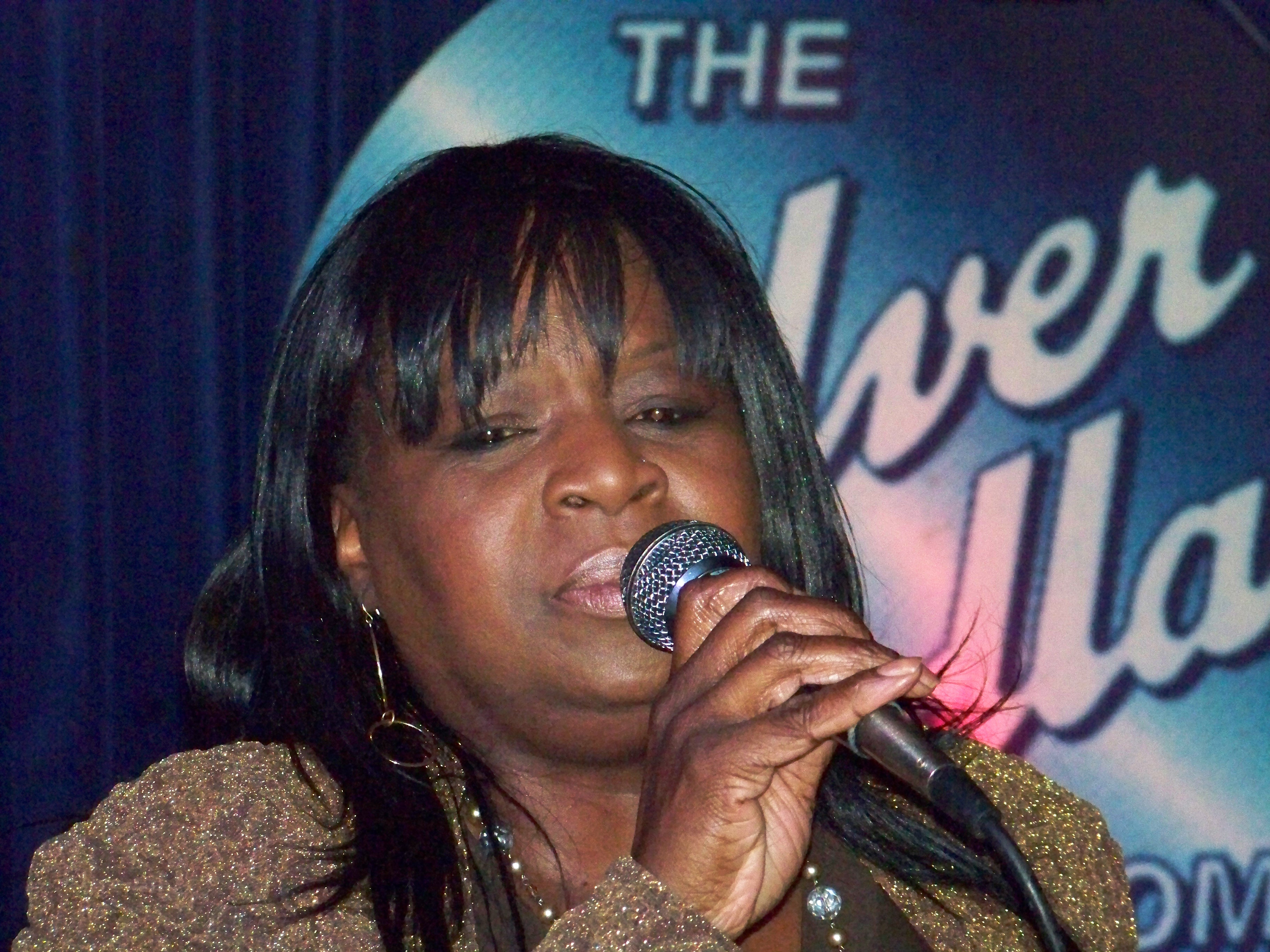
Diana Braithwaite is a Toronto based Blues singer/songwriter and Black History educator.
Braithwaite has won multiple awards for her albums and songwriting.
Enjoy a short piece of a recent performance of Braithwaite’s at Toronto’s Silver Dollar Room (January 2011) in honour of Blues Legend Curly Bridges 77th Birthday.
This video was edited by Zoi De La Pena.
Tune into Black Coffee Poet Monday February 14, 2011 for a video interview with Aboriginal writer Eden Robinson talking about the 800 MISSING and MURDERED Aboriginal women on Turtle Island (Canada).
Also, a review of “Conspiracy of Silence: The Riveting, Real-Life Account of the Helen Betty Osborne Murder and Cover-up that Rocked the Nation. “
Diana Braithwaite is an award winning Blues singer and songwriter whose ancestry traces back to the Underground Railroad.
Not only a musician, Braithwaite educates youth about Black History and the Underground Railraod via workshops that include the Blues.
Braithwaite brings her important message worldwide with her partner Chris Whiteley.
BCP: Why Blues?
DB: Blues is one of the oldest traditional types of music. The music touches the heart and soul.
BCP: Where did you learn how to sing?
DB: I started singing in a family group with my brothers and sisters when I was four years old.
BCP: You won Song Writer of the Year 2010. How long have you been writing songs? What is your writing process? What makes a good song?
DB: I have been writing songs throughout my career. For about 20 years. A good song is one that has all the qualities in it that work together to leave an impression on the listener—good lyrics, a great melody and they both work together really well.
BCP: Who are your influences?
DB: Nina Simone, Dinah Washington, Bessie Smith, Muddy Waters, John Lee Hooker
BCP: Your songs are emotional, honest, and positive. What do you try to convey to your listeners?
DB: My songs are straight from the heart. Blues is passionate music and if I can move people, I know the song is working.
BCP: This is Black History Month. What does Black History Month mean to you? What do you want to see come out of Black History Month that has not come out in the past?
DB: Black history month is a great time to celebrate the accomplishments of Blacks who have paved the way for us today. Every year, I like to learn something new about an event, person or thing that happened to add to my Black history knowledge.
BCP: One of the songs you performed at the Silver Dollar in January 2011had some Black history in it. You told the crowd about being the descendant of peoples who came to Canada via the Underground Railroad. Is there a conscious effort on your part to educate listeners about Black history through your music?
DB: Yes. I always try to include some Black history in my repertoire.
BCP: You run workshops in high schools about the Underground Railroad. Do you include the parallels and shared history between Aboriginal peoples and Black peoples?
DB: Yes. Black people and aboriginals share a similar past.
BCP: You have performed all over the world: U.S, Russia, UK, France, Jamaica, Scotland, The Netherlands. What similarities and differences have you noticed Blues scenes you have witnessed?
DB: Blues is loved all over the world. Often, in countries where English is a second language, blues musicians can sing the lyrics in English. And sound like Muddy Waters.
BCP: Most of the performers at the Silver Dollar show were men. Is that common in the Blues scene? If so, is it difficult being a woman musician in the Blues scene?
DB: I am proud to be one of the few Black women singing blues and keeping the tradition alive.
BCP: What are you working on now?
DB: We have a busy festival season in the works and will be touring to Ireland, England, The Netherlands & Spain.
BCP: When do you expect to have a new CD out?
DB: 2012.
BCP: When and where is your next show?
DB: We have a show coming up at Hugh’s room in March with Bob Hall—a boogie woogie piano player from England—who was in the band Savoy Brown.
BCP: Can you give readers a short recommended Blues list for Black History month?
DB: Look for artists such as:
Bessie Smith
Muddy Waters
Koko Taylor
Memphis Minnie
John Lee Hooker
BCP: What advice do you have for other musicians out there who are having difficulties getting started or putting together a CD or performing?
DB: Once you have your goal in mind, get some advice from seasoned performers as to how to proceed. They can give you tips on what to do and what not to do along the way.
Tune in to Black Coffee Poet Friday February 11, 2011 for a video of Diana Braithwaite performing her music.

 Book of Longing







 Black Coffee Poet