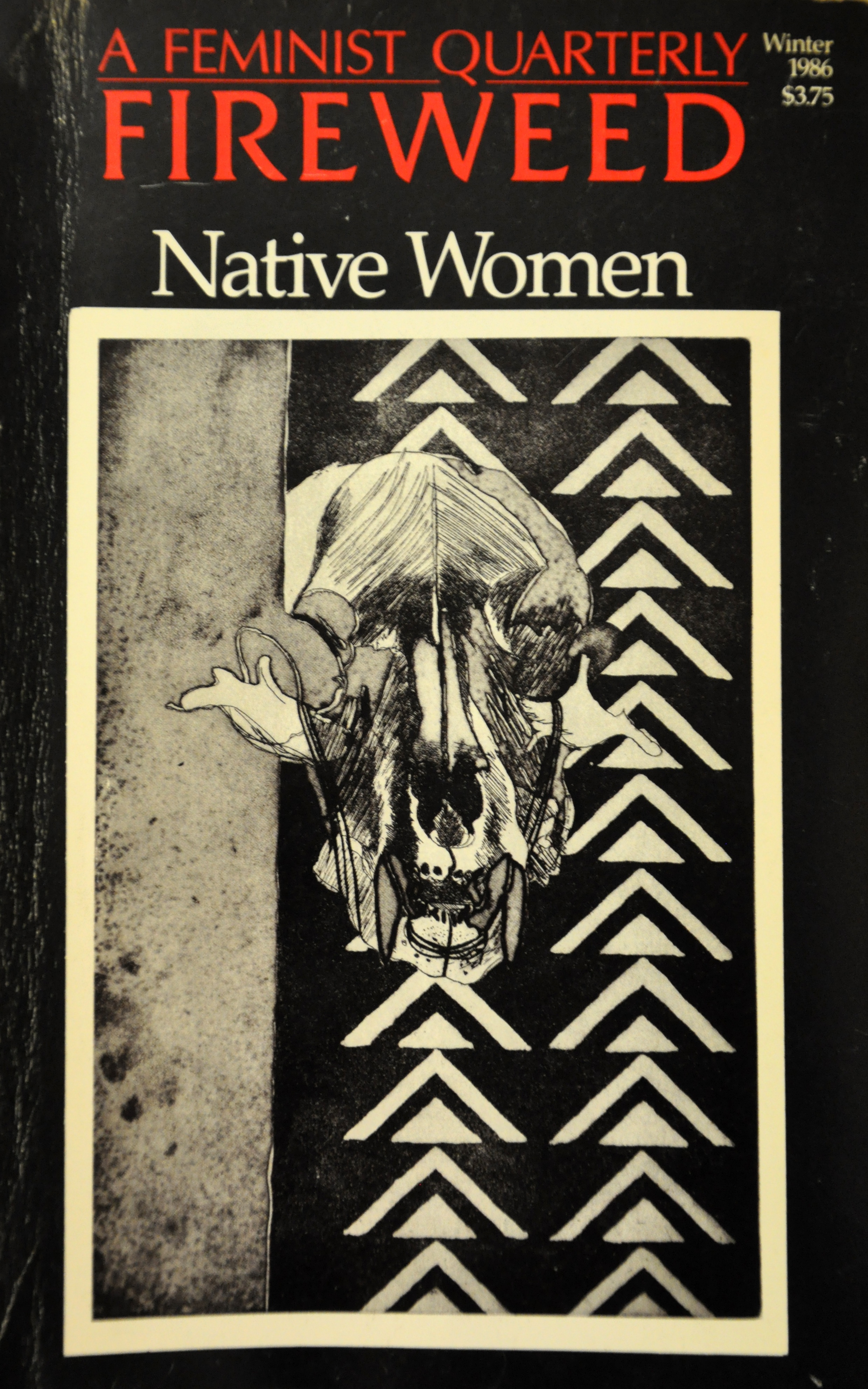
HONOURING AND REMEMBERING INDIGENOUS WOMEN: INTERVIEW WITH WANDA WHITEBIRD + REVIEW OF “FIREWEED # 22: NATIVE WOMEN”

FIREWEED #22: Native Women

Edited by:

Ivy Chaske

Connie Fife

Jan Champagne

Edna King

Midnight Sun

Reviewed by Susan Blight

Traditionally in Ojibwe culture, as in many Indigenous North American cultures, women’s voices were valorized and their contribution to society and community were valued and respected.  As an Anishinaabe woman from a First Nation in Northwestern Ontario, I grew up with strong Native women as role models.  As a Native woman away from her home community now living and working in the largest city in Canada, my mentors continue to be strong Indigenous women.  My mother, my grandmother, my sister, my aunties, my cousins, and my community members were and continue to be examples of strength in the face of adversity and marginalization.  Racism, sexism, colonization and all of its mechanisms—policy-driven poverty, legislative extinction by means of the Indian Act, the prison system, and the continued lack of justice for our missing and murdered sisters—have taken their toll on our communities.  But our women remain strong, defiant, funny, and loving.

This truth was partly why I enjoyed reading FIREWEED #22: Native Women so much.  Its contributors wrote with voices determined to tell our stories from our perspective and with the diversity that defines our experiences.  With February 14th,—the day of the annual Women’s Memorial March to honor the memory of the over 600 Missing and Murdered Indigenous women–approaching, this issue of FIREWEED seemed especially poignant. 

FIREWEED: A Feminist Quartlerly was founded in Toronto in 1978.   The Native Women issue, published in 1986, was guest edited by Ivy Chaske, Connie Fife, Jan Champagne, Edna King, and Midnight Sun.  The determination of the editors to have their voices heard is clear from the beginning as they write in the opening editorial:

“Our decision to accept the responsibility of being a guest collective of Fireweed; came from our belief that our words as Native women have been unheard, silenced, and invalidated too often.” 

It’s a powerful sentence that reveals a principal part of the problem and lays the blame directly on those who refuse to hear.  They go on to write: “It is our recognition, our acknowledgement and our definition of who and what we are that is important. The majority of us are not and have never been willing to allow that definition to come from ‘outside’.”  With those two sentences, the editors declare the sovereignty of our voices and the self-determination we never relinquished and sets the tone for the rest of the contributions.

The acclaimed Anishinaabe activist and writer Winona LaDuke writes about The Indigenous Women’s Network Gathering at Yelm, WA in 1985 and the importance of women meeting to talk and share ideas.   Conveying the significance of talking circles in the process of healing and the holistic approach of the gathering, Winona LaDuke writes:

“Our communities need a holistic healing—from the internalized oppression of men and women, to the disruption of our natural and treaty law systems that protect our people and land.” 

Berenice B. Levchuk of the Navajo Nation contributes four poems to FIREWEED #22.  One of the most emotional for me was Government Boarding School, Carlisle, Pennsylvania, in which the poet writes from the perspective of her clan grandfather, John Curley.  Throughout the 18th and 19th century, Navajo children were taken as far away as Pennsylvania to attend residential school, a practice perpetrated in many other Indigenous communities:

Though it’s forbidden we talk in mother tongue

in secret, to give comfort.

We remind the small children

So they don’t lose memory of it

With this poignant line, we recognize the trauma of the experience of residential school as children were punished for speaking their language but also the resistance that kept our languages, and our cultures, alive.

The poem is heartbreaking in its honesty. I felt a wave of sorrow overcome me as I read the following line, a line that speaks to a yearning for home:

I would request an extra song

For well-being for me and

those who must be here.

I must keep the life of balance.

I long for my life to be with you, Nabahó Diné.

I long to be in the land of my people.

The extraordinary Menominee activist and poet Chrystos addresses racism and classism in her poem Interview with the Social Worker:

It all started because I gave her my best chair with the black velvet cushion

embroidered with red roses & she sat in it like it was a disease

She said how can you live like this

I said how can you live like that.

Chrystos’ poetic approach often centers around giving a voice to the disenfranchised, those who have had injustices committed against them.  In these lines, which are funny in their insolence, Chrystos makes sure that we identify with the person being interviewed and not at all with the symbol of systemic power.  Rather than paint those on one side of the power equation as weak, Chrystos imbues the first person narrator in this poem with a strength and defiance that is admirable.  The closing lines of the poem continue this:

She said…

I am through here

I said I’ll never let you through here

Not if I have anything

To say about it

FIREWEED #22: Native Women has a diversity of voices that makes it an incredibly fulfilling read and displays a commitment to the rejection of imposed boundaries by acknowledging that these are the written works by “Women of Sovereign Nations”.  It is interesting to note that the editors were initially encouraged to focus on writers in Canada but rejected the idea in favor of including those women living elsewhere.  Above all, these stories and poems are at once celebrations of the lives of Native women and powerful calls against injustice.  And in doing so, FIREWEED #22: Native Women honours and recognizes the teaching that we all have a responsibility to speak the truth.
Susan Blight is a member of Couchiching First Nation, Anishinaabe, Turtle Clan.

She received an M.F.A. from the University of Windsor (2007) in Integrated Media, a Bachelor of Fine Arts in Photography (2004) and a Bachelor of Arts in Film Studies (1999) from the University of Manitoba.

Tune into Black Coffee Poet Wednesday February 15, 2012 for an interview with Bridget Tolley of Families of Sisters in Spirit + a photo essay of the February 14th, 2012 rally in Toronto.
Posted in Poetry | Tagged , , , , , , , , , , , , , , , , , , , , , , , | 2 Comments

3 CITY POET WHITNEY FRENCH READS HER POETRY

Whitney French is always a pleasure to hang with.

When meeting to talk about featuring Whitney we chatted for two hours that were filled with lots of laughter.

Equally fun was taping Whitney for this weeks video.  As we stood on the street corner people walked by, drove by, and skateboarded by as Whitney recited her poems from memory.

Enjoy Whitney French reading bradford toronto montreal from her book three cities.  

Check out the Black Coffee Poet YOUTUBE channel for more poetry, interviews, roundtables, and workshops.

Posted in Poetry | Tagged , , , , | 2 Comments

INTERVIEW WITH 3 CITY POET WHITNEY FRENCH

Whitney French is a writer based in the Toronto area although she does most of her eating, sleeping and actual writing in her hide-out north of the city: Bradford, ON.

Her interests include reading and writing. She graduated from Concordia University with a BA in Creative Writing and teaches writing to youth in Toronto.

French is the author of the new poetry collection Three Cities.

BCP: Why poetry?

WF: Poetry is elemental. And it’s immediate. I always read poetry but I didn’t consider myself a poet until recently. The title loomed with the responsibility to be spectacularly well versed, a master of metre, a trickster of words, a code only those with post-secondary schooling could decipher. But the more poetry I read, the more I feel in love with it, the more I wanted to write it. I think I always wrote poetry, but never considered it ‘good’. Even if I’m writing prose or drama, I usually write a poem about it to capture the essence of the story.

BCP: What is your process?

WF: I journal a lot. Almost always I have my notebook on me and I’m scribbling some kind of nonsense. I’ll go back and reread the slosh and pick out a line or two, even a single word and isolate it on the page, see if a poem will grow from it. Other times I walk with a poem for years, collecting the images and emotions waiting to be skilled enough to involve words into the equation. Then I get to ‘vomit’ up poems. I actually have a folder on my computer called vomit, pages and pages of images, ideas, sounds that I come back to pluck from the page and flesh out into a complete piece. 

BCP: Who, or what, are your influences? 

WF: I’m in awe of so many master poets but the one thing that truly gets my pen flying is nature. I’m heavily influenced by my surroundings when writing poetry. When I was younger I used to climb trees and hide out for hours with my notebook and write about the shapes of leaves and the patterns ants crawl. I still write in trees when I get a chance.

I’ve been influenced by my mentors and teachers, one person who has propelled me towards poetry and granted me the confidence to even embark on a project like 3 cities is Wendy “Motion” Brathwaite. Motion influences my writing but more importantly how I see myself as a writer. She’s encouraged me to remain authentic always, be active and politically conscious and she’s helped me understand that the role of a poet is to speak. So I’m speaking through this work.

BCP: What are you reading now?

WF: I just cracked open Michelle Cliff’s Abeng, a novel set in colonial Jamaica. It was loaned to me by a friend of mine, she’s like a second mother. I’ve heard it’s a challenging read and I’m in the mindset to tackle something stimulating.

BCP: Can you provide a recommended reading list for people?

WF: I could go on forever really but these are selected books that have personally moved me.

Fully Empowered – Pablo Neruda

Old Friend, We Made This for You – Yannick Marshall & Yemi Aganga

She – Saul Williams

Lettricity– Kaie Kellough

The Burning Alphabet – Berry Dempster

A Poem Travelled Down My Arm – Alice Walker

Québécité – George Elliott Clarke

Song of Solomon – Toni Morrison

Let the Great World Spin – Column McCann

The God of Small Things – Arundhati Roy

Childhood – Andre Alexis

What It Is! – Lynda Barry

BCP: Your poetry is very political. What do you try to convey to your readers?

WF: Thank you for the compliment for saying my work is political. People are afraid of that word, but I believe it to be an honour. Poetry is, to me, a perfect place for political discourse and it is important that the role of a poet is to voice the experience of the self and of many. In 3 cities especially, I’m attempting to convey alternative perspectives of this land called Canada. Commentary and dialogue rarely happen unprovoked and I guess I’m trying to generate genuine discussion in a country where politeness and small-talk are the only acceptable way to communicate. I strive to write from a place of truth and urgency, but I’m still working at it. My instinct is to be neutral and maybe I’ve been influenced by politeness or complacency too, but there’s too much going on — in terms of race, gender, criminal injustice, education, you name it — to be quiet.

BCP: It’s Black History Month now.  You fought to have Black History Month at your highschool in Bradford.  What does Black History Month mean to you?

WF: Black History Month is a springboard for discussion. And I know it gets a lot of slack for being only one month long, or only focused on slavery and post-slavery, for be repetitive and event-driven. I didn’t have Black History Month in school and I did fight school administration to have it recognized. That’s Black History Month for me, changing the landscape and opening doors of discussion. Dialogue is so crucial and if BHM allows anti-oppressive groups to share experiences, histories and narratives to a larger public audience of various races, that’s progress. Canada’s history in treatment of black people is deliberately hidden but I didn’t know that growing up. African Americans have a specific vocabulary and set of heroes and events that can be used to pin-pointing racism and eventually help them to combating it. Here, our narratives are eclipsed by the Underground Railroad tale. It was through Black History Month I learned about Canadian slavery, Angelique of 1734 or the horrors of Africville of the 1960s and other crucial events in Canada’s history. All year long we can discover and rewrite our history but February is be an ideal time to showcase these narratives in order to reach the masses. It’s only a month, but it’s also an opportunity.

BCP: How has working at Descant, one of the top literature journals in Canada, helped with your writing? 

WF: Descant taught me a level of professionalism that I dually needed. If I was going to write something, I better make sure it is at the apex of my potential. As a production editor, going over meticulous edits made me painfully aware of errors in my own writing. It enforced a new standard of writing for me, not just the quality of content but attention to detail, continuity, presentation. When I decided to do 3 cities into a book, I knew I couldn’t half-ass it. The copy has to be clean, the cover well designed, the typesetting solid. To be taken seriously, you can’t just write well, you have to dress well too. Dress your writing in it’s best and commit to every choice you make, that’s what Descant taught me.

BCP: You teach writing to youth.  Has teaching helped with your writing?

WF: Yes, yes and yes! In a completely different way that Descant helped, the youth I work with infuse so much play into my writing. And I’ve taught writing in different capacities: in an English classroom, an afterschool writing club, tutoring and facilitating workshops. All situations I encourage my students that writing is, first and for most fun. And I myself often forget the fun when I’m months deep into a project, stressed, under a deadline and frustrated with myself. So many stories and poems have been inspired by sessions with the youth I work with, and they always bring me back to being authentic. Whether I’m proofreading a story loosely based on a video game or someone’s crush at school, these youth are truthful in their work and writing what is important to them. Sometimes I get distracted and write things that I think are important to some people, but not so much for me.  And I’m blessed to work with such talented minds, the level of creativity is unbelievable.

BCP: How long were you working on Three Cities?

WF: 3 Cities started as a writing exercise back in March of 2010.  I was part of a writing circle called Womenz Wordz and the challenge was write about a place you want to visit. I wrote about Montreal. I was living in Bradford back then and I was journaling a lot about coming back to my hometown, which later became material for the Bradford section. But I was spending most of my hours in Toronto, doing my internship at Descant and visiting friends. So it came together slowly but I was actively writing the manuscript and putting the book together for a little under a year now.

BCP: Three Cities is very personal.  Was it hard writing some of the poems?

WF: Yes. Writing about myself is one of the things that I was taught not to do in my Creative Writing classes. “It’s self-indulgent,” so it was easy to fictionalize and not go into my personal life. One of the scariest parts of 3 cities is that I own it, it’s my experiences. My mentor helped me realize that if I’m afraid of poem, it usually means I really have to publish it. If it’s hard to write, I’m growing. If I’m growing, I’m moving in the right direction.

BCP: Why did you choose to self publish?

WF: Good question. One reason is to prove I could do it. I have a terrible habit of collecting incomplete writing and let it die in a shoebox under my bed. I wanted a complete project and I wanted go through the motions of seeing it through. Also, I felt I needed to share this story at this time. There was a strong sense of urgency to get 3 cities into the world. It’s difficult to explain, but this had to happen and I couldn’t wait on a publisher’s thumbs up. Plus I learned a lot about how hard it is to do this thing on your own.

BCP: Three Cities is your family history.  Has your family read Three Cities?  If so, what did they think?

WF: My family has heard only a few of the poems in 3 cities and man, was I nervous! My family means so much to me and I love and respect them dearly. It’s impossible to write anything without my family in mind. There are themes and issues in 3 cities that I haven’t fully communicated with my family and that is difficult to make it all public. I’m hoping 3 cities will create a political dialogue but also a personal one with my family, my mother especially. I’m looking forward for their response.

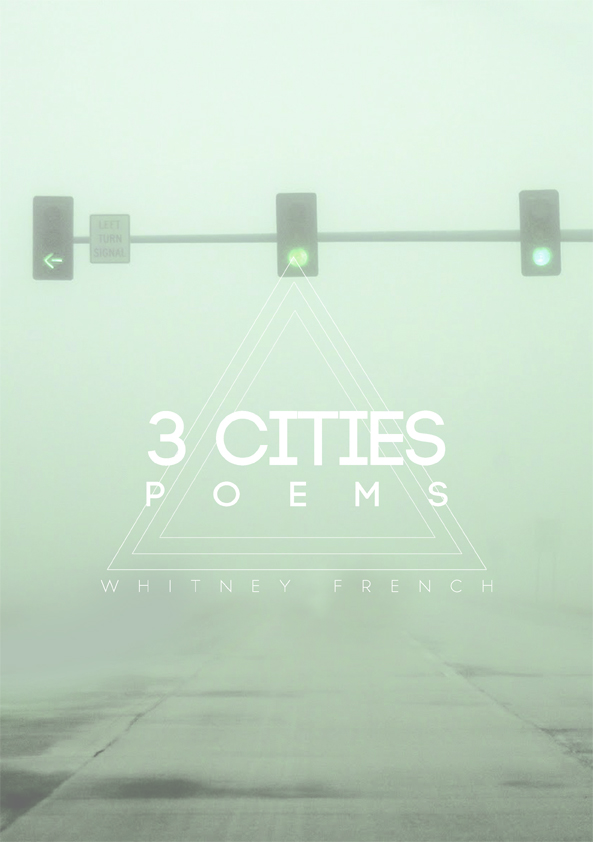
BCP: Can you explain the cover of your book?

WF: Sure. Ankhbayar, also known as Sept designed the cover. The three traffic lights mirror the three cities, pretty basic. I referenced my relationship with the three destinations as a triangle in my opening poem and faint triangles repeat themselves. I’m happy with it. It works well with the tone of the book.

BCP: What advice do you have for other writers consider self-publishing?

WF: Do it. Even if your friends/family/advisors say don’t do it, do it. Consider why you’re doing it. Figure out if how you’re going to market it. Get someone else to edit it. Don’t cheap out on the paper. Talk to others who’ve done it. Keep everything local if you can, it’s cheaper. Stand by your art. Don’t stress about the bio, no one really reads it anyway. Good luck!

Tune into Black Coffee Poet February 9, 2012 for a video of Whitney French reading her poetry.

Posted in Poetry | Tagged , , , , , , , , , , , , , , , , , , , , , , | 4 Comments

THREE CITIES

Three Cities

By Whitney French

Reviewed By Jorge Antonio Vallejos

Have you heard the myth about writers starting to self publish because they’re not good enough to be published by publishing houses?  Well, Whitney French, budding poet, and hardworking literature advocate debunks the myth with her new collection Three Cities.

Part journal, part travel log, part rant, Three Cities takes you on a tour of French’s life.  What a tour it is.

Beam me up Whitney!

Split into three sections, the title is self-explanatory.  French writes about Bradford, Montreal, and Toronto, the three cities she has lived in.  The collection starts off with a funny book disclaimer reminiscent of the start to every Law and Order episode:

all cities in this work are fictitious.

any resemblance to a real city,

whether a thriving metropolis or a ghost town,

is purely coincidental.

unless of course you’re referring to

bradford ontario

montreal quebec

toronto ontario

in which case,

yeah, they’re real.

French’s first section, Bradford Beginings Endings lets the readers know this is not fluff.  There’s mention of the usual small town landscape: Tim Horton’s, BBQs, and beer.  But it’s followed by a reality that many don’t know: 

a woman on the bus saying coloured girl.

French shows how small town Canada has a long way to go via one sentence.  Are we in the American South?  No, but French does describe her home town as “a black girls nightmare” followed by a scene of “a fruit truck carrying mexican field workers home”.  If you didn’t know it was Bradford you’d have USA on your mind for sure.

black in bradford follows the first poem with deeper cuts into the life of French.  The poet describes being called “brownie”; white girls “afraid of the dark”; and a car pulling up and yelling the “N” word three times:

i’m not from the projects

but I’ve been in a drive-by

and the trigger of that word

made me run home scared for years.  

black in bradford, filled with quotes of French’s life could be made into a Shit People Say to Blacks in Bradford YOUTUBE video:

oh, I pictured you differently

why don’t you get your hair in dreadlocks

oh I think black men are so hot

On to Montreal where French’s confession poetry takes a different route: dating white men.  “You and me are nothing but chaos” opens tre.  Booze, parties, and sex are written about.  The poem is minimalist; there is a Bukowski element to it with its short lines, eroticism, and relationship troubles.  But there is no sexist with whiskey on their breath behind the pen in tre.  French writes of confusion and pain masked as love:

for a girl who’s last love

painted only in one shade,

your rainbow feels good to me.

French tells of now knowing it was a bad situation.  “Rage” thought to be love, darkness covered with sex, and the sad reality of domestic violence.  French courageously lets it all out, and drops the reader with a line harder than a Mike Tyson hook:

wait it out like rape

I stopped reading.

French ends with survival:

i sneak off

when you’re not looking

in search of someone else

less handsome

less fun

for someone with less issues.

Now to the T-Dot where French writes of Chinatown, the DVP, the famous heat-wave, and Spadina Road.  DVP ends with a beautiful line:

while the red sun saws

a cloud in half

making one, two

so you’re walking through chinatown is a tour on paper.  Through twelve stanzas French perfectly describes a part of town that is central to Toronto.  Dried fish, carts of fruit, bootleg DVDs, vendors yelling, and the smell of food everywhere makeup French’s vignette.  But there is more.  French weaves her own Jamaican heritage in: ackee and cerasse.  The poet writes for her own mixed ancestry and people calling her “china man pickney”.  Thoughts and memories flood French’s mind having her “walk out of Chinatown” and giving us this poem.

French’s new, self-published, collection is about more then three cities.  Race, relationships, colonization, ignorance, human hurt, survival, and the many good and bads of life grace the pages of Three Cities.  The young poet takes you on a journey, her own French Riviera, the life of a Black woman in transit betweet three Canadian cities:

from bradford to toronto

from toronto to montreal

from montreal to bradford

from bradford to montreal

from toronto to bradford

from montreal to toronto

and back again. 

Tune into Black Coffee Poet Wednesday February 6, 2012 for an inclusive interview with Whitney French.

Posted in Poetry | Tagged , , , , , , , , , , , , , | 5 Comments

BLACK COFFEE POET READS “THE BANNOCK TEACHING”

Two weeks ago I read at The Writers Room put on by ANDPVA (The Association for Native Development in the Performing and Visual Arts).  It was fitting to be on the same card as great poets and signers such as Nicole Tanguay and Faith Nolan whom have inspired many artists, and with the headliner, Duke Redbird, a poet who helped break down barriers for Brown people.  

Why was it fitting?  

Because we are all on the same page in terms of STOPPING violence against Aboriginal women which was the theme for the open mic portion.  It was also fitting because January is mentors month and I read a memoir essay, The Bannock Teaching, about one of my mentors, Lee Maracle, teaching me how to make bannonck. 

I read my piece and heard the crowd enjoying every minute of it.  I honoured my writing mom, carried on tradition, and saw validation for all the time my mentors have put in me and all the time I have put in my craft.  It was a great feeling!  

Please enjoy The Bannock Teaching!

Check out the Black Coffee Poet YOUTUBE channel for more videos of poetry, interviews, roundtables, and workshops.

Posted in Poetry | Tagged , , , , , , , , , , , , , , , , | 1 Comment

MY FIRST MONTH OF THE END OF THE WORLD: JANUARY 2012

My First Month Of The End Of The World: January 2012

By Jorge Antonio Vallejos

It’s a gray day and my T.V has a dark show on: The First 48.  I have no idea why I watch it.  It’s always Browns and Blacks being hauled off to jail for life!  That’s our sad, messed up, racist world that supports the prison industrial complex and the incarceration of Indigenous peoples and peoples of colour.

A harsh cold has put me out for the last 6 days.  Sleep, ache, and lots of used tissue paper have consumed much of my time, as has T.V.  Throughout the sickness I still had to update my site, read, interview people for other publications I write for, and work on setting things up for my special week on Missing and Murdered Aboriginal Women in the land now known as Canada.

It’s been tough. 

I’m still sick.

I reminded myself of an article I wrote a while back: Pushing Through.  And I told myself a showbiz saying, “The show must go on!”  I also thought of how my mom, a woman of colour, who supported me on her own, went to work sick many, many days when I was growing up. 

2012 started off well, no signs of the end to come but just in case I took the first week off and started the new-year with a bang: Sufi poet Doyali Islam was the feature in week 1.  Her book Yusuf and the Lotus Flower was a pleasure to read and review.  So was meeting Doyali who is a very kind and humble poet; I wish they were all like her.

Screams bellow from my T.V. 

A parent is informed of the loss of their child; a common scene on The First 48. 

“Sorry for your loss, sir,” says a white cop.

Week 2 saw me feature Ojibwe poet David Groulx.  I met David at the IFOA (International Festival of the Authors) in Toronto in November 2011.  We hung out, talked writing, politrix, skin privilege, and all sorts of stuff.  Three weeks later his books A Difficult Beauty and Rising With A Distant Dawn came in the mail from different publishers.  I read both with extreme pleasure: one in my bed and the other at a coffee shop.  I have Groulx’s first book, The Long Dance, waiting to be read in one of my many stacks of books.

The response to Groulx’s review and interview were great.  One reader emailed me saying she got the book for Christmas and was now very excited to read it.  Another reader wrote to say they reserved it from their school library.  Reader after reader wrote to say they loved Groulx’s review, interview, and video

Jose Ventura and Henri Orantes, both Brown, both ‘illegal’, are arrested.

“Two down, one to go,” says a cop. 

Browns and Blacks are just numbers.

Week 3 saw Toronto poet Jim Nason be reviewed and interviewed.  I found his amazing book, Narcisuss Unfolding, in a bin outside a used bookshop just off of Yonge St.  It was brand new: no rips, folds, or scratches.  And it cost a whopping $1!  I snatched it up quick after reading the table of contents, and a poem or two.  Plus, I remember poet Maureen Hynes talking about him and his work: “Good poet,” she said over coffee. 

Nason’s poems had me thinking of things I experienced like slipping on black ice in a laneway.  He writes of the ordinary things in life like visiting a café, having stacks of books, conversations with a doorman at a hotel.  There were no pretentious poems in Nason’s collection; the title was fitting.  

Javier Vasquez, Brown guy number 3, is hunted down and taken in.

I met with budding poet Whitney French in the third week of January.  We had coffee and tea and laughed about many things in the literary life.  She gave me a copy of her new self-published collection Three Cities.  I’m excited to read it; it’s next week’s feature.

Anishinabek News accepted my pitch to interview a couple, Leslie and Lindy, for a Valentines story.  While interviewing this beautiful couple I thought of how good a relationship can be with the right person.  More good thoughts came to mind when interviewing Cree NDP candidate Romeo Saganash for XTRA!.  The journalism gigs were good in January.

It was an hounour when ANDPVA (The Association for Native Development in the Performing and Visual Arts) proposed to feature me as one of their readers for their Writers Room reading series.  The open mic was dedicated to raising money for, and bringing awareness to, the epidemic of Missing and Murdered Aboriginal Women in Canada which is something close to my heart.  Several women, including Nicole Tanguay and Faith Nolan, read poetry, letters, and they sang; it was beautiful.  The evening ended with me reading alongside living legend Duke Redbird which was a HUGE for me.  That was a highpoint for me this month.

On the last Sunday of the month I met with Jim Nason to interview him for XTRA!.  I liked our first meeting a lot.  Our second encounter had me inspired.  With me my laptop in front of us recording our interview Nason shared intimate stories, ideas about craft, and his process as a writer.

As Jim talked I was thinking, This man is a writer! 

For the last 15 years Jim has woken up at 5:45 am to write for two hours.  He loves to write.  Some nights his husband has to tell him, “Go to sleep!”, because he is so excited to get out of bed to write.  “I’m willing to give it all up for writing,” said Jim.

Wow!

The first month of 2012 has been a big wow with lots of what I usually do, hustle.  People always ask what I’ve been up to.  I’m surprised their not tired of my answer: reading and writing.  That’s what will see the next 11 months of 2012 for me. 

There was so much hype around this year and it’s supposed end of everything.  I’m Brown so I didn’t believe the white media’s interpretation of the Mayan calendar and prophecy.  Brown people have been here for thousands of years.  We’re still here.  We’re still fighting.  We’re still pushing through the walls, fences, and cells set up for us.

Ventura, Orantes, and Vasquez are sentenced to life.

Posted in Uncategorized | Tagged , , , , , , , , , , , , , , , | 2 Comments

MY CHAT WITH ROMEO SAGANASH, THE FIRST ABORIGINAL PERSON TO RUN FOR LEADERSHIP OF A MAJOR POLITICAL PARTY IN THE LAND NOW KNOWN AS CANADA

Romeo Saganash is one of eight candidates running to replace Jack Layton as leader of the federal NDP.  Saganash is Cree from northern Quebec and is the first Aboriginal person to run for a major political party in the land now known as Canada.  Saganash recently spoke in Toronto at the Native Canadian Centre Toronto; Black Coffee Poet spoke with Saganash about his work and how he plans to get votes.

This interview was originally published on xtra.ca January 25, 2012.

Black Coffee Poet: What sets you apart from the other candidates?

Romeo Saganash: If you consider me with the rest of the other candidates I think I have a very unique history. And it’s that experience of bringing people together. The agreements that I’ve managed to negotiate were meant to bring people together. That’s what I’ve been doing all my life. I’ve worked with industry, forestry, mining, Hydro Quebec; I’ve worked with the government. I’ve gotten everybody to work together, to move forward. And that’s the only way it can be done. 

So, my track record is there to prove that. Everybody can consider that. I think it’s that unique experience I have that distinguishes me from the few.

BCP: With the political left divided in Canada, would you consider aligning with other parties?

RS: No. Absolutely not! I think the foundations that Mr. Layton laid for this party are very solid, very strong, and I don’t think the NDP needs to merge or form alliances with other parties. I think our party is a stand-alone party, very strong, very solid.  We are the Official Opposition right now. And we’ve demonstrated that we have a strong team in the House of Commons. And I think we can prove that this party can form the next government.

BCP: What will you do to address homophobia in First Nations Communities and Canada?

RS: Same thing with the school boards and schools, I think. I think that is something that needs to be worked out in partnership with everybody concerned, including chief and council, the various services and agencies that exist on reserves. And of course, the provincial and federal governments can certainly be partners in that endeavour.

BCP: A problem in the queer community is that Two-Spirit and Trans peoples are often left out of the discourse and tokenized when they are mentioned. What will you do to include these people and increase their visibility?

RS: Well, I think there are a lot of ways to do that. And it’s a two-way street, by the way. We need to recognize their rights, that they are equal to every citizen in this country. That’s something that’s extremely important. It’s a first step to say, “Yes, they are equal.” And from there I think there are many alliances and strategies that we can put in place in partnerships with them to do whatever is necessary. 

If you consider Montreal, for instance, and the various activities that they have in Montreal every year, there are activities of integration and partnership with the various communities, LGBT communities. So there are a lot of ways of doing it. It’s just a matter of being innovative and creative and addressing that issue.

BCP: Something rarely spoken about in Canadian media, and the political realm, is that hundreds of Aboriginal women have gone missing and been murdered in Canada in recent years. Will you bring this issue to the larger Canadian public?

RS: We’ve done it a lot. We’ve met with the people that are working on that issue, both in Ottawa and in the streets. And the NDP has been supportive of their endeavours. We will continue to assist them and support them in their demands for a full national inquiry on the situation. I think the work has started in that direction with the NDP at least, and I think this is a matter of continuum. 

BCP: What are your Aboriginal Elders saying to you? Are you consulting with your community Elders?

RS: Well, I’m consulting with everybody, not just the elders. I’m consulting with the youth, the environmental groups, the human rights groups. I’m consulting with previous candidates or candidates that did not make it this time. I’m consulting with everybody. It’s a wide range of consulting that I always have, that I’ve always had over the last 25 years. I have a network of friends and people that provide opinions, advice and support. That will not change.

BCP: You have spoken about the fact that many Aboriginal people don’t vote. The same is often said about queer people of colour. How do you plan to get those votes?

RS: Well, I think if you don’t show up in a democracy you cannot bring change to society. It’s that simple. So I’ve been telling this to a lot of groups: women’s groups, aboriginal groups, First Nations communities, chiefs and council, youth, whether aboriginal or not. I think it’s important for those 40 percent who do not show up, if they do not show up they cannot complain and certainly cannot bring change. So, I think it’s important for everybody to understand that.

Posted in Uncategorized | Tagged , , , , , , , , , , , , | 2 Comments

QUEER POET JIM NASON READS HIS POETRY

Meeting Jim Nason to tape him for this post was a great time.

Jim and I talked writing over coffee.  We shared what we were working on, our favorite writers, craft, and future plans.

I took Jim to the laneway were I broke my leg 20 years ago.  He read his poems Black Ice and Laneway Home there.

Enjoy Jim Nason read his poems and check out a review of his third book of poems Narcissus Unfolding, and his insightful interview on blackcoffeepoet.com.

Check out the Black Coffee Poet YOUTUBE channel! 91 videos to choose from: poetry, interviews, roundtables, and workshops.

Posted in Poetry | Tagged , , , , , , , , , | 2 Comments

INTERVIEW WITH QUEER POET JIM NASON

Jim Nason is a Toronto poet.

His award-winning poems, essays, and stories have been published in literary journals across the United States and Canada, including The Best Canadian Poetry in English 2008 & 2010

He has recently published his third collection of poetry Narcissus Unfolding and a collection of short stories, The Girl on the Escalator.

In August, 2011, he participated as part of a discussion panel on Canadian poetry at the Edinburgh Fringe Festival.  

BCP: Why poetry?

JN: Through poetry I feel connected to the natural world.  Poetry forces me to slow down and pay attention to plants, animals, the changing seasons … but also my relationship with the city where I live and the places I visit.  I cherish the opportunity to sit with language and appreciate what is revealed through the disciple of the poetic process.

BCP: What is your process?

JN: My process for writing poems has never been the same twice.  Having said that, there are rituals that I respect – I write every morning.  I write when the world is quiet.  I have a bag full of tricks to get me ‘unstuck’ (on the rare occasions when that happens) – I write about art (I do this a lot), write about a scent, write about memory or, random words I place my finger on in the dictionary.

BCP: Who, or what, are your influences? 

JN: There are many poets who I respect and draw from.  Henri Cole once asked me what kind of poet [I] want to be? And I think about his question often.  I want to have the voice of Federico Garcia Lorca; the discipline of Elizabeth Bishop; the audacity of Frank O’Hara and spirituality of Charles Wright, Mary Oliver and W. S. Merwin.  I want to have these qualities, but in answer to your question and Cole’s challenge – I am most influenced by social activists like Allen Ginsberg and Nikky Finney and I want to be the kind of poet who is brave enough to tell the truth, no matter what.

BCP: Two of your poems are dedicated to John Ashbery.  What is it about Ashbery that you like?

JN: I love Ashbery’s uninhibited language.  I love his humour and his wisdom. He lives poetry, and it is evident to me that his entire life aesthetic is poetry.  I appreciate that he doesn’t try to make linear connections between what he writes about, and the fact that he utterly trusts what is revealed through the flow of seemingly disconnected objects.  As I say in my poem “John Ashbery”, It looks random/ but there are no mistakes.

BCP: You teach creative writing.  How does teaching add to your writing?  Does teaching take away from your writing?

JN: All teachers play a mentor role.  Teaching asks that I stay very conscious about what I write and publish.  Knowing it will be scrutinized, and perhaps studied by my students, helps me to push myself harder. 

Teaching is a time commitment, and as such, it requires a certain amount of energy.  So, I’m careful about how much I take on.  If I’m teaching too much and I begin to resent that, I pull back.

BCP: Wayson Choy says the first thing he teaches his students is “everything about the semicolon”.  What is the first thing you teach?

JN: I teach students everything about the blank page.  I teach them to savor it, drool over it, look at the empties as possibility… with its clothes off.

BCP: In 2011 you published a collection of poems, Narcissus Unfolding, and a collection of short stories, The Girl on the Escalator.  Can you talk of the relationship between poetry and short story?

JN: All writing is a celebration of life.  I love life and love feeling connected to the world; both poetry and fiction keep me connected to what I see, touch, feel and hear.  I smell the room that I’m in when I’m working on a poem about oranges; I smell the same poem in a story where a woman licks the juice off her lover’s arm; only in the story they get to talk about it more.

BCP: Can you provide a short recommended reading list for writers?

JN: I’m always tempted to pull every book off my shelf with this question, but in short, the following are books I return to often:

1. CV2: The Canadian Journal of Poetry and Critical Writing

2. bell hooks: Remembered Rapture: the writer at work

3. Diane Ackerman: A Natural History of the Senses

4. Jane Hirschfield: Nine Gates: Entering the Mind of Poetry

5. Lewis Hyde: Trickster Makes This World: Mischief, Myth, and Art

6. Theodore Roethke: On Poetry and Craft

7. Robert Bly: A Little Book on the Human Shadow

8. Richard Hugo: The Triggering Town: Lectures and Essays on Poetry and Writing

BCP: What are you reading now?

JN: I’m often reading several books at once, especially when I’m researching for a novel (as I am now)

1. Charles Wright: Little Foot (for the 3rd time)

2. Tomas Transtromer: The Half-Finished Heaven

3. Maureen Hynes: Marrow Willow

4. Henri Cole: Middle Earth (for the 4th time)

5. Jeffrey Moussaieff Masson and Susan McCarthy: When Elephants Weep: The Emotional Lives of Animals

6. Ted Andrews: Animal Speak

7. Laszlo Krasznahorkai and Max Neumann: Animal Inside

BCP: Your poetry is very much about your life. What do you try to convey to your readers?

JN: I don’t consciously work to convey a specific message to my readers.  I try to live a life that is honest, reflective and respectful.  I try to live life to the fullest, and spend time every day in solitude – it’s important to practice solitude and gratitude.  I hope that readers will understand the importance of compassion.

BCP: How long were you working on the poems featured in Narcissus Unfolding?

JN: There was an organic process to Narcissus Unfolding.  It came to me in sections over a two year period.  The first poem in the book, Huron, was the last to come.  The title poem was inspired by the myth of Narcissus, only I wanted to put a contemporary spin on it, one that includes images from city and nature – an airplane, a squirrel – I wanted to make room for the possibility of transformation through observation (internal and external).  The book is essentially about looking for and finding love.

BCP: The cover to Narcissus Unfolding is beautiful.  Can you explain it a little?

JN: The cover comes from an image by Toronto artist, Kelley Aitken, Leaning Over Water.  Kelley works at the AGO and I met her when I was there as part of a group of poets writing about the permanent collection.  We had a conversation about art and she had just completed the title piece.  I thought it was perfect – the images from mythology, nature … erotic beauty, warm colours… I was in heaven, and was thrilled that the folks at Frontenac gladly supported the decision to use the image as the cover.

BCP: You are part of a longstanding writing group that includes writers who are widely published.  What is the secret to a good writing group?

JN: I’ve given workshops on writing groups: it’s not an easy topic.  But, to keep it simple pick a group with writers who you trust and respect.  The poets have to be excellent poets, and be willing to challenge you to grow; and you must be prepared to be humble and to dish back equal amounts of love and whatever insights or wisdom you possess.

BCP: What advice do you have for young writers?

JN: There are no short cuts.  A writer has to write every day and be open to surprise.  The best part of writing for me, by far, is the sense of surprise I get when I have truly surrendered to the process, and the words take me to a place I had no idea existed.

Timothy Findley told me once: “Know your craft” – a wonderful truth and I thank him for it.  Push yourself.  Learn from others and trust yourself.  Be the best poet you can be every time.

Tune into Black Coffee Poet January 27, 2012 for a video of Jim Nason reading his poetry.

Posted in Poetry | Tagged , , , , , , , , , , , , , , , , , , , , , , , , , , , , , , , , | 4 Comments

NARCISSUS UNFOLDING

Narcissus Unfolding

By Jim Nason

Reviewed by Jorge Antonio Vallejos

Toronto poet Maureen Hynes told me about Jim Nason last year.  She spoke of him with kindness and reverence.  I remember her saying, “good poet,” after his name as she sipped coffee.  A few months later while hitting up the many bookstores that I do in Toronto I came across Narcissus Unfolding, Nason’s latest collection of poems. His name rested under the book’s title in small white letters.

“Nason?” I thought.

The cover caught my attention and the name rung a bell.

My fingers started to move from page to page and my eyes saw titles that interested me:

Endurance

At The Vienna Café

Insomnia

Black Ice

Union Station

Montreal, Two In The Morning

Kind Snow

What I Didn’t Tell The Insurance Agent

Name after name had me wanting to read Nason’s work.  Why?  They were ordinary.  They told me that Nason wrote about the regular things in life, his life, a life that maybe I could relate to, or not, but a life that I would be able to see via the poems in his book.

There is simplicity to the names of each poem that ring true.  Who hasn’t felt like they’ve had insomnia?  If you’re in Toronto, or traveling by train in this part of the country, you’ve probably been to Union Station.  And who the fuck doesn’t lie to their insurance agent?

Weather Girl has one of the most beautiful starts to a poem I’ve read: “Always books”.  For a book lover/junkie like myself there’s no better start to a poem; Nason hooked me in, fast.  He takes you to different parts of a room that has a TV on with the weather girl predicting snow one day and rain the next day.  You see that his first line dictates the poem with books being all over the room:

The lamp on the table

circled by books—Dempsters “Long Illness”,

Rilke’s Orpheus, Ashbery’s “Worldly Country”

Later

And the books—

You hadn’t realized how many,

piled and tilted on the floor

I felt like Nason had broken into my house when I wasn’t home.  Any reader, writer, book lover will feel the same.  Although the poem is so much more, Nason’s morning routine I believe, it’s the first line that set the tone and later saw me smile while reading about the piled, tilted, circling books taking over, and loved by their owner at the same time.   It’s Nason’s life, our life, a life of always books.

Nason’s short poem Loquacious says a lot about life: the use words and how they disappear; the routine of work; years passing by; class; how there is more to people than just what you see.

Through beautiful lines that play with language, “The concierge, body-language-reserved, but each smile a bouquet of adjectives and verbs”, Nason gives you a glimpse into the life of a hotel lobby attendant.  You see the rich get this man to hold their parcels and dog leashes as he stands firm to hold his job and dignity.  And you see his age not only by number, and description, but through Nason’s way of showing the man being tired of his job and those he serves:

Rather loquacious today, sir?” he says, when I stop

to chat with him in the lobby.  Fingerprints each time

on the door.  Always more to the story.

There’s always more to what you see.  And there are more stories in Nason’s book.  He takes you to a subway station where thoughts of suicide arise (Waiting at Chester Station); a John Ashbery reading at Toronto’s Harbourfront Centre (John Ashbery); the Atlantic Ocean (Atlantic Turtles); and different laneways, “souls of the city” writes Nason, in Toronto (Laneway Home).

Nason has you engaged via long poems, short poems, numbered poems, prose poems, dedications, memories, answers, and questions.  Maureen Hyens was right: Nason is a good poet.  Narcisuss Unfolding is another book I’m glad to have in my ever-growing collection of books, always books.

Tune into Black Coffee Poet Wednesday January 25, 2011 for a inclusive interview with Jim Nason.

Posted in Poetry | Tagged , , , , , , , , , , , , , , , , , , , , | 4 Comments