 Showing Up #5: Staring Back At The Look So Many People Give You
By Jorge Antonio Vallejos
I’m used to people staring at me.
It happens everyday.
And there are different reasons:
- my limp
- my colour
- my body
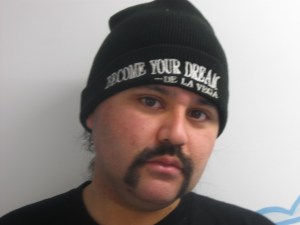
- my handlebar goatee
People notice me a mile away because of the way I walk. I had an accident years ago where I broke my femur, the largest bone in your body. (Watch out for black ice!) People I have not seen in years remember me. And of course anyone I’m meeting will see me coming. Years ago during World Cup celebrations a crew of guys were giving me props for dancing: “The man with the walk!”
But those aren’t the people whose stares I remember.
It’s the stares I get everyday where people laugh at my limp that I remember. It’s a cowardly stare: they look, smirk, tap their friend, they laugh together. Until. I look at them.
When they realize a 200lb Brown guy with a funny walk is staring at them there are no more smirks, no more tapping, and no more looks. While my eyes lock on them they look to the ground, or to the side, or up at the sky.
Being Brown has me get stares in stores, from cops, and basically everywhere I go. Have you heard of “driving while Black”? Well, there’s “walking while Brown”. And it’s not just at the Mexico/U.S border or the streets of Arizona. Even lawyer Sunny Hostin, a guest on the hit T.V show The View, talked about being Brown (she’s Puerto Rican) and being followed in department stores in New York City. She a lawyer who is often on T.V!
My body: well it’s a fat phobic society.
My goatee: people fear it, some love it. It gets positive and negative attention.
But the stare that I’m writing about here, which is related to all of the above, is the one that Judge Sonia Sotomayor, member of the U.S Supreme Court, and first Latin@ to be so, talked about last night on 60 Minutes:
“…it is the look that so many people give you. It’s the look that I was still receiving when I was nominated to the Supreme Court: was I capable enough? We have to prove ourselves and we have to work hard at doing it.”
I know that look.
Many Indigenous Peoples and Peoples Of Colour know that look.
And it’s not just about working hard like Sotomayor says. We are taught that we have to be better than. I don’t think I have to specify about better than who.
Sotomayor shared a story about a nurse in her high school walking up to her after finding out that she got a letter from Princeton just before graduating. It was part of the controversial Affirmative Action program; a program that I support. The nurse wanted to know why Sotomayor, a poor Puerto Rican girl from the Bronx ghetto of New York City, was contacted by Princeton as opposed to the white kids.
“You can’t be a minority in this society without having someone express disapproval about Affirmative Action,” said Sotomayor to 60 Minutes journalist Scott Pelley.
I would add that you can’t be a minority without having someone, or people, express disapproval about your success.
In grade 9 I scored 100% on my fist history test. The teacher made the mistake of telling everyone. Were my classmates, who were mainly white, happy for me? Did I get a congrats? Did anyone say, “Hey, you want to study together for the next test?”
No.
I was told flat out: “You cheated!”
I’ll never forget that. It stuck with me then, and still comes back now.
I was no angel. But I studied my ass off for that test.
In my heart and mind I knew it was racism. To them I was incapable of scoring so high because I was Mesitzo (Indigenous and Spanish). To them there was no way I could have honestly achieved that grade. To them, if a white kid couldn’t do it then how could I?
Ms. Peppin knew I earned my 100% because I sat right in front of her. And she was a hawk during tests and exams.
I never got my high school diploma. I let that incident get to me. And many others.
When I got into university via the Pre University Program I again earned high grades. And again history repeated itself; a white guy had to make a comment. It was not as bold as “You cheated!” But it was still problematic. Similar to the high school kids, he felt there was something fishy going on with my getting A’s and A+’s on essays.
When I earned scholarships to travel in university I again had classmates make comments to my face and behind my back. How did he get the Dr. Stanley Ho Award? How and why is he on a 2nd and 3rd trip?
Racism isn’t just fools with shaved heads wearing Doc Martin boots and sporting swastikas on their biceps. It’s more commonly expressed via the attitudes and comments like the ones I’ve written about above. And more.
When Sotomayor speaks to kids she tells them, “Don’t ever stop dreaming! Don’t ever stop trying! There’s courage in trying.”
I believe it.
I know it.
I live it.
The writing world is no different from the streets or academia. The whiteness of the writing community is no different than the students in the stories I’ve shared. It just changes to questions with problematic tones as opposed to accusations:
“You were published in The Kenyon Review?”
Si!
And you can add Descant, Crave It, and The Yellow Medicine Review to that, gring@!
Whether it’s an ableist staring at my walk; a racist following me in a store; a fat phobe looking at my body; a fellow student questioning my grades; a writer surprised at my publishing achievements; I stare back. Sometimes with my eyes, sometimes with words on a page.
Sotomayor said it well when attributing stubbornness to her success:
“For me at least, it’s the stubbornness to say, “I’m gonna do it. And I’m gonna do it well!”
See previous parts of my SHOWING UP series: click #s one, two, three, and four.








 Black Coffee Poet